
KAMPALA — Uganda has been urged to consider providing free sanitary pads to schoolgirls as part of efforts to strengthen menstrual hygiene and keep girls in school, with advocates arguing that the intervention should be treated with the same urgency as other public health supplies.
Dr Jibril Semakura Owomugisha made the call during the National High-Level Dialogue on Climate Resilient Water and Sanitation Services held at Sheraton Kampala Hotel, saying menstrual hygiene is central to education, dignity and gender equality.
“If the Government is able to offer free condoms, why not free sanitary pads for girls in schools?” he asked.
Dr. Jibril, Uganda’s Permanent Representative to the United Nations Environment Programme (UNEP) on the UN Decade on Ecosystem Restoration, said menstrual hygiene should be elevated to a national priority within the broader water, sanitation and hygiene (WASH) framework.
He said the Parliamentary WASH Committee had approved funding of €183 million and Shs150 billion to support menstrual hygiene management, construct public sanitation facilities aimed at eliminating open defecation, and improve urban water supply systems.
He also warned that climate change is worsening water insecurity, particularly in refugee-hosting areas, where competition for scarce resources is increasing.
“Climate stress fuels conflict between local communities and refugees. Recurring droughts lower water tables, reducing the output of many boreholes and leaving people struggling to access clean water,” he said.
Dr. Jibril urged greater investment in rainwater harvesting, noting Uganda’s high rainfall potential.
“Uganda receives about 66 billion cubic metres of rainwater every year. Let us harvest it and use it for irrigation and domestic purposes,” he said.
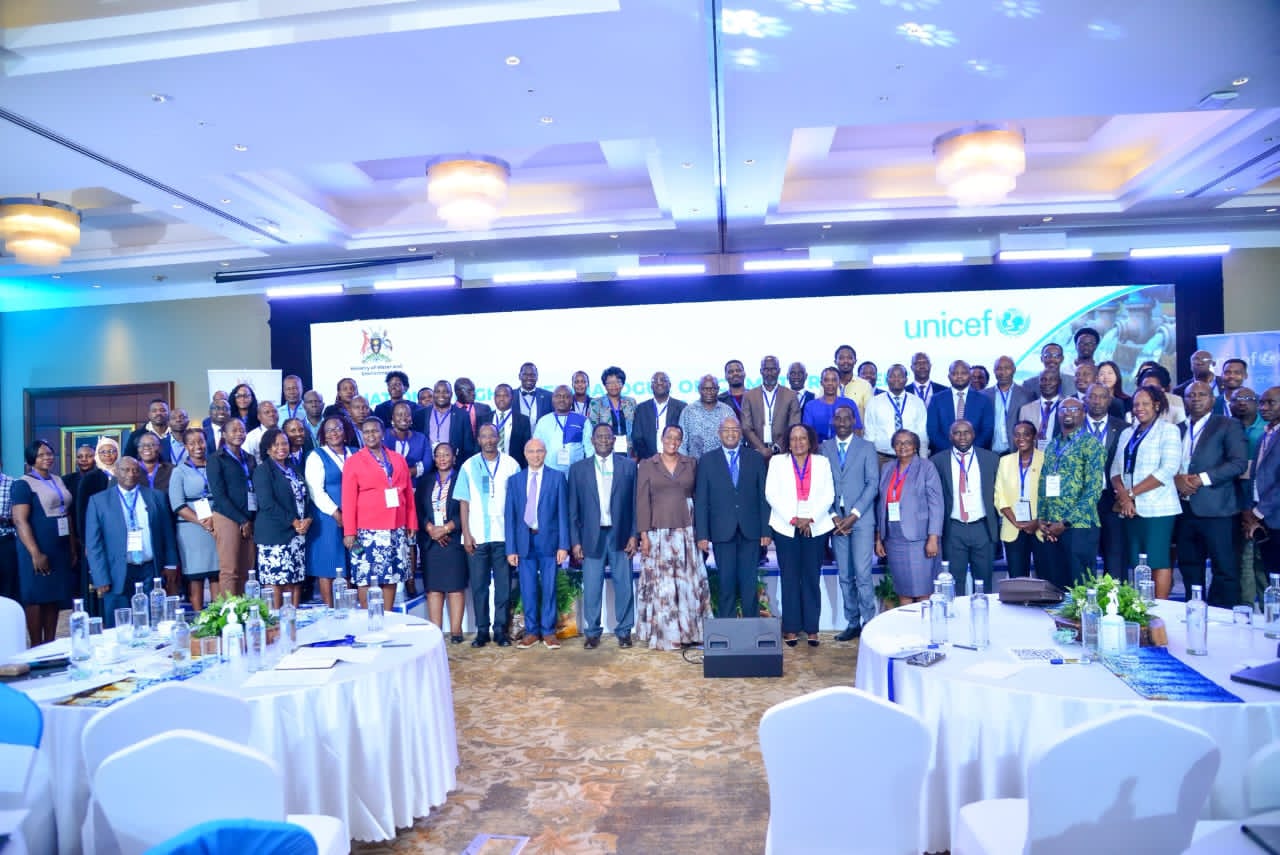
The two-day dialogue, organised by the Ministry of Water and Environment in partnership with UNICEF Uganda, brought together government officials, development partners and sector experts to assess progress and identify practical solutions for climate-resilient water and sanitation services.
State Minister for Water Aisha Sekindi, representing the Minister of Water and Environment, said climate change must be central to national water planning.
“We cannot achieve sustainable development, realise our National Development Plan goals or attain Sustainable Development Goal Six if our water systems collapse with every shift in weather,” she said.
She called for increased investment in innovative and environmentally friendly technologies.
“I urge you to look at water and sanitation through a climate lens. Let us invest in innovative, resilient and inclusive green technologies,” she said.
UNICEF Uganda Representative Dr. Robin Nandy said water, sanitation and hygiene go beyond infrastructure, describing them as foundational to health, education, dignity and economic productivity.
The Permanent Secretary of the Ministry of Water and Environment, represented by Commissioner for Water Resources Planning and Regulation Dr. Callist Tindimugaya, said transformation of the sector requires stronger political commitment and coordination across government institutions.
“As the Water and Environment sector, we are focusing on systemic shifts that require strong political backing and inter-ministerial and inter-sectoral collaboration,” he said.
He added that long-term investment is needed to build resilient systems capable of withstanding climate shocks.
“Let us design water and sanitation systems that outlast the climate crisis,” he said.
The dialogue concluded with calls for increased investment in climate-resilient water infrastructure, stronger institutional partnerships, and expanded access to safe water, sanitation and menstrual hygiene services across Uganda.
