

When news broke that four of President Museveni's ministerial nominees had missed the Cabinet swearing-in ceremony over unresolved citizenship questions, the immediate public reaction in many quarters was one of mixed feelings.
Foreign Affairs Minister-designate Adonia Ayebare, State Minister-designate for Foreign Affairs Calvin Echodu, State Minister-designate for Microfinance Sharsti Kutesa Musherure, and State Minister-designate for Internal Affairs Lawrence Muganga all hold or held American or Canadian citizenship alongside their Ugandan nationality.
This calls for a very simple question; why would anyone willingly surrender the passport of a country widely considered more stable, more prosperous, and more protective of individual rights, just to serve in government back home?
The answer, it turns out, is neither simple nor purely sentimental. It is a calculated trade-off rooted in power, legacy, identity, and a particular understanding of where one's greatest impact, and greatest rewards, can be found.
The Legal Gun to the Head
Before examining motivation, it is important to understand the legal architecture that makes renunciation non-negotiable.
Uganda's Constitution under Article 15 and the 2009 Citizenship and Immigration Control Act bar dual citizens from occupying offices listed in the Fifth Schedule, which includes Cabinet Ministers and Ministers of State.
This is not a technicality that can be navigated around. It is a binary requirement: you either hold sole Ugandan citizenship or you do not qualify for the role. For all four nominees, the moment Museveni released the list of his cabinet appointees, a legal clock started ticking.
Adonia: The Culmination of a Life's Work
Of the four, Ayebare's case is perhaps the most illuminating when it comes to understanding the logic of renunciation. Born in 1966, Ayebare built a career spanning journalism, conflict mediation, and multilateral diplomacy, serving as Uganda's Permanent Representative to the United Nations from 2017 to 2026.
He is a man who spent decades in New York, educated at some of America's most prestigious institutions, holding two master's degrees from Long Island University and Tufts University's Fletcher School of Law and Diplomacy, as well as a certificate from Harvard Kennedy School.
His appointment as Foreign Affairs Minister follows his central role in organizing Uganda's successful hosting of the 2024 Non-Aligned Movement and G77+China summits in Kampala, events that brought dozens of heads of state and United Nations officials to Uganda.
This is a man who spent over two decades building his value to the Ugandan state from a perch in New York, and the Foreign Affairs Ministry was, to many observers, the logical destination for that investment. Giving up American citizenship, which he acquired only in 2025, was essentially the final transaction in a very long career negotiation.
The US passport, in this context, was a tool of convenience during his years abroad, not the destination itself.
Calvin Echodu: The Politician Betting on Home
Calvin Echodu, nominated as State Minister for Foreign Affairs (International Affairs), faced questions about his dual citizenship during Parliament's vetting sessions and informed legislators that he would relinquish his American citizenship should his appointment be confirmed.
Echodu is a Member of Parliament for Soroti City West, meaning he was already embedded in Uganda's political machinery before this appointment. His American citizenship, like that of many Ugandans in the diaspora, likely served as a safety net and a mark of professional mobility rather than a primary identity.
For a politician already in Parliament, a ministerial appointment represents a significant elevation. It brings access to executive decision-making, greater visibility on regional and international platforms, and the kind of proximity to State House that defines political survival and advancement in Uganda's system.
Echodu secured the Appointments Committee's approval after presenting documentation showing he had initiated his renunciation process. That he moved relatively swiftly to satisfy that requirement suggests the calculation was not difficult for him. His political capital was in Uganda. The American passport was a credential. The ministry was the prize.
Sharsti Kutesa Musherure: Dynasty, Duty, and the Weight of Inheritance
Musherure's case introduces a dimension the others do not share as directly: political dynasty. She is the daughter of former Foreign Affairs Minister Sam Kutesa and the twin sister of Charlotte Kutesa, wife of General Muhoozi Kainerugaba, President Museveni's son.
She is not merely a politician; she is part of the interlocking elite that has governed Uganda for decades. Immigration records show she acquired American citizenship on March 14, 2025. The timing is notable. She obtained US citizenship just over a year before her ministerial nomination, suggesting it was acquired for personal or professional convenience, not as a long-term replacement identity.
For someone like Musherure, the question of whether to give up an American passport for a ministerial role must be understood in the context of who she is within Uganda's power structure.
Walking away from a Cabinet appointment would be not just a personal setback but a visible retreat from a political inheritance that spans her father's long career and her own years in Parliament.
The Kutesa family's influence is deeply woven into the NRM's power networks. A ministerial post, particularly one in Finance, places her squarely in the chain of economic patronage that defines Uganda's political economy. American citizenship, however valuable as a travel document or emergency option, cannot replicate that.
Dr Lawrence Muganga: The Most Complex Case
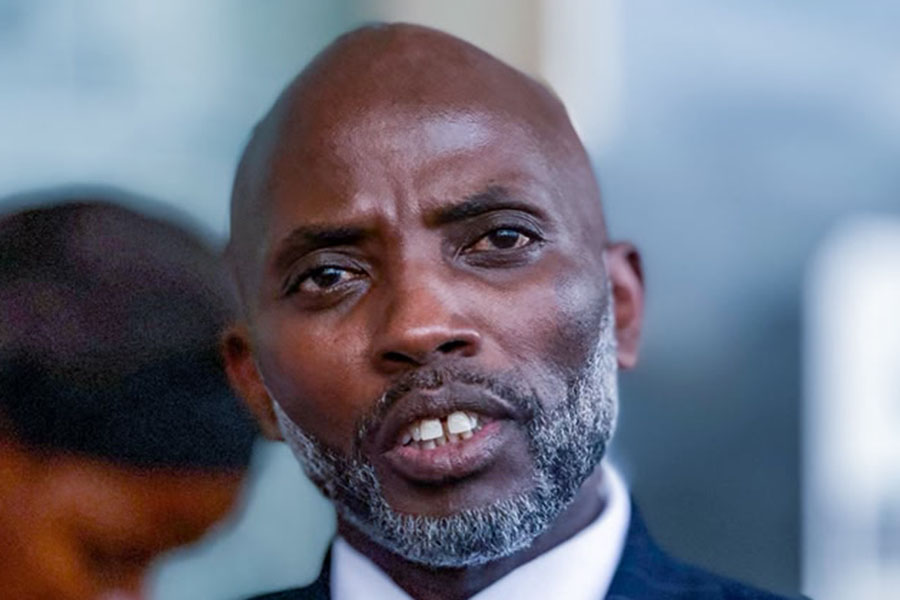
Muganga's situation is the most legally complicated and politically contentious of the four. The Appointments Committee found that he held three citizenships, Ugandan, Rwandan, and Canadian, and while Muganga argued that he had renounced his Rwandan citizenship when he became Canadian, he was unable to convince the committee with documentary evidence. The committee rejected his nomination, making him the only one of the four to be turned down outright.
Muganga, who serves as Vice Chancellor of Victoria University in Uganda, represents a different archetype from Ayebare or Echodu. He is primarily an academic and administrator who returned to Uganda after years in Canada, and his nomination was interpreted as Museveni's attempt to bring credentialed technocrats into government.
His ethnic identity as a Munyarwanda added a political dimension that went beyond paperwork. Muganga strongly denied holding Rwandan nationality, clarifying that he is Munyarwanda by tribe, not Rwandese by nationality, noting that Banyarwanda are among the tribes in Uganda.
Why would Muganga give up Canadian citizenship for this? The most rational explanation is that his professional identity had already re-rooted itself in Uganda. Running a university in Kampala is not the same as being a Canadian professional.
The Cabinet appointment represented an opportunity to translate academic influence into policy power, a leap that no Canadian position could offer him. The personal cost of renunciation is real, but for someone whose career had already pivoted back to Uganda, it was the logical next step rather than a sudden departure from the life he was building.
The Pattern Behind the Individual Stories
Taken together, the four nominees reflect a recognisable pattern in African politics, particularly in countries with long-ruling governments that have cultivated skilled diaspora loyalists over decades.
Uganda allows dual citizenship broadly, but carves out exceptions for sensitive offices. This functions as a selective talent-retrieval system, drawing ambitious Ugandans who built credentials abroad back into the fold when they are needed, on the condition that they demonstrate irreversible commitment.
The perception that Western citizenship is inherently more valuable rests on average quality-of-life comparisons that do not apply uniformly to political elites.
A senior minister in Uganda does not live an average Ugandan life. The total compensation package, official housing, vehicles, security details, international travel, per diems, and post-tenure opportunities in consulting, board positions, and business, narrows the practical lifestyle gap considerably.
More importantly, the informal architecture of influence available to a Ugandan minister, the ability to shape policy, direct contracts, build networks, and accumulate the kind of social and political capital that translates into generational advantage, is not replicated by most professional roles available in North America to immigrants, however credentialed.
There is also a ceiling question that rarely gets openly discussed but almost certainly factors into these decisions.
For African professionals in the United States and Canada, certain doors, particularly in politics, elite diplomatic appointment, and executive authority, remain structurally difficult to reach. A Ugandan holding a mid-level UN position or running a Canadian university has achieved something significant.
But becoming a minister, shaping national foreign policy, or sitting in Cabinet alongside the head of state is an entirely different category of power. For those to whom that category matters most, no Western passport makes it accessible in the way that proximity to Kampala's State House can.
Is This Really About Money?
The short answer is that raw salary is probably not the primary driver, but the total economic calculus is more nuanced than it first appears.
Official ministerial salaries in Uganda are modest by Western standards. However, the judgment that government pays worse misses the point. What the government in Uganda's political system offers is access; to networks, decisions, and opportunities that compound far beyond the official salary.
Whether or not one chooses to exploit that access corruptly or legally, the value is real and visible to anyone watching Uganda's political economy over time.
For Ayebare, after decades serving Ugandan diplomacy from New York, the calculation was likely never primarily financial. For Musherure, who is embedded in one of Uganda's most influential families, the ministry is as much about sustaining dynastic relevance as it is about income. For Echodu and Muganga, the appointment represents a platform for influence and legacy that their foreign citizenship could never provide.
In the end, what all four nominees share is a primary socio-political identity that was never really transferred to America or Canada, even as they held those countries' passports. The citizenship was borrowed mobility. Uganda was always the arena that mattered most. And for that arena, they were willing to make the trade permanent.
