
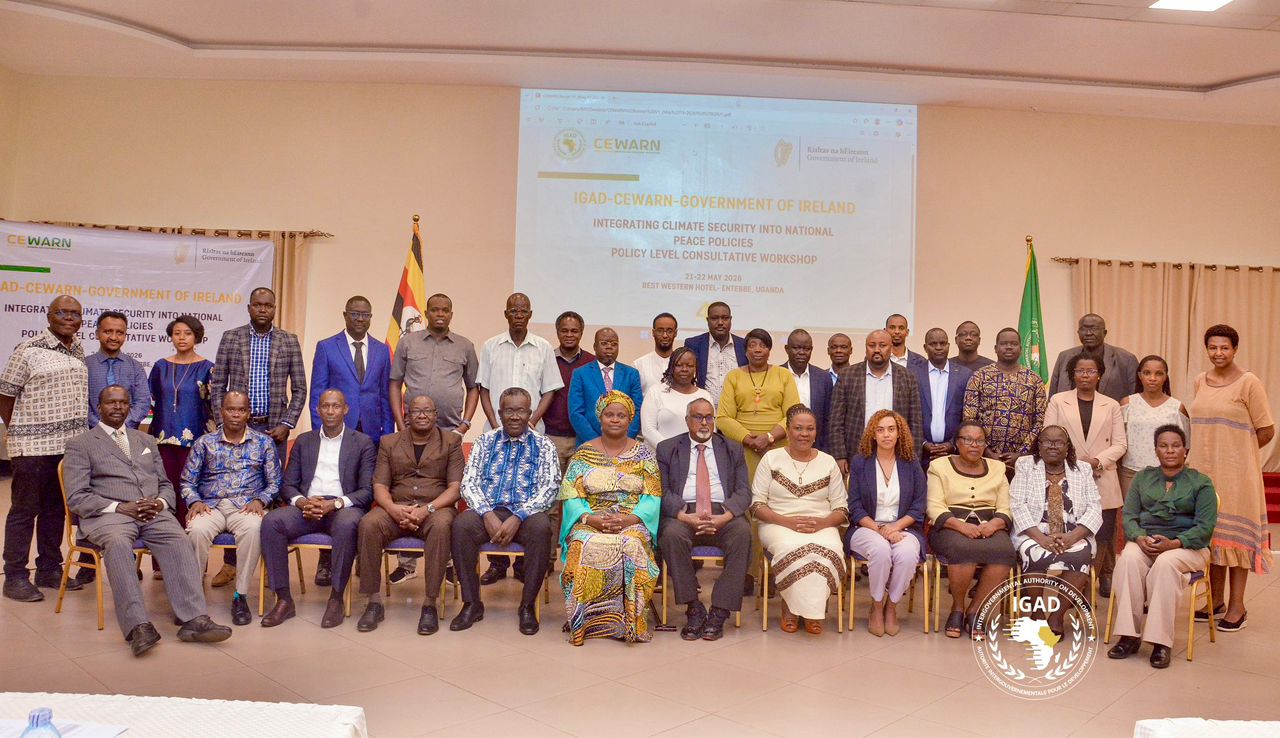
Intergovernmental Authority on Development member states are moving to integrate climate security into national peace and security frameworks through a new draft policy aimed at addressing climate-related conflicts in the arid and semi-arid pastoral areas of the region.
Edith Namutebi Nsubuga, Head of the Peace and Security Department at Uganda’s Ministry of Foreign Affairs, said the framework marks a major policy shift by directly linking environmental challenges with peacebuilding and conflict prevention efforts.
“For decades, peace and security strategies were treated separately from environmental policies. Today, reality demands a different approach. We can no longer talk about sustainable peace without addressing the profound impacts of climate change,” Namutebi said.
She explained that although climate change does not directly cause war, it intensifies vulnerabilities that can trigger instability, displacement, competition over resources and insecurity.
Namutebi made the remarks while opening the IGAD Conflict Early Warning and Response Mechanism (CEWARN) policy-level consultative workshop on integrating climate security into national peace policies, held in Entebbe.
According to the World Bank Country Climate and Development Report for Uganda, unmitigated climate shocks could significantly reduce Uganda’s GDP growth by 2050.
Despite the growing risks, officials noted that responses to climate-related insecurity across the region have remained fragmented and poorly coordinated.
By integrating climate data into national peace policies, IGAD member states hope to strengthen anticipatory governance, improve disaster preparedness and enhance cross-border collaboration on climate security.
Mohamed Abdi Ware said many countries within the region continue to face high levels of insecurity and conflict, making climate adaptation efforts even more difficult.
“It has to go beyond theory. It must be reflected in policy decisions, budgetary allocations, and laws passed by parliament,” Ware said.
“We need to bring the relationship between climate and conflict to the centre of the agenda,” he added.
Ware also called for a shift in the perception of borderland communities, which are often associated with insecurity, smuggling and armed conflict.
“I was born and raised in the borderlands. They are areas of entrepreneurship and resilience. Our ministries of foreign affairs have helped place borderlands at the centre of regional discussions,” he noted.
Joselyn Bigirwa said the draft policy will strengthen Conflict Early Warning and Early Response Units by integrating climate security data alongside traditional peace and security information.
“The data they generate will feed into district and national plans, and ultimately into a regional policy. This will then cascade back to national levels,” Bigirwa explained.
She added that member states will now integrate climate, peace and security data into policymaking processes rather than focusing solely on conventional security indicators.
Meanwhile, Camlus Omogo said the framework is expected to improve coordination between governments and early warning systems, leading to more effective responses to climate-induced conflicts.
“CEWARN has integrated climate change risks into its conflict early warning systems by incorporating climate parameters as independent variables,” Omogo said.
He revealed that the tool is already being piloted in four sub-ecosystems within the Karamoja cluster, with rollout to the Mandera cluster expected in June.
The initiative comes as East African countries increasingly grapple with prolonged droughts, floods, displacement and competition over natural resources, particularly in pastoral and border communities vulnerable to climate shocks.
