
For many households in northern Uganda, a radio remains a source of news, entertainment and information. But for Stella Aciro , a farmer in Lamwo District, it has become a powerful tool for transforming her livelihood, strengthening her community and building financial independence.
Every Tuesday and Friday, Aciro tunes in to Tembo FM to listen to the Farmer’s Voice Radio (FVR) programme — a routine she describes as an important appointment rather than a simple pastime.
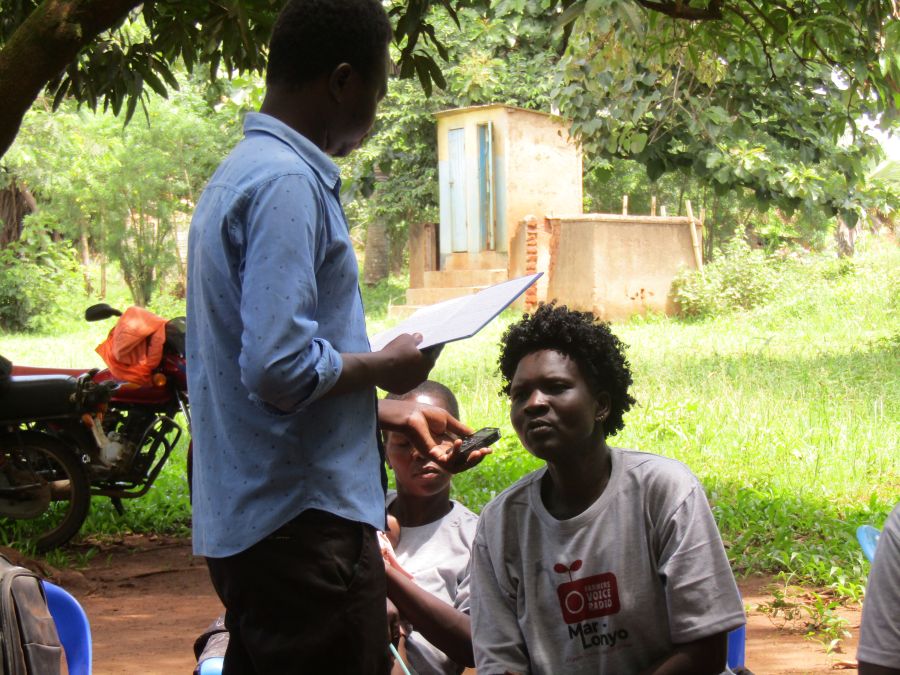
As the deputy chairperson and women’s representative of the Mar-Lonyo Group, a radio listener group in Lamwo, Stella does not keep the lessons to herself. She mobilises family members, neighbours and fellow farmers to listen, discuss and apply the knowledge gained from the programme.
Before discovering FVR, Stella relied on traditional farming methods that limited her productivity. Her crops were planted without proper spacing, with maize and sorghum often grown together in the same holes, resulting in poor growth, depleted soil nutrients and low yields.
However, through FVR’s programmes on sustainable land management and modern agronomy practices, Stella learned improved farming techniques including proper spacing, row planting and better crop management.
The lessons transformed her garden into a more organised and productive farm, increasing her harvest and opening new opportunities for income generation.
A major turning point in Aciro’s journey came when the programme introduced her to the importance of value addition.
Like many smallholder farmers, she previously sold raw groundnuts immediately after harvesting — often at a time when market supply was high and prices were low.
After learning about processing and value addition, she began grinding her groundnuts into paste before selling them, allowing her to earn more from the same produce.
The strategy significantly improved her earnings, with Aciro making more than Shs1 million in net profit in a single season.
The additional income helped her improve her family’s welfare by ensuring food security, accessing medical care and paying school fees for her children.
Embracing financial literacy and diversification
Beyond farming techniques, Aciro also benefited from FVR’s financial literacy sessions.
She adopted better money management practices, including saving her earnings through formal financial institutions rather than spending her profits immediately.
She also embraced diversification by investing part of her income into coffee farming — a long-term cash crop expected to provide additional financial stability for her household.
For Aciro, the impact of knowledge goes beyond income. She says access to agricultural information has strengthened women’s participation in household decision-making.
“I believe that now women take part in decision making in their families because they get knowledge on different things like sustainable land management and how to properly grow crops. This makes them contribute to the family by providing valuable knowledge that produces tangible results,” she said.
She believes that women’s ability to contribute practical solutions to farming challenges has increased their influence and recognition within their homes and communities. Inspired by lessons on cooperation and collective action, members of the Mar-Lonyo Group are also shifting towards collective farming and bulk marketing.
By combining their produce, the farmers hope to reduce dependence on middlemen, negotiate better prices and access larger markets.
The approach, Aciro says, will help smallholder farmers overcome challenges associated with low production volumes and limited transport options.
Planting trees for future generations
She has also incorporated environmental conservation into her farming journey.
Through the Transformative Approach to Sustainable Landscapes and Livelihoods (TASLL) Project in Northern Uganda, supported by UK International Development and ECOTRUST, she has established a woodlot of 3,465 trees to promote sustainable landscapes and the planting of native tree species.
Her woodlot includes indigenous species such as Milicia excelsa (Muvule), Markhamia (Musambya), Khaya grandifoliola (Tido), white and black teak, as well as fruit trees including jackfruit.
Aciro views the trees as a long-term investment that will provide future income through sustainable harvesting of poles and timber while also supplying household firewood.
Her journey from struggling with low-yield traditional farming to running a diversified agricultural enterprise demonstrates how access to reliable information can transform rural livelihoods.
Through Farmer’s Voice Radio, Stella’s ordinary radio set has become a gateway to improved farming practices, financial empowerment, environmental conservation and greater participation of women in community development.
