
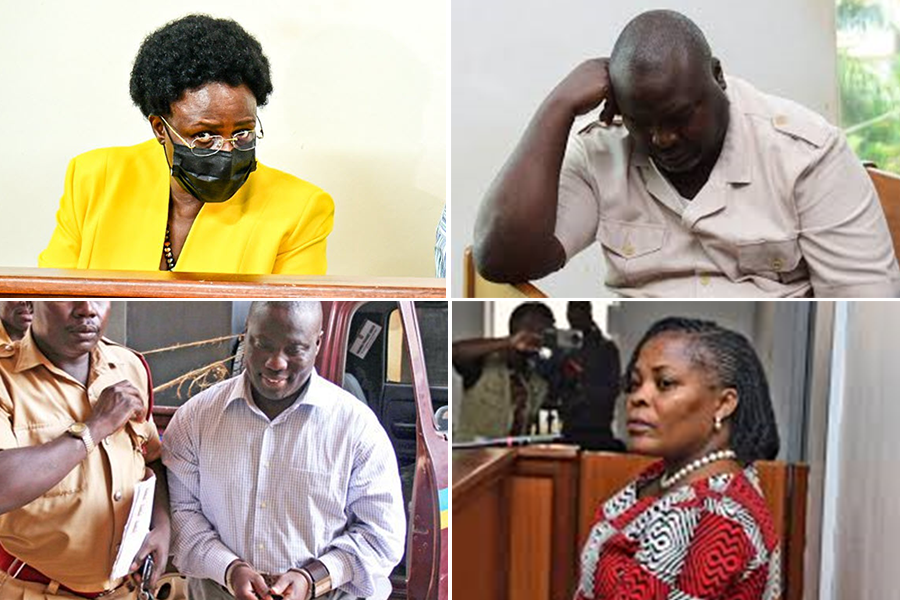
Remember when General Kale Kayihura was taken into the dock of the General Court Martial in Makindye looking totally the opposite of the most powerful Inspector General of Police he projected for years?
Well, it was a Court Martial but still a trial of a powerful figure who had hit the grass from the skies.
The investigations involving former Speaker Anita Among are unfolding against a complicated legal and political backdrop in Uganda.
Anti-corruption agencies have at times secured landmark convictions against senior government officials, but have also repeatedly faced accusations of selective prosecution, political compromise, and inconsistent enforcement.
That tension is central to understanding what could happen if Anita Among is eventually charged.
On paper, Uganda possesses one of the more extensive anti-corruption legal frameworks in the region. The country has a specialised Anti-Corruption Court, an Inspectorate of Government with constitutional powers, asset declaration systems under the Leadership Code, and anti-money laundering legislation that allows investigators to freeze and recover suspicious wealth.
In practice, however, the state's willingness and ability to successfully prosecute politically connected figures has varied dramatically depending on the individual involved, the political climate, the available evidence, and the level of institutional backing behind investigators.
The strongest precedent for any potential illicit enrichment prosecution against Among is the case of Geoffrey Kazinda, whose conviction fundamentally changed how Ugandan prosecutors approach unexplained wealth cases.
Kazinda was not a minister or elected politician, but he occupied a highly influential position within government financial administration during the Office of the Prime Minister corruption scandal that shook Uganda in the early 2010s.
In 2020, the Anti-Corruption Court convicted him on three counts of illicit enrichment under Section 31 of the Anti-Corruption Act. The ruling became one of the clearest judicial endorsements of Uganda's unexplained wealth provisions.
The Inspectorate of Government built its case using detailed financial reconstruction methods known as "source and application of funds analysis." Investigators compared Kazinda's official earnings against his spending habits, luxury lifestyle, hotel bills, vehicles, land acquisitions, and real estate holdings.
One of the most cited parts of the judgment involved evidence showing Kazinda spent more than UGX 210 million staying in a luxury suite at Kampala Sheraton Hotel during a period when his total lawful income was estimated at just UGX 83.7 million.
The prosecution argued that the financial gap could not reasonably be explained through legitimate earnings.
Perhaps even more important was the court's approach to concealed ownership.
Kazinda had attempted to shield assets by placing some properties under structures linked to a religious trust managed by Christian monks. Prosecutors successfully argued that despite the paperwork, he remained the true beneficial owner of the assets.
That aspect of the case matters because modern financial crime investigations increasingly focus not only on direct ownership, but also on indirect control, proxy ownership, trusts, family-linked entities, and associated business structures.
The Anti-Corruption Court ultimately sentenced Kazinda to 15 years in prison, ordered confiscation of several assets, and barred him from holding public office for 10 years.
Legally, the Kazinda ruling established several important precedents.
First, Ugandan courts signalled they were willing to convict based heavily on financial analysis rather than direct eyewitness evidence of theft or bribery.
Second, the court demonstrated willingness to look beyond formal paperwork and examine the practical realities of who controls assets.
Third, the judgment reinforced the idea that unexplained wealth itself can form the basis of criminal liability for public officials.
If investigators are indeed conducting lifestyle audits, analysing declarations, or examining asset ownership linked to Anita Among, the Kazinda case is likely to become one of the most important reference points guiding prosecutors.
But Uganda's anti-corruption history also shows that legal precedent alone does not determine outcomes.
Another major precedent frequently cited in public sector corruption cases is that of David Chandi Jamwa.
Jamwa was prosecuted for causing financial loss and abuse of office during his time at the National Social Security Fund after authorising the premature sale of government bonds in a transaction that caused significant losses to the fund.
The prosecution argued that the decision violated sound financial procedures and improperly exposed public resources to avoidable losses.
The Anti-Corruption Court convicted Jamwa and sentenced him to 12 years in prison. Importantly, the conviction survived appeals at both the Court of Appeal and the Supreme Court, strengthening the authority of the Anti-Corruption Court and confirming that senior public officials could face custodial sentences for decisions deemed arbitrary and financially harmful to state institutions.
The Jamwa case became especially significant because it demonstrated that prosecutors did not always need evidence of personal theft to secure convictions. Abuse of office charges can instead focus on whether an official improperly exercised authority in ways that prejudiced public institutions.
That precedent could become relevant if investigators examining parliamentary spending, procurement decisions, or financial authorisations linked to Anita Among attempt to argue that official powers were improperly used even absent direct evidence of personal appropriation.
Yet perhaps the most instructive historical precedent for Among's current predicament is one that did not end in conviction at all.
The Temangalo saga, involving then-Security Minister and NRM Secretary General Amama Mbabazi, his business partner Amos Nzeyi, and the National Social Security Fund, offers something neither Kazinda nor Jamwa can: a detailed blueprint for how a high-ranking official can deploy institutional technicalities, parliamentary manoeuvres, and legal bottlenecks to emerge completely unscathed.
In 2008, Mbabazi faced intense pressure over allegations that he used political influence to force NSSF to purchase 414 acres of his private land in Temangalo at an inflated price of UGX 11 billion, bypassing competitive bidding processes under the Public Procurement and Disposal of Public Assets Act.
When civil society organisations sued to nullify the transaction, the High Court ultimately cleared it in 2011. The court ruled that the NSSF Act gave the board and the Minister of Finance wide investment discretion, meaning that strict PPDA procurement laws did not override the Fund's internal investment mandates.
For Among, that lesson is immediately applicable. Her defence team is likely already examining the Administration of Parliament Act and parliamentary internal rules for procedural loopholes that could complicate or constrain the Inspectorate of Government's mandate.
The Temangalo precedent also illustrated the raw power of parliamentary arithmetic. A select committee investigated the matter and produced a minority report recommending that Mbabazi and then-Finance Minister Ezra Suruma be held politically accountable and step down. As NRM Secretary General, Mbabazi mobilised the party caucus, and the ruling party used its parliamentary majority to vote down the censure recommendations, effectively rewriting the committee's conclusions to exonerate him.
Among faces an inverted version of that dynamic. She used to leads the legislature and has now lost control of the political state machinery. If the executive has ordered the current UPDF and CID operations targeting her homes and associates, the NRM caucus is unlikely to be mobilised in her defence the way it was for Mbabazi.
A third dimension of the Temangalo saga, one that receives less attention but carries significant implications, is the role of time itself. The case dragged across more than a decade, eventually morphing into separate ownership disputes involving a Canadian-based Asian family asserting original 1924 land titles. In 2019, the High Court dismissed those external claims against NSSF on a straightforward basis: statutory limitation. The window to sue had simply expired.
That outcome encodes a broader strategic logic familiar to legally embattled officials in Uganda. Investigations stretched through endless constitutional references, procedural applications, and structural delays can lose momentum or run past clear legal windows entirely.
But while Mbabazi successfully navigated the Temangalo crisis and eventually rose to become Prime Minister, the structural environment in 2026 makes his blueprint far harder to replicate.
The differences matter. Mbabazi was a historical architect of the ruling establishment, carrying systemic leverage accumulated over decades. Among is a strategic political ally who entered the establishment later. The state's protection mechanics have historically operated very differently for foundational insiders than for newer political entrants.
There is also an institutional difference that did not exist during the Temangalo era. The operationalisation of the Leadership Code Tribunal under Article 235A of the Constitution has introduced a dedicated forum for trying declaration discrepancies and asset omissions — one that functions as a streamlined administrative process rather than a chaotic, politically contested parliamentary floor vote. An official today can be removed from office through a clinical institutional procedure that the Temangalo playbook was never designed to defeat.
But while Kazinda, Jamwa, and the Temangalo saga each illuminate different dimensions of Uganda's anti-corruption landscape, none of the three operated against the specific backdrop Among now faces.
The iron sheets scandal, locally known as the Mabaati scandal, exposed the limits and inconsistencies of Uganda's anti-corruption enforcement system when politically powerful figures become implicated.
The scandal centred on iron sheets and relief items intended for vulnerable communities in Karamoja but allegedly diverted to senior political leaders and officials.
A striking number of top figures became linked to the controversy, including cabinet ministers, the Vice President, senior parliamentary figures, and eventually Among herself.
Yet despite the scale of public outrage, the prosecutorial outcomes varied sharply.

Amos Lugoloobi initially faced criminal charges connected to the scandal, but the Director of Public Prosecutions later withdrew the case after formally notifying court of a loss of interest in continuing prosecution.
Mary Goretti Kitutu, who became the central political face of the scandal, has managed to significantly delay substantive trial proceedings through procedural litigation, including legal challenges surrounding her arrest and claims of mistreatment.
Agnes Nandutu ultimately emerged as the only minister who was convicted for the crime.
Those outcomes reinforced a long-standing criticism frequently directed at Uganda's anti-corruption institutions; that prosecutions often become uneven once investigations begin touching politically sensitive individuals.
Critics have argued that anti-corruption drives in Uganda have historically succeeded more consistently against technocrats, civil servants, accountants, and politically weakened officials than against sitting members of the country's most powerful political networks.
The evolution of the Leadership Code system also matters in understanding the current moment.
For years, Uganda's enforcement of asset declaration laws was weakened by institutional limitations. The Inspectorate of Government could identify discrepancies or breaches but lacked an effective standalone adjudicating mechanism capable of quickly imposing sanctions.
That changed with the operationalisation of the Leadership Code Tribunal under Article 235A of the Constitution.
The Tribunal now provides a dedicated forum for handling declaration disputes, unexplained omissions, late submissions, and alleged false declarations by public officers.
Modern Leadership Code enforcement has increasingly focused on whether leaders fully disclosed assets, accounts, and business interests in their mandatory declarations. Once investigators identify an omitted or suspicious asset, the burden effectively shifts toward the official providing a credible explanation.
Unlike criminal corruption trials, Leadership Code proceedings are partly administrative and institutional in nature. That means investigators may not necessarily need to prove classic criminal theft beyond reasonable doubt in order to establish misconduct serious enough to justify removal from office or disqualification from future public service.
That distinction could become highly significant if prosecutors conclude that criminal corruption charges may be difficult to sustain but declaration discrepancies are easier to establish through documentary evidence.
The broader issue now confronting Uganda's anti-corruption system is therefore not simply whether laws exist. The laws are already there, and previous courts have shown willingness to impose severe penalties in certain cases.
The bigger question is whether investigators and prosecutors are prepared to apply those precedents consistently when the subject of scrutiny sits at the very top of Uganda's political establishment.
That is the unresolved tension hanging over the Anita Among investigations.
Uganda has demonstrated before that senior officials can be investigated, prosecuted, imprisoned, stripped of assets, and banned from office. The Kazinda and Jamwa cases proved that clearly.
But Uganda has also repeatedly shown that political influence, institutional hesitation, prosecutorial withdrawals, negotiated exits, and procedural delays can reshape the trajectory of major corruption scandals long before final judgment is reached.
The Temangalo saga proved something further still: that a sufficiently connected official, with the right legal arguments and the right political timing, can walk through the middle of a major scandal without facing any of those consequences at all.
Any eventual prosecution of Anita Among would therefore test not only the evidence gathered by investigators, but also the credibility, independence, and consistency of Uganda's entire anti-corruption system.
