
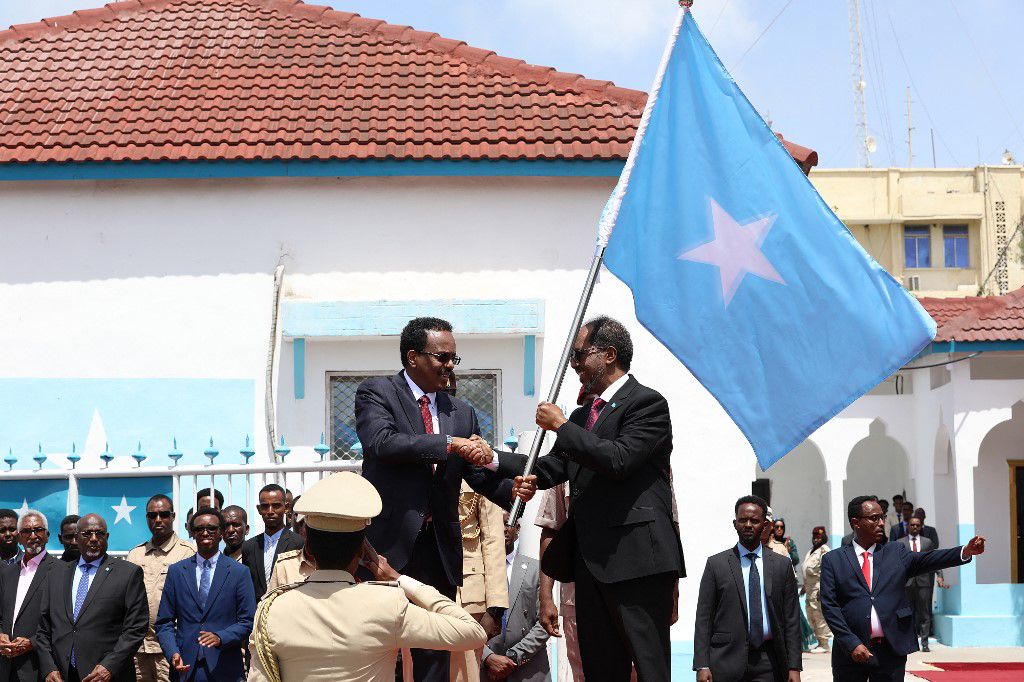
For months, opposition voices in Somalia have intensified accusations against President Hassan Sheikh Mohamud, charging him with deviating from the path of national unity, the dream of democracy, the reunification of the regions, and the consensus he once pledged an approach observers have characterised as a revival of the failed model associated with his predecessor, Mohamed Farmaajo.
The platform “Somali Stream” contends that “as President Hassan Sheikh Mohamud approaches the end of his presidential term, scheduled to conclude in May 2026, Somalia’s fragile political settlement is once again drifting toward uncertainty.
Negotiations between the federal government and the Council for the Future of Somalia, aligned with the opposition, have collapsed after months of stalemate over the structure, legitimacy, and administration of the forthcoming elections.”
Somali MP Yusuf Hussein Jimadeed has launched “a scathing attack on Sheikh Mohamud, accusing him of violating the constitution, undermining national unity, and engaging in what he described as authoritarian conduct that threatens the country’s fragile democracy.”
The platform “Shabelle Media” quoted Jimadeed in a sharply worded statement issued weeks ago as saying, “The president’s actions constitute a betrayal of the social contract,” warning that continued disregard for the constitutional order could once again plunge Somalia into political turmoil and insecurity.
He cautioned that “dismantling the constitutional framework, looting public property, and using force against poor and vulnerable citizens far exceed the responsibilities of national leadership,” describing such moves as “dangerous actions that erode public trust and threaten the foundations of the Somali state.”
Personal Ambitions
In this context, Abdirahman Abdishakur, a member of Somalia’s Federal Parliament and one of the country’s opposition leaders, wrote in “Horn Observer” that “Hassan Sheikh Mohamud’s election in 2022 brought with it an opportunity to deepen reconciliation, strengthen institutions, and unify a fractured nation.
Yet rather than humbling himself before the renewed confidence of the people, President Hassan Sheikh Mohamud grew increasingly arrogant, presiding over an administration defined by personal ambition rather than national interest.”
Abdishakur delineated the contours of Sheikh Mohamud’s second term, stating: “His leadership has rested upon a fundamental error—the belief that personal loyalty is the foundation of good governance.
In truth, the president does not demand loyalty to the nation, but personal loyalty—an antiquated notion that calls for absolute submission. Preferring flattery over competence is not a mere oversight; it is a deliberate strategy that has paralyzed the state and betrayed the public trust.” Sheikh Mohamud’s first term spanned 2012 to 2017.
The Somali opposition figure cited “the first year following Sheikh Mohamud’s return to power, during which he pledged to combat Al-Shabaab and eradicate corruption.
He promised to liberate territories still under terrorist control and strengthen state authority. These commitments earned him substantial domestic and international support.
Many hoped he would leverage this political capital to reinforce governance and enact legitimate electoral reforms. Yet his administration failed to deliver.”
He added, “Instead of pursuing a national anti-corruption agenda, the Somali president turned toward personal enrichment—selling public lands, misusing state resources, and focusing on private gain.
In a tragic irony, a leader who vowed to fight corruption now appears poised to leave office as one of Somalia’s wealthiest figures.”
According to Abdirahman Abdishakur’s assessment, “True leadership recognizes that state-building in a country like Somalia requires collective effort.
The challenges we face—from security and unemployment to navigating a complex geopolitical landscape—demand a team of experts, not a retinue of loyalists. Yet President Hassan Sheikh Mohamud’s model stands in stark contrast: he has replaced governance with domination.
Appointments have been made based on three criteria: clan affiliation, personal loyalty, and—most perilously—deliberate incompetence.
This incompetence has enabled the president to centralize power, blur the separation of constitutional authorities, and transform state institutions into instruments for suppressing opposition.”
Rejection of Dictatorship
In a similar vein, writer Mohamed Abdulkafar Haji Hussein argued in an analysis published by “Wardheer News” that “Hassan Sheikh Mohamud’s selection in May 2022 came at a moment when Somalis were largely united and eager to turn a new page after a long and bitter political confrontation, during which former president Mohamed Abdullahi Farmaajo faced widespread accusations of attempting to entrench his authority by extending his term by two additional years, justifying the move on the grounds that upcoming elections would be held under a one-person, one-vote principle.”
He continued: “Sheikh Mohamud was among those who denounced President Farmaajo’s plan as dictatorial and urged the Somali people to oppose it.
No one expected any candidate to replicate the same mistake committed by Farmaajo. For the first time in a long while, Somalis believed they had finally found the right path. Ultimately, Hassan Sheikh Mohamud was elected president. During his campaign, he promised to lead a Somalia at peace with itself and with the international community.
This message, coupled with his prior experience as president, convinced many Somalis that he was the right figure to reunify the country provided he honored his pledge. Yet immediately after his election, President Hassan appeared to alter his course.”
He stated, “Sheikh Mohamud swiftly retreated into his political circle, focusing on forming a government dominated by his allies, while many candidates who had worked tirelessly to secure his victory were sidelined.
Power once again began to concentrate in the presidency. Somalis had expected him to form a genuine national unity government and to bring all stakeholders to the negotiating table, including President Farmaajo, and to clearly declare that Somalia’s priority must be finalising the constitution and establishing a credible electoral system. Had he adhered to that course, Somalia’s situation today would be entirely different.”
He added, “As President Hassan’s term nears its end, no agreement has been reached on an electoral mechanism. Amid this political ambiguity, Somaliland moved towards independence.
At that moment, President Hassan had a clear opportunity to unite the country: once agreement on the upcoming elections was secured, the next step should have been direct engagement with Somaliland to open dialogue.
Any other path chosen by the president would lead to catastrophe. Yet at present, he appears inclined to proceed with elections based on his own vision, believing that international support suffices to manage the Somaliland question.”
