
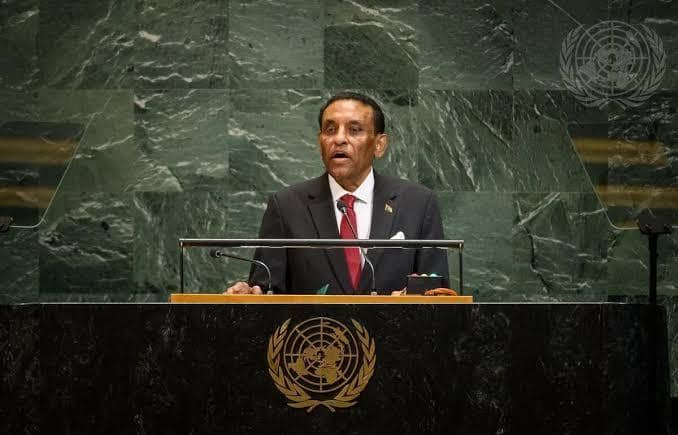
Sudan’s Prime Minister, Dr Kamil El Tayeb Idris, has presented a new government peace initiative to the United Nations Security Council, saying the country stands at a decisive moment where courage can secure an end to the war or hesitation can prolong suffering.
Addressing the Council in New York on December 22, 2025, Dr Idris said Sudan had paid an unbearable price in human lives and social breakdown, with cities destroyed, families displaced and hope under siege.
“Sudan stands today at a defining moment in its history, a moment where the silence of guns can either be delayed by hesitation or secured by courage,” he said.
The Prime Minister said the Government of Sudan Peace Initiative was born out of necessity and responsibility, not illusion or victory, and aimed to replace violence with law and despair with hope.
He told the Council the plan was rooted in international principles and aligned with the Saudi American peace initiative.
“Today, Sudan does not ask for sheer sympathy, it asks for partnership in securing peace, justice and dignity for its people,” Dr Idris said, adding that the initiative was locally driven and not imposed from outside.
In a detailed statement, Sudan accused the rebel militia formerly known as the Rapid Support Forces of waging war in violation of international law, leading to a humanitarian catastrophe and regional instability.
The government said the initiative reflected the vision of a civilian transitional government determined to protect civilians, stop the bloodshed and preserve Sudan’s unity and territorial integrity.
At the centre of the proposal is a comprehensive ceasefire to be supervised jointly by the United Nations, the African Union and the League of Arab States. The ceasefire would be accompanied by the withdrawal of rebel forces from all areas they occupy, in line with the Jeddah Declaration of Principles signed in May 2023.
The government also proposed gathering militia fighters in designated camps under international supervision, registering and screening them using biometric data, and later disarming them under strict guarantees to prevent weapons from being reused.
The initiative further calls for the safe return of internally displaced persons and refugees, as well as unhindered humanitarian access to all war affected areas.
As part of confidence building measures, the government said it would pursue accountability for serious crimes while adopting policies to address the status of militia members not involved in war crimes, genocide or major human rights violations.
The government pledged not to deny any Sudanese citizen identity documents and to review security reports to allow those wishing to return home to do so, in preparation for a national dialogue.
On security arrangements, the plan proposes integrating qualified individuals into regular state forces, implementing disarmament, demobilisation and reintegration programmes, and supporting former fighters through regional and international rehabilitation initiatives.
Economic measures include increased investment in Darfur, Kordofan and other affected regions, reconstruction projects, microfinance schemes to raise living standards, and job creation and training programmes to help former combatants rejoin civilian life.
Socially, the government said uninvolved militia members and supportive civil groups would be engaged in community peace, reconciliation, education and health projects to rebuild trust and repair the social fabric.
The initiative also outlines plans for local and international reconciliation conferences, working with the United Nations, donors and regional partners to promote national healing.
Politically, Sudan proposes a Sudanese led dialogue during the transitional period to agree on governance arrangements, followed by free and fair elections under international supervision.
In his closing remarks, Dr Idris urged the international community to act decisively.
“History will not remember how complex this conflict was, it will remember whether the world acted when action was possible,” he said.
He added that the initiative offered a clear test of collective resolve through a monitored ceasefire, enforceable disarmament, non selective justice and meaningful reconciliation.
“There can be no peace without accountability, no stability without a single national authority, and no future without healing,” Dr Idris said. “Sudan seeks neither impunity nor endless war, it seeks a just peace, anchored in law and safeguarded by the international community.”
He called on the Security Council to support the plan, saying it could mark the moment Sudan stepped back from the edge and the world stood on the right side of history.
Sudan is facing an existential crisis as a result of the war waged by the rebel militia (formerly the Rapid Support Forces), in flagrant violation of all international laws and norms, which has led to an unprecedented humanitarian catastrophe and regional and international instability.
To this end, and in line with the roadmap submitted to the Council and in conjunction with the Saudi-American peace initiative, the Sudan Prime Minister presented the Sudanese Government's initiative for peace, which expresses the vision of the Sudanese civilian transitional government of hope to put an end to this armed aggression by the militia and its supporters, protect civilians, and stop the bloodshed, in accordance with the suffering of our people, in order to preserve the unity and soil of our country and to maintain international security and peace.
Sudanese Government basic steps for peace
First, ceasefire. Declaration of a comprehensive ceasefire under the joint supervision of the United Nations, the African Union and the League of Arab States, to be accompanied by the withdrawal of rebel militias from all areas they occupy, in accordance with the Declaration of Principles signed in Jeddah on 11 May 2023.
Second, gathering rebel militia fighters in designated camps. Withdrawal of militia fighters and their gathering in agreed camps, under joint supervision of the United Nations, African and Arab entities. Registration and sorting of rebel militia fighters and collection of their personal data, including biometric data.
Third, displaced persons, refugees and humanitarian aid. Facilitate and secure the return of displaced persons to their areas of origin. Facilitate and secure the voluntary return of refugees. Facilitate and secure the flow of humanitarian aid to those in need in all areas affected by the war.
Fourth, disarmament of rebel militias. Implementing comprehensive disarmament under agreed international supervision, with guarantees that weapons will not be recycled.
Confidence-building measures
Based on Security Council Resolution 2736, the Sudanese Civilian Transitional Government of Hope, adopting national ownership of peace-building, shall take multiple confidence-building measures to ensure a response to the Sudanese Government's peace initiative, including political, economic, security and social aspects.
Political measures include taking measures regarding legal prosecution in relation to public law, and adopting policies regarding the accountability of militia members who are not involved in committing war crimes, genocide, human rights violations, or other crimes defined in international law, whether they are military or civilian, while subjecting perpetrators of crimes to transitional justice. This also includes not depriving any Sudanese citizen of obtaining identity documents, reviewing recorded reports, and reconciling the status of anyone who wishes to return to the country in preparation for a climate of Sudanese-Sudanese dialogue.
Security measures include integrating individuals who meet the criteria specified by the state into the regular forces of the Government of Sudan.
This also includes implementing disarmament, demobilization and reintegration programs for those who meet the criteria, with the aim of returning them to civilian life, as well as supporting reintegration through international and regional programs to rehabilitate former combatants and facilitate their integration into society.
Economic measures, including reparation, include supporting development projects in the states of Darfur and Kordofan, and other affected states, by allocating additional government and international resources as well as reconstruction projects. This also includes creating productive projects through microfinance funds with the aim of improving living standards in war-affected areas, and providing job opportunities and civilian training programs to rehabilitate former combatants and facilitate their integration into the labor market, while involving non-convicted militia members in the implementation of these projects.
Social measures include involving uninvolved militia members and the civil entities that support them in community peace initiatives, and providing opportunities to contribute to community reconciliation and reparation programs, thereby restoring the confidence of local communities in them. This also includes involving uninvolved militia members in educational and health projects by supporting schools and hospitals in war-affected areas and making them part of the community solution.
Reconciliation and community peace conferences
Holding international and local conferences to re-establish community peace, reconciliation and national healing, in cooperation with the United Nations, international and regional organizations, donors, and sisterly and friendly countries, to address the effects of war, mend the social fabric and create a healthy community environment.
Political process
Holding a Sudanese-Sudanese dialogue during the transitional period, in which political forces agree on how to manage the state and govern the country. This will be followed by free and fair elections under international supervision to complete the requirements for comprehensive democratic transition.
