
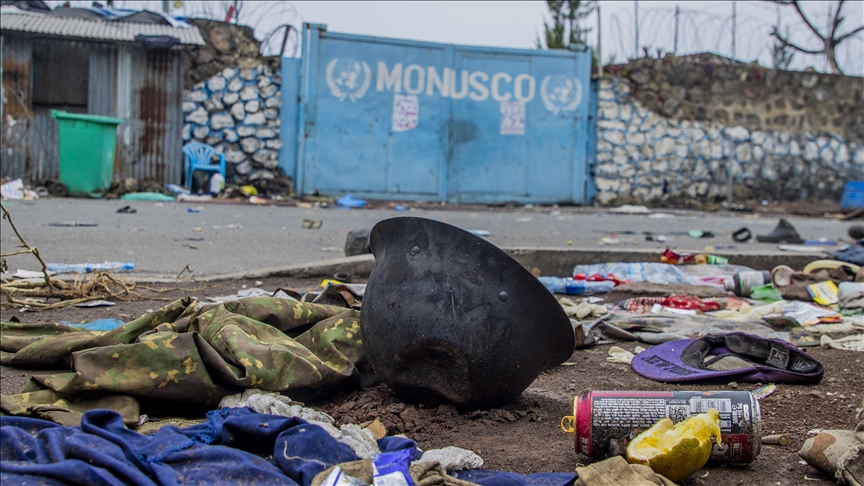
Two days before a crunch meeting with United States President Donald Trump, there is still no sign of a ceasefire in eastern Democratic Republic of the Congo, with the M23 rebel movement accusing government forces and their Burundian allies of launching new large-scale attacks on populated areas in South Kivu.
In a statement issued on Tuesday, M23 spokesperson Lawrence Kanyuka said joint operations by the Congolese army, FARDC, and Burundian troops had intensified along several front-line axes.
“From the first hours of this Tuesday, December 2, 2025, the combined forces of the Kinshasa regime have launched widespread attacks against densely populated areas as well as along all front lines,” Kanyuka said.
“The assaults, of particularly high intensity, are concentrated notably along the Katogota–Luvungi, Kaziba–Haut Plateau, Tchivanga–Hombo, and Kasika–Mwenga axes. The situation is catastrophic and is deteriorating minute by minute.”
Kanyuka further accused the Burundian army of committing grave violations of international law during operations in eastern Congo.
“In addition to violating the 1949 Geneva Conventions, the 1998 Rome Statute, and the United Nations Charter, the Burundian army tramples on the fundamental principles of human dignity and international law,” he said.
According to Kanyuka, Burundian forces retreating from battlefields have buried their soldiers and Imbonerakure militiamen in hastily dug mass graves and abandoned explosives that threaten civilians.
He added that airstrikes targeting rebel-held zones were being coordinated from Burundi.
“All the bombings carried out by Soukhoï-25 fighter aircraft and drones against densely populated areas and the entire front lines are orchestrated from Burundi,” he wrote earlier.
“This country serves as a rear base and command center for the coalition forces of the Kinshasa regime.”
M23 leader Bertrand Bisimwa echoed the accusations, saying the alleged bombardments amounted to international crimes.
“These deadly attacks carried out by the Burundian Army against Congolese citizens in their villages constitute crimes against humanity and war crimes under the 1949 Geneva Conventions, the 1998 Rome Statute, and the United Nations Charter,” Bisimwa said.
Burundi has not responded to the accusations, including one that said its military base was being used as a launchpad for air raids on M23 positions.
Meanwhile, the rebels have continued their territorial advances despite the US-mediated ceasefire signed last month.
Over the weekend, M23 captured Bulungu and Matale and advanced towards the Muta Heights. The group is now about 26 kilometres from Muta in the Shabunda direction.
Fresh offensives along the N2 highway have seen M23 seize Kasika, Kalambi, and Nzibira.
Front-line sources say FARDC and allied Wazalendo militias have withdrawn from Kibumpa, Iganda, Ilangi and are now pulling back towards Mwenga.
Heavy airstrikes by FARDC south of Bukavu continued through Monday night as government forces attempted to halt the rebel advance.
Neither side is observing the ceasefire commitments made under the recent Qatar Framework Agreement or the earlier US-DRC-Rwanda initiatives.
The escalation comes at a sensitive moment, as Rwanda’s Paul Kagame and Congo’s Félix Tshisekedi are set to meet President Trump in Washington on Thursday.
The three-way summit is scheduled for Thursday, December 4, 2025, when Trump will host Kagame and Tshisekedi in Washington, D.C., to sign and ratify a U.S.-brokered peace and economic agreement.
The meeting follows a preliminary accord signed by their foreign ministers in June and aims to cement commitments on troop withdrawal, cessation of hostilities, and a regional economic integration framework — part of a broader push by the US to stabilize eastern Congo and channel Western investment into the region’s mineral-rich economy.
The leaders are expected to reaffirm commitments made during past peace efforts, including the Qatar agreements and earlier bilateral understandings reached in the United States aimed at de-escalation, demobilisation of armed groups, and restoration of cross-border cooperation.
However, with front lines shifting rapidly and accusations of war crimes rising from both sides, the worsening situation on the ground threatens to overshadow diplomatic efforts.
Civilians across South Kivu continue to flee bombardments, and humanitarian organisations warn that renewed offensives risk plunging the region deeper into crisis.
