
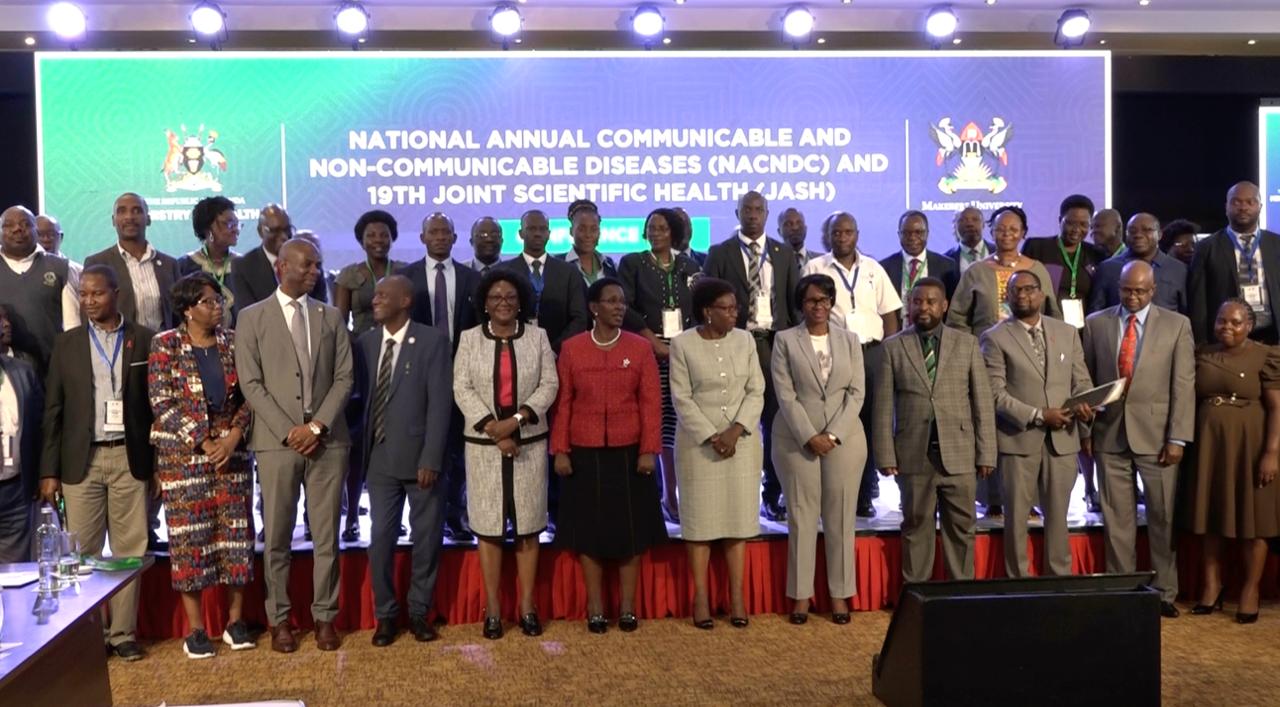
Makerere University’s Principal of the College of Health Sciences, Professor Bruce Kirenga, has urged the Ministry of Health to intervene in what he described as a growing crisis of unemployment among health professionals in the country.
Prof. Kirenga made the appeal during the Annual Communicable and Non-Communicable Disease Joint Scientific Conference held in Kampala.
The conference brought together researchers, medical practitioners, and health experts from within and outside Uganda to discuss strategies for strengthening both preventive and curative health interventions.
Prof. Kirenga revealed that over 40,000 nurses who have graduated remain jobless, with many resorting to odd jobs such as riding boda bodas to make ends meet.
“There are 40,000 nurses on the streets who graduated but have no professional jobs. Some have resorted to doing odd jobs, while others are riding boda bodas, we need to come up with interventions to solve this.
Our product is not well consumed, especially nurses and other allied healthcare professionals.” Prof. Kirenga noted.
He appealed to the Ministry of Health the country’s biggest employer in the health sector to create mechanisms that can absorb more of these qualified health workers into the system.
“We ask you, Honorable Minister, to use all mechanisms available to open up your consumption of our products you are the biggest consumer,” he emphasised.
His remarks come at a time when Uganda continues to grapple with healthcare staff shortages in public facilities, particularly in rural and underserved areas.
Meanwhile, Professor Rhoda Wanyenze, the Dean of Makerere University School of Public Health, reaffirmed the institution’s commitment to improving the quality and relevance of its graduates to meet national and international health needs.
“As the School of Public Health, we shall look at our training because our workforce is absolutely critical. We need to send out a workforce aligned with the agenda of unified action against communicable and non-communicable diseases,” Prof. Wanyenze said.
She added that the university is re-evaluating its approach to research and innovation, ensuring that students’ work contributes meaningfully to national health priorities.
“We need to be critical about the research and innovation our students are doing, and refocus to move within this agenda,” she noted.
