
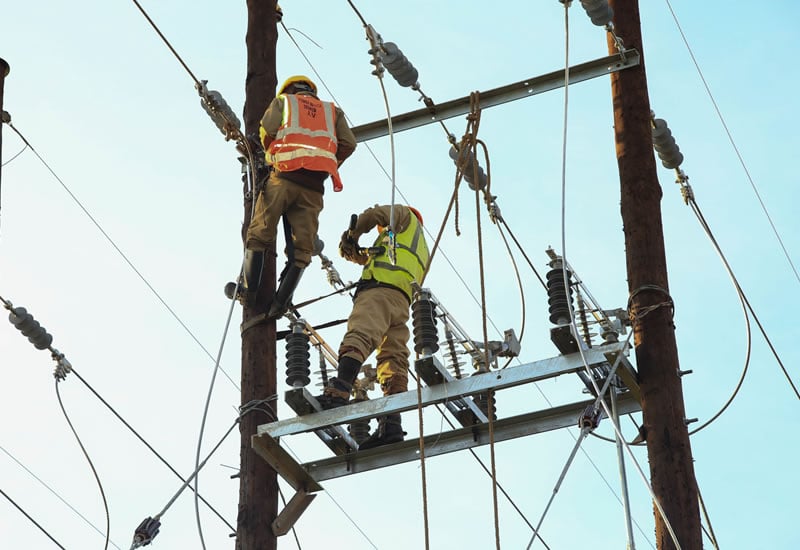
Kampala – The Ministry of Energy and Mineral Development (MEMD) has signed two key implementation agreements with Uganda Electricity Distribution Company Limited (UEDCL) under the World Bank-funded Electricity Access Scale-Up Project (EASP), assigning UEDCL the task of connecting over 900,000 new households to the national power grid.
The Shs1.4 trillion ($368 million) initiative is part of a broader government strategy to achieve universal electricity access by 2030 and is aligned with Uganda’s Vision 2040 and National Development Plan III.
The EASP, which became effective in 2023, aims to make at least one million new connections by 2027.
Speaking at the signing ceremony held in Kampala, Permanent Secretary for the Ministry of Energy Irene Bateebe explained that the formal agreements define operational responsibilities under Component One of the EASP, which focuses on expanding the national grid and accelerating household connections.
“As a country today, we are reporting 60 percent electricity access, which we need to grow to 100 percent universal access. Under this facility, we aim to make one million new connections, and that is the essence of today’s ceremony,” Bateebe said.
While UEDCL is a government-owned utility directly supervised by MEMD, the agreements are necessary to structure implementation under the World Bank’s results-based financing model.
Under this framework, UEDCL will receive disbursements based on verified performance milestones.
The first agreement mandates UEDCL to deliver approximately 508,000 new household connections over the next two years, particularly targeting eligible consumers under the Free Connections Policy.
This policy allows low-income households within 90 meters of an existing low-voltage pole to receive a one-pole or no-pole connection at no cost.
The second agreement places procurement responsibility on the Ministry, which will acquire and supply the materials needed for the rollout, enabling UEDCL to concentrate on fieldwork and service delivery.
“We have already made 155,088 connections since the project became effective in 2023. Our goal is to reach one million by 2027. This means UEDCL must deliver about 400,000 connections annually—a bold but necessary goal to fulfill our commitments,” Bateebe said.
UEDCL Managing Director Paul Mwesigwa welcomed the assignment and pledged the company’s readiness to meet the ambitious targets.
“We are excited to officially implement a project that will connect over 900,000 customers to electricity. This will include free one-pole and no-pole connections for eligible households,” Mwesigwa said.
He noted that UEDCL has already secured initial stock, streamlined application procedures through online platforms, and prepared logistics to commence large-scale installations immediately.
“We’ve prepared logistics, secured initial stock, and ensured that materials are already in transit. The goal is to execute this within two years, making 450,000 connections annually,” he added.
Beyond household electrification, the broader EASP aims to deliver 1,075,000 connections by 2027, including to public institutions such as schools and health centers, and to businesses.
Special emphasis is placed on rural areas, refugee-hosting districts, and growth corridors where access to electricity remains limited.
The EASP includes a separate component focused on off-grid solutions through the Uganda Energy Credit Capitalisation Company (UECCC), targeting underserved communities with solar home systems and other decentralized energy technologies.
By integrating electricity access into broader development goals, the government believes the project will stimulate small business growth, improve service delivery in education and healthcare, and boost the productivity of youth and women entrepreneurs.
“Electricity access is not just about infrastructure—it’s about people,” Bateebe said. “We are empowering welders, agro-processors, salon operators, schools, health centers, and entrepreneurs—especially women and youth—by creating safer, more efficient, and more productive environments.”
With UEDCL now tasked as the main implementer for grid connections under Component One, and MEMD managing procurement and oversight, the government hopes the structured approach will ensure accountability, speed, and transparency in one of Uganda’s most ambitious electrification programs to date.
The overall EASP is backed by $638 million in funding from the World Bank and the Government of Uganda and is seen as a cornerstone in the country’s energy transition agenda.
