

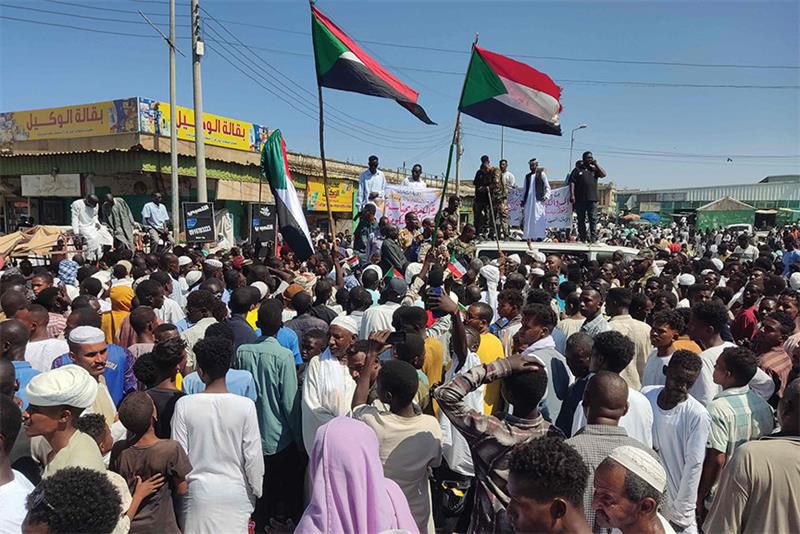
The war in Sudan continues to unfold in tragic chapters, leaving behind immense destruction and a worsening humanitarian crisis.
The intensifying wave of violations targeting innocent civilians has drawn sharp alarm. Since mid-April, international and human rights organisations have documented horrific war crimes, particularly in the Darfur region, where daily images of suffering and despair are emerging.
Documented War Crimes in Nyala
In a disturbing development, Human Rights Watch (HRW) revealed on June 4 that the Sudanese Armed Forces carried out aerial attacks on residential and commercial districts in Nyala, the capital of South Darfur, in early February.
In a detailed report published on its official website, the organisation confirmed that these airstrikes killed a "large number of civilians" due to the use of unguided bombs dropped from aircraft.
HRW stated that "the attacks were indiscriminate, as the bombs used have wide-area effects and limited precision, making it nearly impossible to target specific military objectives in populated areas. Intentionally or recklessly launching indiscriminate attacks constitutes a war crime."
The organisation further emphasised that these presumed war crimes "killed and wounded many civilians," and pointed out that the army had carried out repeated assaults on Nyala since the Rapid Support Forces (RSF) seized control of the city in late October 2023.
Once home to over 800,000 people before the conflict, Nyala is the largest city in Darfur and among the largest in Sudan, magnifying the scale of the humanitarian catastrophe.
The HRW report was based on “credible accounts of numerous airstrikes between November 2024 and February 2025.” Researchers investigated five specific air raids launched on February 3 that caused civilian casualties.
Their findings were drawn from “interviews with 11 victims and witnesses, three members of medical teams who treated the wounded, and analysis of photographs and videos from social media, some showing remnants of munitions from three of the raids.”
A review of images of munition remnants confirmed the use of OFAB-250 high-explosive fragmentation bombs during a strike in front of Mecca Eye Hospital.
Another unguided, multi-purpose FAB bomb was identified as the source of damage in a nearby strike, approximately 140 meters northwest of the hospital, further evidence of the indiscriminate and destructive nature of these attacks.
Targeting Humanitarian Convoys: Another War Crime Deepens the Crisis
Simultaneously, humanitarian convoys - the only lifeline for besieged civilians - have also come under terrifying attack.
The United Nations recently reported that an aid convoy in North Darfur was struck by an aerial bombardment launched by Sudanese military aircraft, killing five people and injuring others.
The World Food Programme (WFP) and UNICEF condemned the June 1 attack on a joint convoy near Al-Kuma in North Darfur.
The agencies confirmed that five convoy members were killed and several others wounded, adding that “multiple trucks were burned, and vital humanitarian supplies were damaged.”
The 15-truck convoy was attempting to deliver life-saving food and nutrition aid to children and families in El Fasher suffering from famine.
Meanwhile, the Founding Sudan Coalition accused the army and the Islamic Movement of deliberately targeting the WFP convoy in Al-Kuma, east of El Fasher, on Monday, June 2. The attack reportedly killed several drivers and their assistants, injuring others, in what was described as a blatant violation of all international norms and treaties.
Military Fractures: Protests and Ethnic Marginalisation
These developments coincide with alarming fractures within Sudan’s military establishment, threatening to unravel fragile alliances and further complicate the conflict.
The Sudanese army has suffered heavy losses in Kordofan, where it was expelled from five strategic areas by the RSF, along with significant casualties among senior commanders.
Among the dead was Major General Ihab Youssef Al-Tayeb, commander of Kordofan operations and a leader of the chemical weapons unit.
His death raised suspicions of betrayal by fighters from the Zaghawa tribe, given the precision of the operation that killed him and several other commanders.
In response, the armed forces arrested Abdullah Jenna, the Zaghawa leader and commander of joint operations.
The Zaghawa tribe had previously mobilised to support the army against the RSF, but their treatment as “second-class citizens” within military and civil institutions has reportedly led to growing disillusionment although not officially declared. Sudanese reports suggest this has caused internal rifts in the military, which have recently begun to surface.
Darfur’s regional governor, Minni Arko Minnawi - himself a Zaghawa and leader of the Sudan Liberation Movement allied with the army - denounced military regulations that prevent groups such as the Zaghawa, Masalit, and Fur from ascending to senior ranks.
These groups, he noted, are classified with a “MFZ” code by military intelligence, reflecting deep-seated ethnic discrimination.
In a related development, Minnawi accused unnamed parties in March of obstructing the implementation of security arrangements outlined in the Juba Peace Agreement.
Speaking at a Ramadan iftar, he affirmed his faction's desire to integrate into a unified army, stating they had no intention of maintaining independent forces once the security protocols were fulfilled.
Observers viewed his remarks as a protest against the military’s failure to promote Zaghawa fighters within its ranks.
Efforts to Contain the Mutiny: Can Diplomacy Succeed?
Amid this internal storm within the army's coalition, Port Sudan’s interim government leader, Kamal Idris Al-Tayeb, held a meeting with Minnawi and a delegation from the Sudan Liberation Movement.
Sudanese observers noted that the meeting focused on recent developments following Minnawi’s protests and the arrest of Zaghawa commander Abdullah Jenna.
The question remains: can these diplomatic efforts succeed in containing the growing mutiny and easing the tensions within Sudan’s armed forces? Or will ethnic fractures and continued marginalisation deepen the crisis, further derailing the prospects for peace in Sudan?