
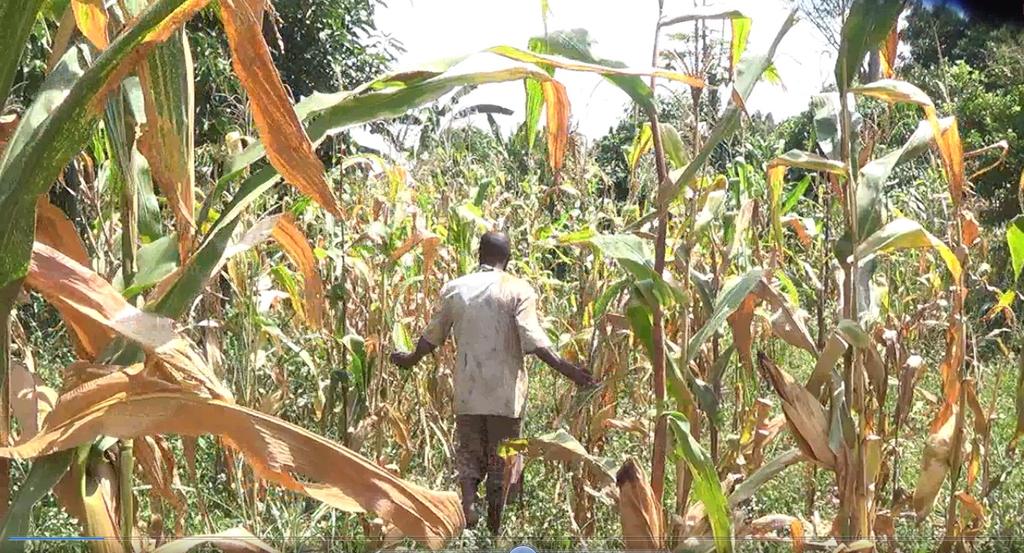
On Tuesday, November 14, a new alliance representing over 35 million family farmers are publishing new analysis which shows that small scale producers get just 0.3% of international climate finance even though they produce a third of the world's food.
The research also found that just a fifth of international public climate finance for food and agriculture supports sustainable practices. The food system accounts for a third of global emissions and is the main driver of biodiversity loss.
The UN Climate Summit will have a big focus on food this year with the COP28 Presidency urging governments to formally include food and agriculture in national climate plans and scale up finance. A new Global Adaptation Goal is also due to be agreed.
The farmers networks from Africa, Latin America, Asia and the Pacific say family farmers hold the key to climate proofing the food system but are being sidelined by funders and shut out of decision-making on food and climate.
The analysis of international public finance for climate mitigation and adaptation was
conducted by Climate Focus. A snapshot of spending in 2021 reveals:
- The agri-food sector received US$8.4billion in international public climate finance –
around half the US$16 billion spent on energy – with climate vulnerable and food
insecure countries such as Zambia and Sierra Leone getting just US$20 million each.
- Just 2% of international public climate finance (US$2 billion) was directed at
small-scale family farmers and rural communities – equivalent to around 0.3% of total
international climate finance from both public and private sources. Smallholders’
finance needs are estimated at US$170 billion per year in Sub-Saharan Africa alone.
- Only a fifth (19%) of international public climate finance spending on food and
agriculture was used to support sustainable and resilient practices such as
agroecology (US$1.6 billion). A fraction of the estimated US$300 - 350 billion a year
required.
The report, Untapped Potential, also shows that 80% of international public climate finance
spent on the agri-food sector is channelled through recipient governments and donor country
NGOs. This makes it harder for family farmer organisations to access because of complex
eligibility rules and application processes, and a lack of information on how and where to
apply. Family farmers received just a quarter (24%) of finance spent on the agri-food sector
in 2021.
Many family farmers lack the infrastructure, technology and resources to adapt to climate
impacts with serious implications for global food security and rural economies. Family farms
of less than two hectares produce a third of the world’s food (32%) while farms of 5 hectares
or less account for more than half of the global production of 9 staple crops - rice, peanut,
cassava, millet, wheat, potato, maize, barley and rye - and grow almost three-quarters of the
coffee and 90% of the cocoa. Over 2.5 billion people globally depend on family farms for
their livelihoods.
The Intergovernmental Panel on Climate Change says the most effective way to safeguard
food security is to shift to more nature friendly and diverse food systems. Family farmers are
at the forefront of these efforts. For example, in the Pacific farmers are planting breadfruit
trees alongside other crops as it is drought resistant, seldom uprooted by storms and
cyclones and produces a nutritious staple food crop.
