

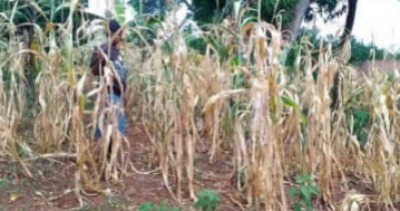
Farmers in Ibanda District are feeling the brunt of a prolonged dry spell that has scorched grazing lands, dried up wells, and withered crops, especially maize, before they could reach maturity.
The heatwave has left many worried about food shortages and the survival of their livestock as water sources continue to diminish.
“We have no more pasture for our animals, and our maize has dried before it can be harvested,” lamented Peter Kamukama, a livestock farmer in Kicuzi Sub-county. “The milk we used to sell daily has drastically reduced, and some of our animals are already showing signs of malnutrition.”
Several areas across Ibanda, including Nyabuhikye and Rukiri sub-counties, have reported complete drying up of shallow wells that once served as lifelines for both households and animals.
With the rising temperatures, water scarcity has become a growing concern, forcing farmers to travel long distances in search of alternative sources.
“This drought has hit us hard. We used to fetch water just a few metres from our homes, but now we walk over three kilometres to the nearest borehole,” said Aidah Katusiime, a smallholder farmer in Kagongo Division.
“Our animals are suffering, and it’s becoming too expensive to maintain them.”
In response to the growing crisis, the Ibanda District Agricultural Officer, Peter Bwengye Abaho, has urged farmers to adopt drought preparedness strategies as a long-term measure to cushion themselves from climate shocks.
“We encourage cattle keepers to grow pastures on at least one acre of land, which can be harvested and stored to feed animals during the dry season,” he said.
Abaho also emphasised the importance of water harvesting and storage to sustain livestock during prolonged dry periods. “Farmers need to invest in water storage facilities like tanks and underground reservoirs.
This is essential for ensuring animal health and productivity throughout the year,” he added.
The district agricultural office has started conducting awareness campaigns in the most affected sub-counties, educating farmers on sustainable farming practices, pasture management, and climate-smart agriculture.
The local government is also engaging with development partners to explore support options for affected communities.
Farmers are hopeful that with timely intervention and support, they can build resilience and adapt to the increasingly unpredictable weather patterns.
“If we get help in time, like drought-resistant seeds and advice on modern farming—maybe we can bounce back,” said Kamukama. “But for now, we are struggling to survive.”
