

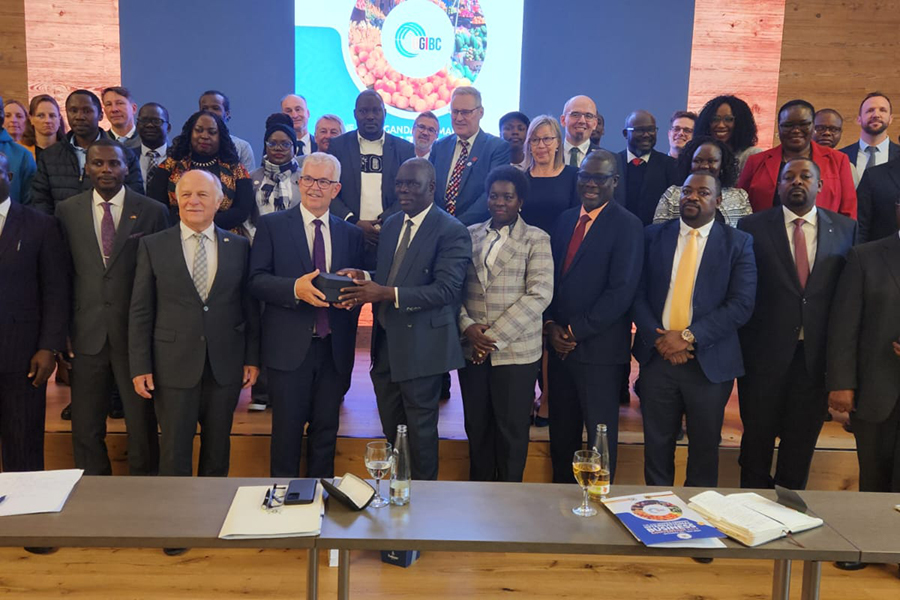
Senior Presidential Advisor on Trade, Phillip Kakuru, has called on investors from Munich, Germany, to explore business opportunities in Uganda.
Speaking at the Bayerisches Staatsministerium Conference Hall, Mr Kakuru emphasized the growing economic ties between Uganda and Germany and highlighted Uganda's untapped potential in various sectors.
The event, opened by the Vice Minister of the Bavarian Ministry of Food, Tourism, and Forestry, attracted business leaders and government officials from both countries.
The Bavarian Vice Minister conveyed his government's message, sharing key strategies that have driven Bavaria’s success, particularly in areas such as food security, natural resource preservation, sustainability, and ensuring sufficient income for farmers.
These pillars, according to the minister, could serve as a framework for Uganda's development, particularly in agriculture and rural economic empowerment.
Stephen Mubiru, Uganda's ambassador to Germany, stressed the deep historical ties between the two nations, dating back to the 1960s.
Mubiru emphasized the importance of strengthening these bonds through increased investment and collaboration, particularly in skilling Uganda's youth.
He called for partnerships between German companies and Uganda’s TVET (Technical and Vocational Education and Training) institutions, highlighting how these partnerships could empower Uganda’s growing workforce.
Kakuru, while addressing the gathering, placed significant emphasis on Uganda's thriving coffee industry.
He urged German coffee importers to consider processing Uganda’s coffee locally, as new environmental regulations from the European Union are limiting the export of African coffee to European markets.
By investing directly in Uganda, German companies could help alleviate these challenges while benefiting from Uganda’s high-quality coffee production.
In addition, Kakuru congratulated the Ugandan diaspora on Uganda's 62nd Independence Anniversary and encouraged them to invest back home through avenues such as government bonds, housing, and tourism.
He also called for Germany to employ Ugandan healthcare professionals, particularly nurses and midwives, to fill labor shortages in their healthcare system.
Bagonza Mohammed, Uganda’s Senior Presidential Advisor on Diaspora Affairs, also spoke at the event.
He outlined the role of Uganda’s State House Diaspora Unit in facilitating investment from Ugandans abroad.
He encouraged further investment in agriculture, ICT, education, and Uganda’s emerging oil and gas sectors.
The event ended with a mutual commitment from both Uganda and Germany to continue exploring ways to enhance economic collaboration, paving the way for a stronger partnership in the future.
