

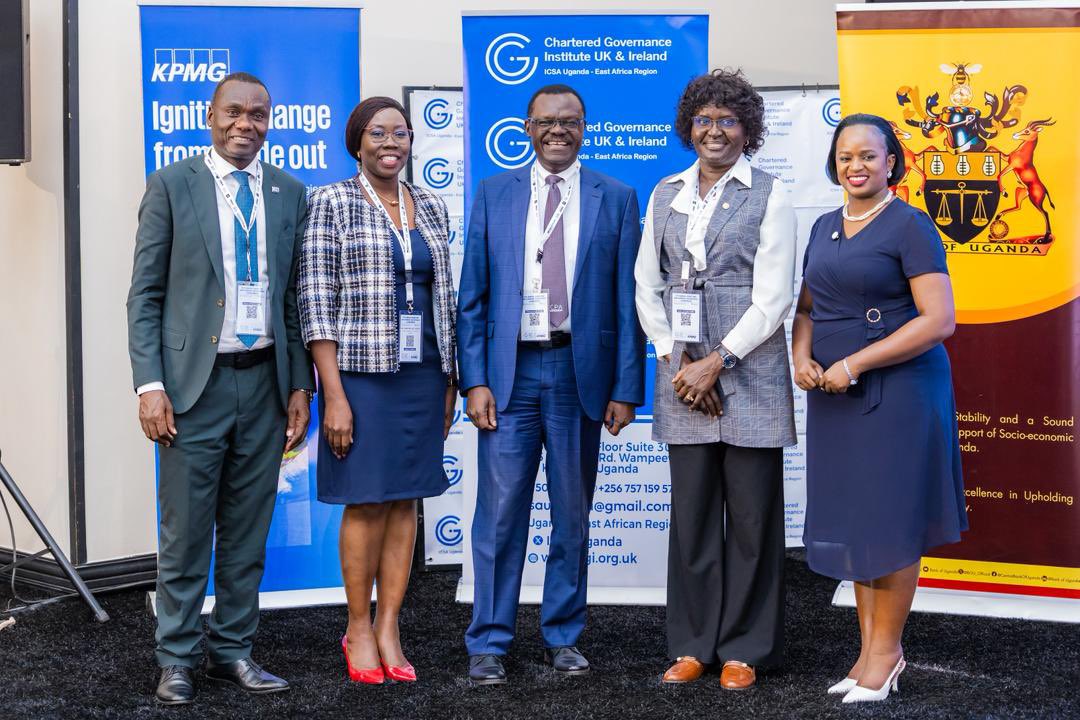
Corporate leaders have been urged to embrace Artificial Intelligence (AI) while prioritising strong governance frameworks to ensure its safe, ethical and sustainable use.
Speaking at the 15th Annual Directors and Company Secretaries Conference organised by the Institute of Chartered Secretaries and Administrators (ICSA) Uganda in partnership with KPMG Uganda, the Chief Executive Officer of the Capital Markets Authority, Josephine Okui Ossiya, said AI is already embedded in everyday operations across institutions.
The conference was held at Mestil Hotel under the theme “Corporate Governance: The Bridge to Artificial Intelligence.”
Ossiya emphasised that the debate is no longer about whether AI will transform institutions, but how it should be governed.
“The question now is not whether AI will transform the institutions we are in, but how to govern it,” she said. “AI generates intelligence, but corporate governance generates wisdom. That is what will create sustainability in its use.”
She warned that without governance, AI can become volatile and risky. However, with proper oversight, it can drive value, efficiency, accountability and trust.
According to Ossiya, corporate governance provides the bridge that enables AI to scale safely, ethically and profitably. She called on organisations to establish clear AI policies, defined roles, internal controls, monitoring systems and audit mechanisms.
“You must be able to demonstrate how AI-generated outcomes are reached. That raises issues of evidence, audit trails and independent assurance,” she said.
Ossiya noted that unlike previous technologies, AI introduces new challenges such as opaqueness, where systems are not easily explainable. She added that while human error may affect a handful of people, automated errors can impact thousands simultaneously.
She urged organisations to formally introduce AI discussions into boardrooms to strengthen oversight.
The Managing Director of National Social Security Fund (NSSF) Uganda, Patrick Ayota, said AI adoption is accelerating globally and locally, citing applications such as biometric authorisation, navigation systems and autonomous vehicles.
“The question is not what AI can do, but what it should do,” Ayota said. “Embrace it and manage it. It is here—you cannot hold it back.”
However, he cautioned that organisations must address ethical concerns including algorithmic bias, transparency in decision-making, data privacy and cybersecurity threats.
“There is an increased risk of data breaches. We need strict data access controls and stronger vendor governance,” he said.
Ayota encouraged companies to foster a human-AI partnership rather than viewing AI as a replacement for employees.
“We should stop thinking of AI as a replacement and instead see it as a collaborator. That requires redefining roles and investing in training,” he said.
He also warned directors and company secretaries about the growing threat of deepfakes and urged organisations to invest in AI literacy, integrate AI risks into enterprise risk management frameworks and formalise oversight by making AI a standing board agenda item.
“History will remember those who governed AI well,” Ayota said.
The Chairperson of Institute of Chartered Secretaries and Administrators (ICSA) Uganda, Jane Okot P’Bitek Langoya, said many organisations are already using AI—sometimes unknowingly—but have yet to elevate it to a strategic board-level issue.
“AI is here and will take over some roles, but we must reskill staff so they work alongside it rather than be displaced,” Langoya said.
She noted that AI lacks human judgment and emotion and can inherit biases from its training data, underscoring the need for careful management.
“There are ethical risks such as deepfakes. Organisations must ensure they do not engage in unethical AI practices,” she added.
Langoya called for an open mindset among leaders and employees to adapt and strengthen their capabilities in an AI-driven environment.
The Country Leader of KPMG Uganda, Stephen Ineget, said AI is reshaping global markets amid economic volatility and rapid technological advancement.
“Innovation must not outpace oversight,” Ineget said. “AI improves operational efficiency and unlocks growth opportunities, but it also introduces risks such as regulatory uncertainty, cybersecurity threats and data privacy concerns.”
He stressed that organisations have a responsibility to establish governance frameworks to monitor, assess and audit AI systems to ensure alignment with corporate strategy and stakeholder interests.
“AI must be governed, controlled, monitored, checked and audited,” he said.
Ineget added that directors and company secretaries must put in place robust frameworks, policies and procedures, while recruiting competent professionals capable of managing AI-related risks.
The conference aims to strengthen the capacity of directors and company secretaries to responsibly adopt and oversee Artificial Intelligence in their organisations.
