

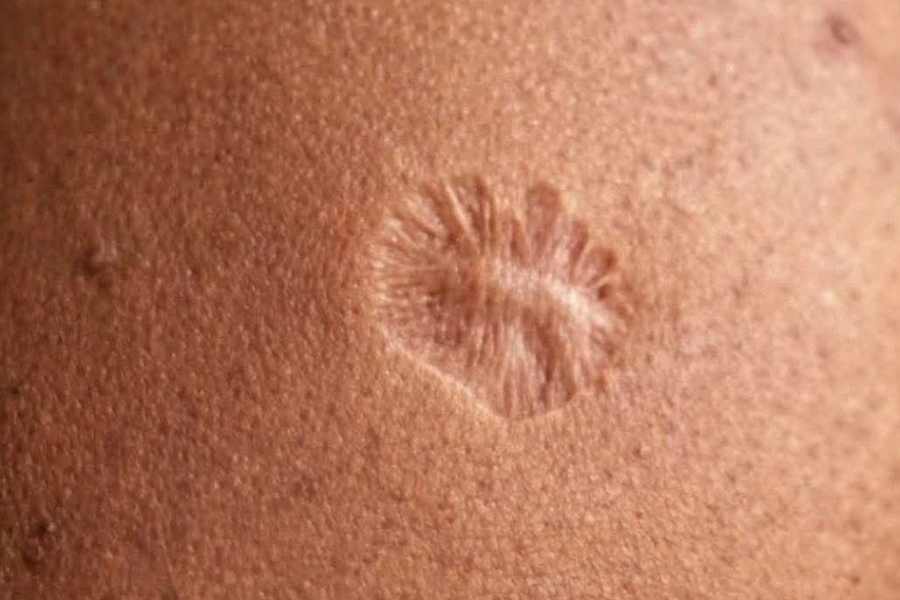
A close look at many older adults’ upper left arms reveals a small, round, often slightly sunken scar with a textured centre. For decades, this mark has sparked curiosity, confusion, and even superstition. In reality, it is a medical relic of one of humanity’s most successful public health campaigns: the eradication of smallpox.
The scar originates from a vaccine that was fundamentally different from modern injections. The smallpox vaccine used a live vaccinia virus, administered not through a single needle injection, but through a bifurcated needle that punctured the skin multiple times in a tight circular pattern.
The aim was not simply to deliver a dose, but to deliberately trigger a localised, controlled infection in the skin.
This process caused a predictable sequence of reactions. Within days, the site would develop a small bump, followed by a blister, then a pustule, before finally drying into a scab that eventually fell off. What remained was a permanent scar, formed as the body repaired the deeper skin damage caused by the immune response.
The distinctive circular shape and sometimes radiating texture are the result of clustered punctures and the way skin contracts during healing. Health workers of the time even used the appearance of the scar as proof that the vaccine had successfully “taken,” meaning the body had developed the intended immune response.
Not all scars look identical. Some are deeply sunken, while others appear raised or smoother. This variation depends on individual healing responses, skin type, and how strongly the immune system reacted at the injection site.
In contrast, other vaccines such as BCG, used against tuberculosis, typically leave a raised mark rather than a depressed one, adding to common confusion between the two.
Over time, several myths have grown around the smallpox vaccination mark. One persistent belief is that the scar indicates a past infection with smallpox itself. This is incorrect. The mark signifies protection from the disease, not the disease itself.
Another misconception is that the scar contains a lingering virus or serves as a form of permanent biological tracking. In reality, the vaccinia virus does not remain active in the body once the healing process is complete.
In some communities, the mark has also been interpreted through cultural or spiritual lenses, sometimes viewed as a mysterious imprint or foreign identifier. These interpretations largely arose because the vaccination campaigns of the mid-20th century were widespread but not always well explained to recipients.
Smallpox vaccination was discontinued globally after the disease was declared eradicated in 1980. As a result, the scar is now largely found among older generations who were immunised before routine vaccination stopped.
Today, the small circular mark stands less as a medical curiosity and more as a quiet historical record on the human body—a reminder of a time when a global disease was brought to an end through one of the most ambitious vaccination campaigns in history.
