

The National Social Security Fund (NSSF) has formally written to the Ministry of Finance, Planning, and Economic Development seeking approval to channel a portion of members’ savings directly into government-led development programs.
The move aligns with the Fund’s 10-year strategy to nearly double its assets under management from the current Shs26 trillion to Shs50 trillion.
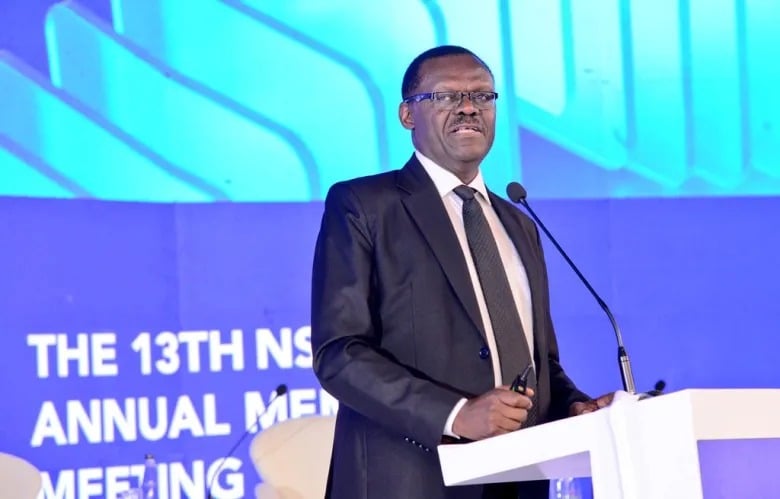
“Our long-term ambition is clear,” said NSSF Board Chairperson David Ogong.
“We want to grow the Fund in a way that creates value not only for our members but for the wider economy. By investing in government programs, we can play a bigger role in transforming Uganda while protecting member savings.”
NSSF has shown steady growth, reporting a 17.5% increase in assets during the 2024/2025 financial year to Shs26 trillion.
Traditionally, the Fund invests heavily in Uganda’s financial markets, select East African Community stock exchanges, local real estate, and government debt, making it the country’s single largest lender.
At the Fund’s 13th Annual Members’ Meeting on Monday, Managing Director Patrick Ayota underscored NSSF’s readiness to support large-scale national projects, including the Jinja Expressway, if granted approval.
“NSSF can provide sustainable, long-term financing that reduces Uganda’s dependence on external borrowing,” Ayota said.
The Ministry of Finance recently declared a 13.5% interest rate for NSSF members for 2024/2025, up from 11.5% the previous year, following earnings growth of 11% to Shs3.52 trillion.
Ayota noted that broadening domestic investment opportunities could further strengthen returns.
The legal framework guiding the Fund imposes strict investment limits: government securities within the EAC may account for up to 80% of assets, equities in listed companies up to 70%, while real estate, fixed deposits, and corporate bonds are capped at 30%.
Private equity is limited to 15%, and cash holdings to 5%.
Chief Financial Officer Stevens Mwanje highlighted NSSF’s operational efficiency as a key pillar of success.
“For FY 2024/25, we cut our cost-to-income ratio to 7.9%, a 16% reduction, and lowered administrative costs to 0.88%. We achieved this without compromising growth, demonstrating our commitment to efficiency and value creation,” Mwanje said.
An independent True Value Assessment by KPMG illustrated the Fund’s broader economic impact. Over the last decade, NSSF contributed Shs60 trillion to the national economy.
For FY 2024/25 alone, its activities supported Shs32 trillion in economic value and generated 1.9 million jobs.
Ogong emphasized that if approved, the proposal could redefine the relationship between NSSF and Uganda’s development agenda.
“This is a win-win opportunity. Members gain stronger, sustainable returns, while Uganda secures reliable financing for its most pressing programs,” he said.
