

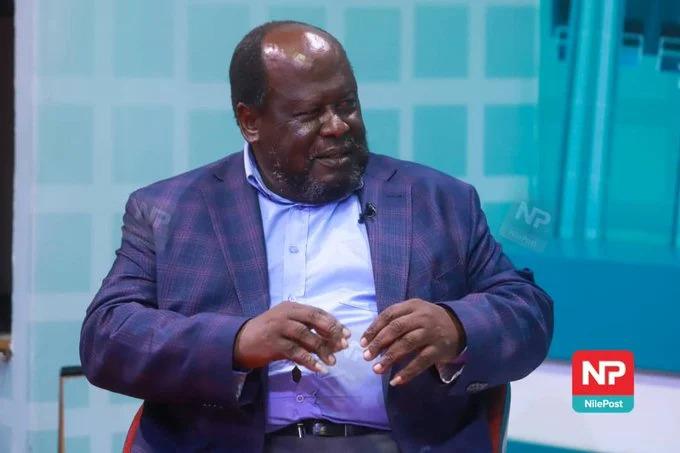
Former Leader of Opposition and veteran politician Professor Morris Ogenga Latigo has questioned the National Resistance Movement’s (NRM) true motives in Acholi, arguing that the recent defection of several opposition MPs to the ruling party raises more questions than it answers.
In his latest reflections titled Protecting the Gains, Ogenga wonders whether these political shifts represent “a super deal or super desperation — or perhaps both.”
“Borrowing from Odonga Otto’s recent assertion that we should ‘blame local leadership, not Museveni,’ I find that these crossovers have had no tangible impact on our region,” Ogenga wrote.
“The issues of war debt compensation, poverty, and infrastructure remain unresolved while politics continues as usual.”
Ogenga cautioned that while leaders must be accountable, President Yoweri Museveni is far from a passive observer in the process.
“He is a strategist of absorption, a master of co-optation — a man who builds alliances not on trust, but on leverage,” he wrote.
He noted that Museveni’s renewed focus on Acholi comes at a time when Buganda, traditionally a political powerhouse, is increasingly disillusioned with the ruling establishment.
“Why would Acholi MPs choose Museveni over Buganda? Because Buganda, at this moment, is not offering a cushion. Buganda is bitter, fractured, and disillusioned,” Ogenga observed.
According to him, the so-called “gains” that Museveni once promised have already evaporated.
“Their silence is now resistance. Their loyalty is now memory,” he wrote, adding that the president has turned northward to seek new political survival.
Ogenga warned that Museveni’s offers of roads, appointments, and vague promises of federalism are designed to “stir hope but never deliver it,” citing historical examples of betrayal in Uganda’s post-war politics.
“In 1985, the Nairobi Peace Agreement between Tito Okello’s government and Museveni’s NRA was signed — and then broken. In 1988, after the UPDA peace deal, Museveni absorbed some rebels, sidelined others, and dismantled the movement. With Joseph Kony, he flirted with peace talks, but peace was never the goal — containment was,” Ogenga wrote.
He argued that MPs aligning with the NRM today are not signing political partnerships but “signing silence.”
“There’s a paradox in a system built on patronage. Proximity to power means survival, but it also means the erosion of local voice, the dilution of federal dreams, and the branding of our pain as progress,” he warned.
Quoting a local elder, General Yengtong, Ogenga added: “The president is desperate — but so are we. And desperation is a dangerous place to negotiate from.”
He concluded by challenging Acholi leaders to reflect deeply on their legacy: “Are our MPs building a bridge or laying down as a landing mat? Are they midwifing federalism, or burying it for short-term gain? The North must decide — do we want to be remembered as the region that saved Museveni’s fall, or as the region that redefined Uganda’s future?”
