

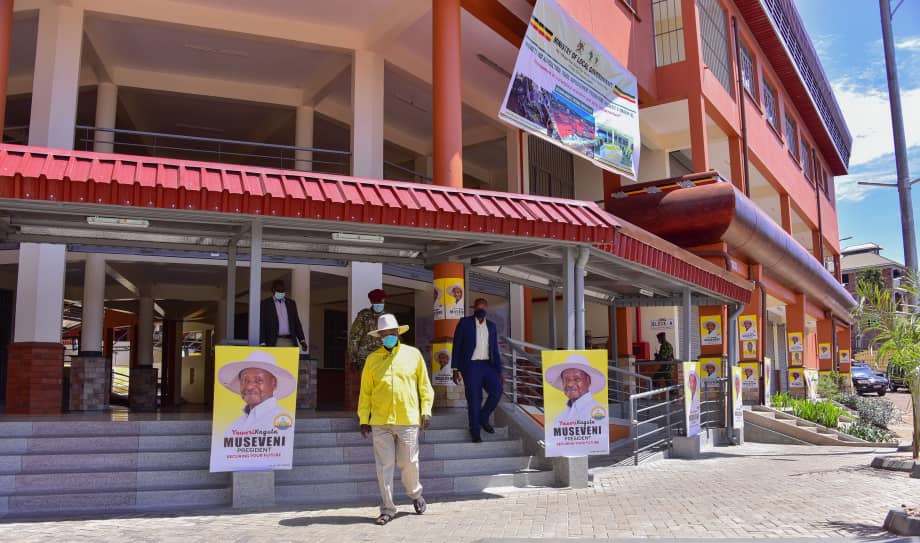
President Museveni has explained that markets are the starting points for low income earners who want to learn how to do business in the country.
“This market is the starting place for low-income earners. Someone with little capital which can only enable them purchase tomatoes can come to sell them from here before moving elsewhere when he becomes rich,”Museveni said on Tuesday while commissioning the new Kitooro market in Entebbe, Wakiso district.
Equating the market to a school set up, Museveni explained that after learning business and becoming richer, the person who started off as a low-income earner can upgrade from the market to start business elsewhere, noting that the markets ought to remain public facilities as opposed to being owned by private individuals.
“If this government-aided primary school(read market) is made private, where will the other students(upcoming low-income earners) study from? “
Making a case for the Emyooga presidential initiative on job and wealth creation, the President said the new project will help low-income earners like market vendors get some capital to enable them inject into their businesses for survival.
“That’s why government has put in place the emyooga initiative for people like market vendors and it is a grant that you won’t be paying back. Use it to develop yourselves,” he said.
The Emyooga initiative targets Ugandans especially in the informal sector who come together in form of saccos under 19 clusters including Boda boda riders, taxi drivers, restaurants, welders, market vendors, women entrepreneurs, youth leaders, people with disabilities, journalists, performing artists, veterans, fishermen, and elected leaders.
Each of the saccos will receive shs30 million as seed capital.
The State Minister for Primary Education, Rosemary Sseninde who represented the Local Government Minister Raphael Magyezi said that in a bid to contribute to wealth creation and employment among Ugandans, government is providing opportunities and conducive environment for the less privileged member of the society to work and earn a living.
“Government came up with a policy or markets redevelopment and management where it was agreed that they will never be sold to investors but give sitting vendors chance to redevelop them on condition that they can mobilise funds to construct modern structures,” the minister said.
“In the event vendors are unable to raise the required funds to modernize the markets, they shall be free to identify a private partner with whom they can pool resources.”
According to the minister, the Central and Local Governments can as well develop the markets and give priority in the allocation of facilities to the sitting or existing vendors.
Kitooro market
The Shs 29.1 billion modern Kitooro market has over 950 facilities including 268 lockup shops, 560 stalls, restaurants, banks, clinics, salons, fruit and vegetable stands, butcheries, and a daycare centre, as well as a CCTV camera connection.
The multi-billion modern market also has a community hall, paved parking area, solar hybrid system firefighting equipment, public address system, ATM machines, advertising spaces and a police booth among other facilities.
The new market is part of the 12 modern markets being constructed by government around the country under the Markets and Agriculture Trade Improvement Project (MATIP) and implemented by the Ministry of Local Government.
Museveni has earlier commissioned five other modern markets in Soroti, Busia, Lugazi, Kasese and Tororo, all constructed under the Markets and Agriculture Trade Improvement Project.
