

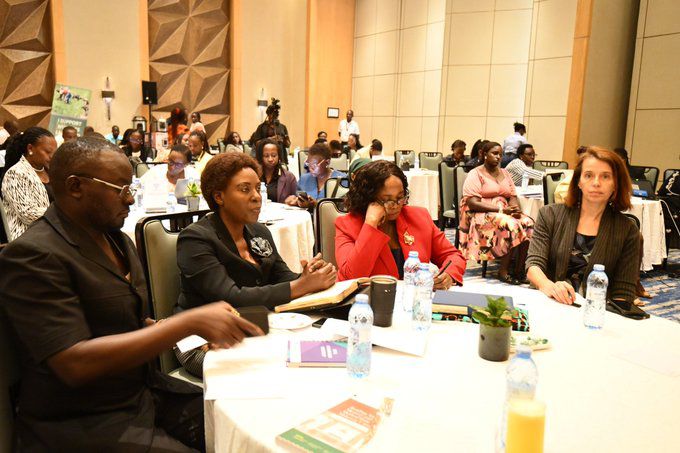
The Commissioner for Gender and Women Affairs at the Ministry of Gender, Labour and Social Development, Ms Angella Nakafero, has raised concern that unpaid care and domestic work remains a major barrier to women’s economic empowerment in Uganda.
Speaking during the dissemination of research findings in Kampala, Nakafero said women and girls continue to spend significantly more time on unpaid household responsibilities than men, limiting their participation in income-generating activities and broader economic development.
The study, conducted by Uganda Women’s Network in collaboration with Oxfam in Uganda and academic institutions between 2023 and 2025, examined government responses to unpaid care and support work in both Kampala Metropolitan and Gulu.
It focused on activities such as childcare, cooking, fetching water, caregiving and overall household management, all of which remain largely unrecognised in formal economic planning.
According to the findings, women continue to shoulder the bulk of unpaid labour both at home and in some public settings, reducing time available for business, education and productive work.
“More time spent on unproductive work definitely reduces the time spent on productive work and indirectly affects the amount of income somebody can earn at the end of the day,” Nakafero said.
She noted that although unpaid care work remains largely invisible in national statistics and planning frameworks, government interventions are gradually helping to reduce the burden.
She cited improved access to clean water as one of the key achievements, saying it has reduced the long distances women and girls previously walked to fetch water.
“We no longer walk 10 kilometres to fetch a jerrycan of water. Increasingly, communities are able to access water within one kilometre or even within their homes,” she said.
Nakafero also pointed to investments in cleaner cooking energy and agricultural technologies as interventions helping women save time and reduce exposure to health risks linked to traditional domestic work.
She noted that reliance on firewood has historically contributed to respiratory illnesses due to indoor air pollution, while also consuming large amounts of time spent collecting fuel.
The study further acknowledged government expansion of health services as a positive step in reducing caregiving pressures on families. However, it noted that women still remain the primary caregivers when family members fall sick.
“In most cases, when someone is sick, it is a woman who takes care of that person, meaning women continue losing productive time,” the report stated.
The research also assessed government programmes such as the Parish Development Model (PDM), the Generating Growth Opportunities and Productivity for Women Enterprises (GROW) Project, and the Uganda Women Entrepreneurship Programme (UWEP).
According to Ms Susan Achen, Programme Coordinator for Women’s Rights and Access to Justice at Uganda Women’s Network, some of these initiatives are beginning to integrate responses to unpaid care challenges.
She said the GROW Project, in particular, has introduced childcare and social norm interventions to enable women to participate more fully in business activities.
“The project is promoting childcare centres in markets and trading centres so that women can safely leave their children as they work,” she said.
The study found that the Parish Development Model, which allocates 30 per cent of its resources to women, has also improved access to financing and economic opportunities for women.
Researchers noted that although UWEP does not directly address unpaid care work, beneficiaries have used funds to hire labour, employ farm workers and invest in labour-saving technologies such as ox-ploughs and solar dryers.
However, the report warned that entrenched social norms continue to limit women’s economic participation, with some communities still expecting women to remain primarily in domestic roles.
“Some communities still believe women should remain in domestic spaces, while others associate women’s financial independence with family conflict,” Achen said.
The study further noted that unpaid care responsibilities often prevent women from attending government sensitisation meetings and enterprise training sessions.
“Sometimes women are invited to attend barazas, but they cannot leave household duties to participate,” Achen added.
Researchers recommended stronger government action across sectors, including increased investment in water infrastructure, childcare services, healthcare, education and affordable labour-saving technologies.
They also called for public awareness campaigns to encourage more equitable sharing of domestic responsibilities between men and women.
Nakafero stressed that addressing unpaid care work requires coordinated effort from government, communities and development partners.
“If these challenges are not addressed deliberately, women may continue participating in business but fail to grow from micro enterprises into sustainable medium businesses,” she warned.
