

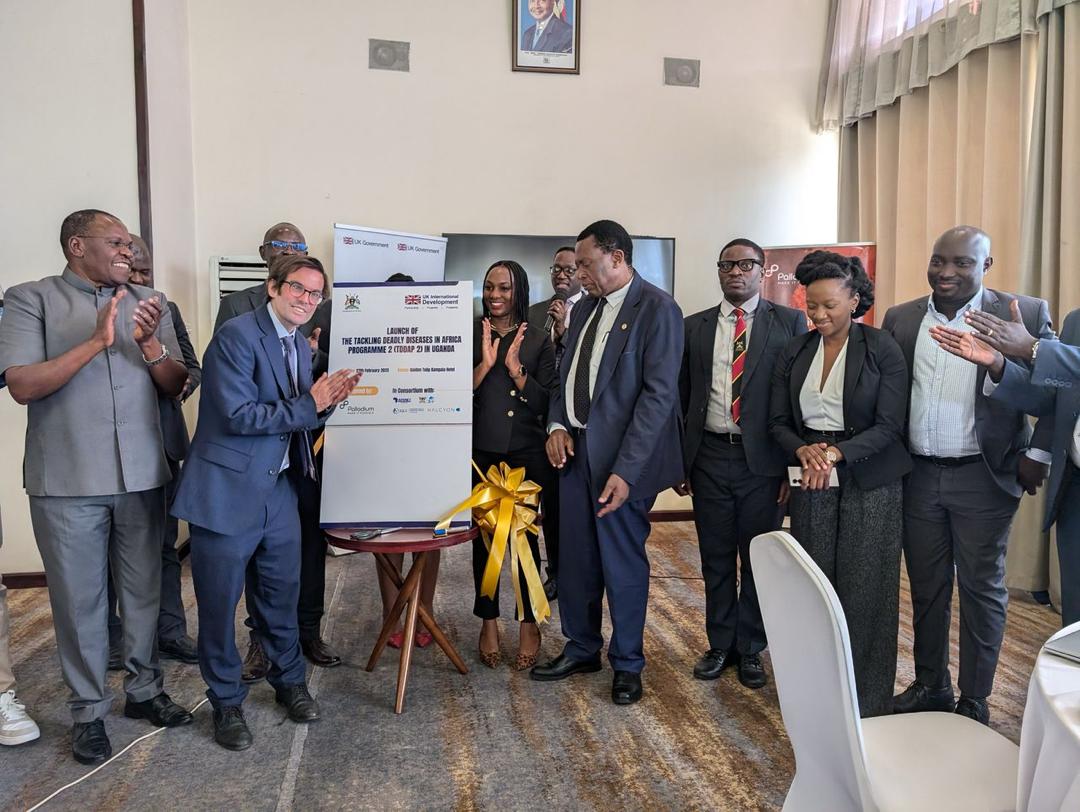
The British High Commission in Uganda has launched the second phase of the Tackling Deadly Diseases in Africa Programme (TDDAP2), a £19 million, four-year initiative aimed at strengthening Uganda’s preparedness for future disease outbreaks.
Speaking at the launch event in Kampala, Phil Elks, Health Programs Manager at the British High Commission, emphasised the urgency of investing in disease prevention, citing increasing outbreaks driven by climate change and population growth.
“This is a crucial program. Disease outbreaks pose serious health and economic risks for Uganda, and the time to act is now. The UK is committed to working with the Ugandan government to enhance preparedness and response capacity,"he said.
TDDAP2 will focus on research, workforce development, and strengthening Uganda’s ability to respond swiftly to future outbreaks.
The program will adopt a One Health approach, which recognises the link between human, animal, and environmental health.
Elks highlighted the importance of monitoring zoonotic diseases, which originate in animals before spreading to humans, as a key strategy for outbreak prevention.
Uganda is currently in a 42-day countdown to being declared Ebola-free, following the discharge of the last case on February 19.
However, health officials remain vigilant.
At the launch, Dr. Charles Olaro, Acting Director General at the Ministry of Health, emphasized Uganda’s vulnerability to disease outbreaks and the need for community engagement in response efforts.
“As a country and a region, we are prone to outbreaks. Communities must be empowered to take an active role in response efforts and protect themselves.”
The program will also strengthen animal health laboratories to improve early detection of infections.
“Most outbreaks have zoonotic origins, so we must address both human and animal health to prevent spillovers,” Olaro noted.
The Ministry of Health reaffirmed its commitment to international health regulations and called on the public to support government-led prevention measures.
TDDAP2 is being implemented by Palladium in collaboration with the Infectious Diseases Institute (IDI), African Field Epidemiology Network (AFENET), Halcyon Consulting, and Integrated Quality Laboratory Services (IQLS).
The initiative extends beyond Uganda, providing long-term technical support to the Democratic Republic of Congo, Ghana, Kenya, and Malawi.
During the launch, stakeholders from Uganda’s government and the UK Foreign, Commonwealth & Development Office (FCDO) emphasized the program’s role in strengthening national capacity to implement Uganda’s National Action Plan for Health Security, with a focus on climate considerations, gender equity, and social inclusion.
Dr. Rose Ademun, Commissioner of Animal Health at the Ministry of Agriculture, welcomed the UK’s ongoing support in tackling infectious diseases and antimicrobial resistance.
“This program builds on our existing collaboration to combat zoonotic diseases, which pose a significant public health risk,” she said.
Timothy Lubanga, Commissioner for Monitoring and Evaluation at the Office of the Prime Minister, described TDDAP2 as “exceptionally timely,” aligning with Uganda’s recently launched National Action Plan for Health Security II, which aims to strengthen compliance with International Health Regulations (IHR).
