

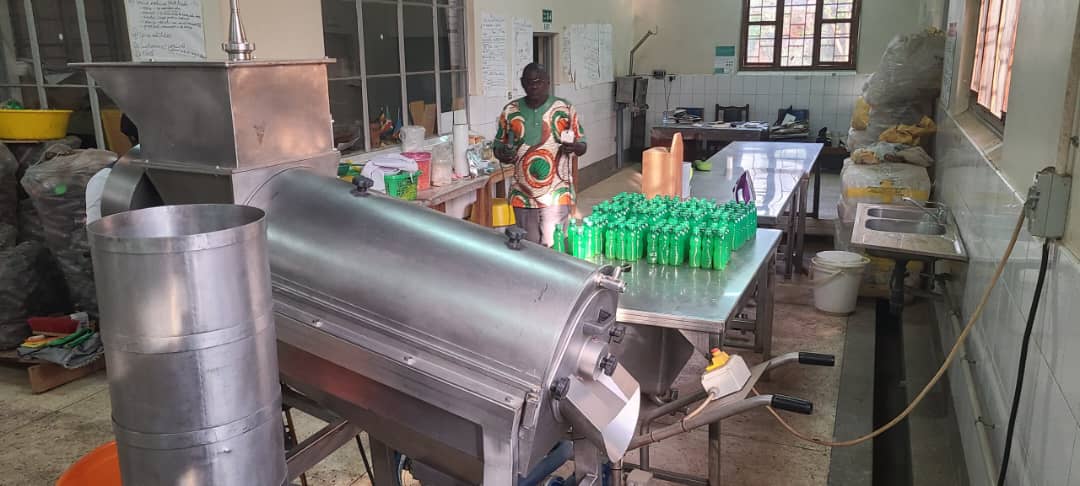
Nearly 13 years after President Museveni commissioned the Nile Natural Fruit Juice Factory, the facility has yet to reach its full operational capacity.
The factory’s proprietor, Emmanuel Ajedra, says the facility was commissioned before it was ready for production and that several machines promised at the time were never delivered.
According to Ajedra, the project has already received significant investment but still requires additional funding to operate at full capacity.
“I am in production but not to full capacity. Already between Shs8 billion and Shs9 billion has been injected into this project. For it to become fully operational, I need to complete several phases totaling about Shs10.5 billion,” he said.
The factory has the potential to employ more than 80 workers and produce up to 1,600 litres of juice per day during an eight-hour shift.
Despite earlier support from the Uganda Industrial Research Institute, which invested approximately Shs1.2 billion, the facility currently remains largely idle. Several machines supplied under the project are reportedly at risk of rusting due to prolonged inactivity.
Ajedra attributes the slow progress partly to the high cost of borrowing from financial institutions such as the Uganda Development Bank.
“It is very expensive. The interest rate is around 11 percent, and with insurance it can rise to about 15 percent. What I need is a loan facility of between 2 and 3 percent,” he said.
The factory was officially commissioned on December 19, 2013, but Ajedra insists the facility was not ready for operations at the time.
By early March 2026, only a few green bottles of lemon juice are displayed at the factory in Arua City, offering a glimpse of what the facility could produce if it were fully operational.
Local residents have also raised concerns about the stalled project. One resident, Swalik Musema, partly blamed government authorities for failing to adequately supervise the initiative.
“Government should not just commission projects and then leave them without proper follow-up or leadership,” he said.
The machines procured by the government are currently lying idle at the facility located in Ayivu East Division of Arua City.
When fully operational, the factory was expected to boost agro-processing in the West Nile sub-region, creating jobs and providing a ready market for local fruit farmers.
The facility’s production plan focuses primarily on mango juice from eight mango varieties, with future expansion into processing other fruits including tamarind, lemon, soursop and hibiscus.
The Arua City Production Officer, Joseph Ayaba, said local authorities have repeatedly raised concerns about the stalled factory.
“When we came into office in 2021, the factory was one of the key assets we reviewed, and we found that it had many challenges,” Ayaba said.
However, Bernard Atiku, who was the area Member of Parliament when the factory was commissioned, faulted the proprietor for failing to open up ownership of the project to other potential investors.
According to Atiku, broader shareholder participation could have helped mobilize additional capital needed to fully operationalize the facility.
So far, approximately Shs9 billion has been invested in the project, but experts estimate that an additional Shs9 billion to Shs10.5 billion would be required to make the factory fully operational, including acquiring equipment to manufacture its own bottles.
