
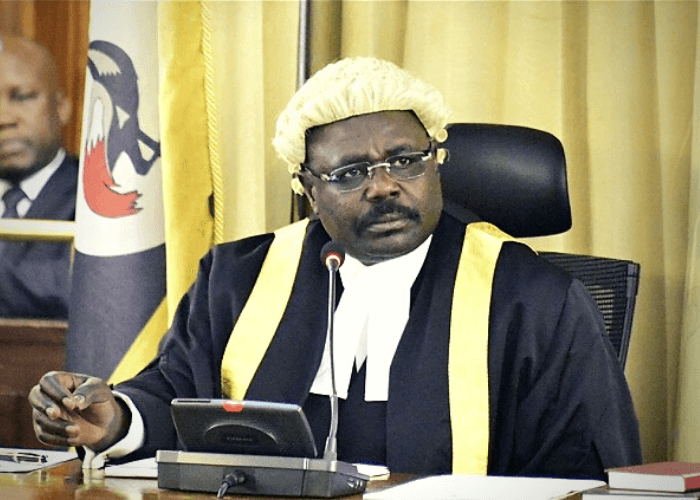
On March 20, 2022, Uganda woke to the news that its sitting Speaker of Parliament, Jacob L’Okori Oulanyah, had died at a hospital in Seattle. He was 56. The announcement, made by President Museveni, placed the time of death at around 10:30am East African Time, closing a chapter on one of the country’s most prominent legal and political careers.
Museveni described Oulanyah as a “good cadre” and a leader whose trajectory suggested far greater national influence lay ahead.
“Oulanyah was young but had already made impact,” he said at the state funeral held at Kololo Independence Grounds. “Losing him at this time is a big loss because he was coming up and the country was going to benefit from him.”
Born in 1965 in what is now Omoro District, northern Uganda, Oulanyah trained as a lawyer and rose to prominence through both the courtroom and Parliament. He served multiple terms as Member of Parliament for Omoro County South and built a reputation as a skilled debater and constitutional lawyer.
Before becoming Speaker, he was Deputy Speaker from 2016 to 2021, a role in which he presided over contentious legislative debates and positioned himself as a steady hand within the ruling National Resistance Movement (NRM).
His election as Speaker in May 2021 marked a significant political shift. In a closely watched contest, Oulanyah defeated long-serving Speaker Rebecca Kadaga with 310 votes to 197, consolidating NRM influence in Parliament and reinforcing his standing as a key political figure from northern Uganda.
Analysts at the time linked his victory to broader regional calculations following the 2021 general elections.
Yet his tenure as Speaker lasted less than a year. By 2021, concerns about his health had already begun to surface.
According to Jane Ruth Aceng, Oulanyah’s illness dated back to 2019, when he noticed a swelling in his neck. His condition reportedly worsened over time, eventually leading to his transfer abroad for specialized treatment, where he later succumbed to multiple organ failure.
His death, however, was not without controversy. At his burial in Lalogi village, Omoro District, his father, Nathan Okori, publicly rejected the official explanation, alleging foul play. He told mourners that his son had been poisoned and had undergone medical procedures in an attempt to counteract the alleged toxins.
“I am not mourning in vain. I want to state clearly that Jacob was poisoned. He told me that he was operated on as doctors attempted to deal with poison. It affected his health so badly and by the time he was flown out he was not in position to recover,” Okori told mourners on April 8, 2022.
The claims prompted police interest, but no conclusive findings were ever publicly established, and the matter faded without formal resolution.
Oulanyah’s send-off reflected his stature in national life. It included a state funeral at Kololo, a special parliamentary sitting, and a series of vigils at his residence in Muyenga.
Tributes from across the political divide emphasized not only his legal mind but also his wit and ability to navigate Uganda’s often fraught parliamentary politics.
Five days after his death, Parliament elected Anita Among as his successor, with 401 votes against 66 for Asuman Basalirwa. The transition was swift, underscoring both the institutional need for continuity and the political weight of the office Oulanyah had briefly occupied.
Four years on, Oulanyah’s legacy continues to be invoked by colleagues and political actors. Among has described him as a source of “wise counsel, guiding leadership, and humour that always brought us joy,” reflecting on the enduring personal and institutional imprint he left behind.
“Days have stretched into months, and months into years since we lost you to death's cold grasp. May you find eternal peace and rest in the company of angels, Ladit,” she wrote on her X (formerly Twitter) account.
Meanwhile, Norbert Mao has used the anniversary to frame broader reflections on Uganda’s political trajectory, hinting at a moment of transition and uncertainty.
Oulanyah’s story remains one of rapid ascent and abrupt loss—a lawyer who rose to the apex of legislative power, only for his tenure to be cut short at a moment when his influence appeared to be consolidating.
In Uganda’s political memory, his life is not only recalled for what he achieved, but also for what many believe he might yet have become.
