
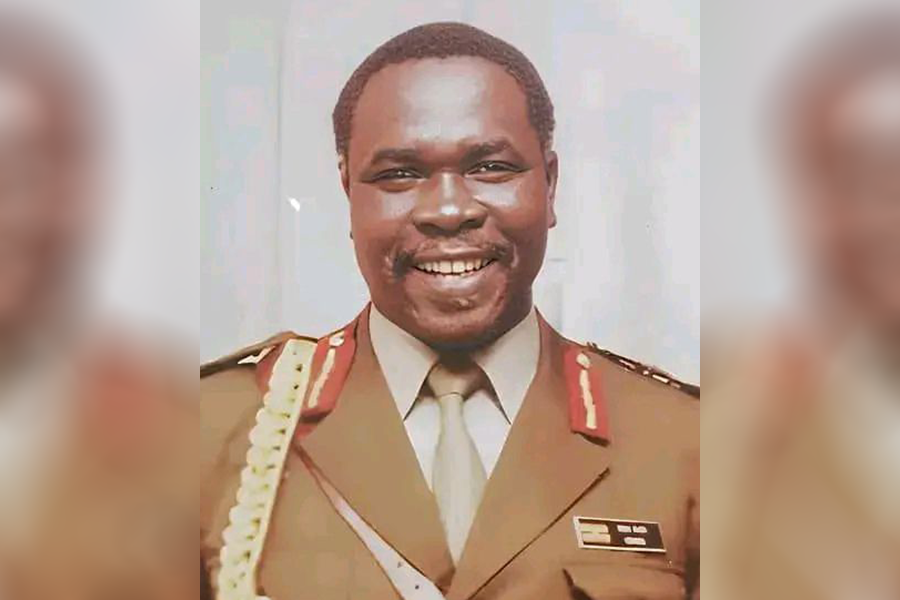
Forty-two years ago, on December 2, 1983, Uganda lost one of its most consequential and controversial military figures when Maj Gen David Oyite Ojok died in a helicopter crash at the age of 43.
Born on April 15, 1940, in northern Uganda, Oyite Ojok had risen from a young soldier in the 1960s to one of the most powerful men in the country by the early 1980s.
His sudden death sent shockwaves through the political establishment and altered the course of the country’s already fragile trajectory.
Oyite Ojok’s career was deeply intertwined with Uganda’s upheavals. As a senior commander of the Uganda National Liberation Army (UNLA), he played a central role in the 1979 war that toppled Idi Amin.
His battlefield leadership, particularly during the Tanzanian-backed push toward Kampala, cemented his reputation. International wire reports at the time frequently described him as “one of the most capable battlefield commanders” during the anti-Amin war.
After Amin’s ouster, the Military Commission—chaired by Paulo Muwanga and including Oyite Ojok—oversaw the country’s transitional governance.
The commission wielded immense influence, and as army chief of staff, Oyite Ojok became a decisive voice within the post-Amin state. When Milton Obote returned to power after the 1980 elections, Oyite Ojok became his most trusted military ally.
His authority extended far beyond the barracks, giving him political leverage that few could rival as Chief of Staff of the Uganda National Liberation Army (UNLA).
But his legacy was not solely defined by state-building. As guerrilla movements—most prominently Yoweri Museveni’s National Resistance Army (NRA)—challenged Obote’s government, Oyite Ojok directed aggressive counter-insurgency campaigns.
Human rights organisations and opposition politicians frequently accused the UNLA under his command of carrying out heavy-handed operations, especially in the Luweero Triangle.
Foreign correspondents of the era described him as “feared and uncompromising,” a commander determined to crush rebel activity at any cost.
Even his allies recognised his centrality to the regime. One account cites a ferocious exchange with President Obote over control of coffee exports, where Oyite Ojok reportedly reminded the president that “it was because of him and the army that he (Obote) was still in power” – a quote that captured both his confidence and the fear he inspired within the political class.
On the morning of December 2, 1983, Oyite Ojok boarded a Bell helicopter on a mission linked to operations against NRA rebels.
The aircraft burst into flames shortly after takeoff near Kasozi Ka Mirembe – the “hill of peace” – in Nakitoma, killing him and nine other officers.
Initial reports were confused. NRA sources claimed they had shot down the helicopter. President Obote, in a statement on December 5, 1983, firmly rejected that version.
“Some people say the bandits shot the helicopter, others say it was a piloting error, but I assure you, it was a result of mechanical fault," Obote said. "But whichever angle you look at it, it was a disaster.”
The word “disaster” was no exaggeration. His death removed the regime’s most capable commander at a critical moment.
Analysts argue that the loss of Oyite Ojok weakened Obote’s grip on both the battlefield and the barracks, deepening rivalries between Langi and Acholi officers in the UNLA and setting the stage for the 1985 coup that toppled Obote’s government.
In its announcement, the Obote government described Oyite Ojok’s death as “a great national tragedy,” a phrase reported in both Reuters and Uganda Radio bulletins.
Prime Minister Otema Allimadi, speaking at the time, said the country had lost “a commander whose dedication to the state was unquestionable,” a sentiment that appeared in multiple press accounts across East Africa.
Conspiracy theories have flourished ever since. Some have claimed sabotage, others point fingers at foreign actors or internal enemies, and still others insist it was simply an accident.
A later investigation cited by Ugandan media even floated the possibility that the helicopter may have been sabotaged, with another officer rather than Oyite as the original target.
International media also captured reactions from the political class. A December 1983 Associated Press dispatch quoted regional observers describing Oyite Ojok as “the single most influential figure in the UNLA,” noting that his death “creates an immediate vacuum at the heart of Uganda’s military command.”
The BBC Africa Service reported that diplomats in Kampala viewed the crash as “a turning point with unpredictable consequences,” given Oyite Ojok’s central role in coordinating the war against insurgent groups.
Those consequences became clear in the months that followed. His death weakened Obote’s military grip, deepened internal splits within the UNLA, and heightened uncertainty as rebel forces continued gaining ground. Less than two years later, the Obote government itself collapsed.
Yet, despite his role as Obote’s hardline enforcer and the UNLA’s record of abuses, Oyite Ojok has also been formally honoured by the government that defeated his army.
President Museveni’s administration has recognised him as a national hero, acknowledging his contribution to the overthrow of Idi Amin and his place in Uganda’s military history.
Forty-two years on, David Oyite Ojok remains a deeply paradoxical figure: celebrated as a brilliant commander who helped end Amin’s terror, condemned for the brutal counter-insurgency he directed in Luweero, and remembered as the powerful general whose sudden death changed the course of Uganda’s politics.
On this day in history, December 2, 1983, the crash that killed him did more than claim the life of a 43-year-old general; it removed a pillar of Obote’s regime, unsettled the balance of power within the army, and left a mystery that continues to haunt Uganda’s memory of its turbulent past.
