
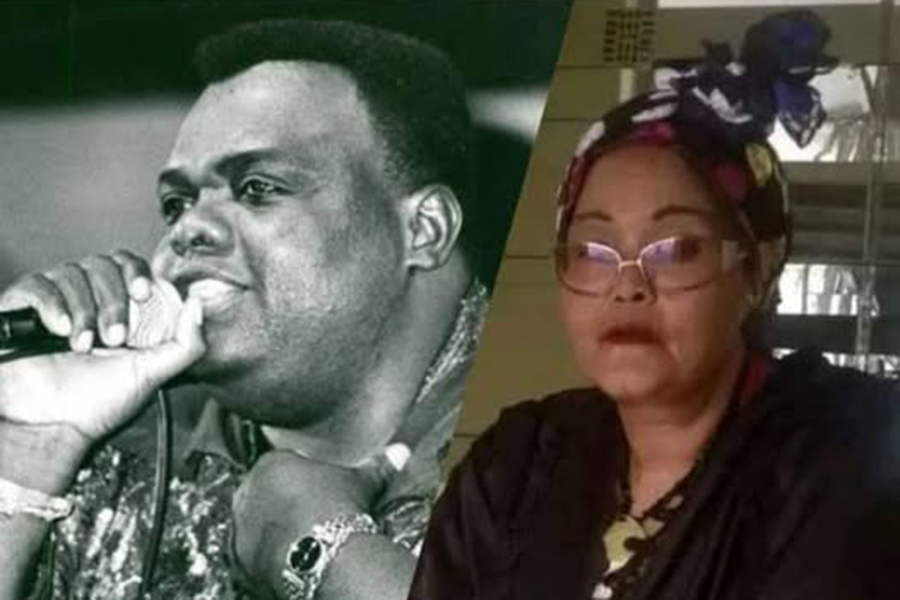
Kabaselle Yampanya, better known to the world as Pepe Kalle, was a towering figure in Congolese rumba and soukous music, earning the nickname “The African Elephant” for both his imposing physical presence and his larger-than-life personality.
Yet, beyond the stage lights, sold-out concerts, and jubilant sebene rhythms, there was a man whose heart was as massive as his stature—and whose love life became a story as wild, passionate, and sometimes turbulent as the music he made.
Pepe Kalle lived a life with insatiable appite for women, he loved too much. And the women of his life left their marks not only on his heart but on the songs that immortalized him.
I once tracked down Christine Dube hoping to coax a story out of her about Pepe Kalle’s 1995 hit, Don’t Cry Dube. She refused to speak, but Pepe Kalle’s childhood friend, business partner, and music collaborator Jean Dode Matolu Mbizi, aka Papy Tex, offered insight, though at first with restraint.
“I would rather not go into that story out of respect for my elder brother because it was so dear to him,” Papy said. But a year later, he revealed the truth. “Yes, Pepe Kalle met Christine during our tour and was dearly in love with her.”
Don’t Cry Dube is a classic ‘générique’ style song, featuring non-stop sebene that sweeps audiences into dancing from the first note to the last. Within it, Pepe Kalle also name-checks Chinyanga (Filipa) and Imanko (Iris), two Zimbabwean socialites of the time—suggesting that his attentions, and perhaps his affections, extended beyond Christine.
A Zambian somewhere joked that Pepe Kalle once overstayed his visa because he was seeing a woman in Lusaka and could not just leave before "settling desire".
Meanwhile, Gracious Bwanya recalls an anecdote about Pepe Kalle’s characteristic charm and audacity.
“That was his behaviour,” she said. “Pepe Kalle wanted to marry my mom when he came for a show, and my mommy was on duty as a police officer.”
Empire Bakuba, the band he led, toured Zimbabwe in 1991 and 1992, overlapping with other East African stops, including Tanzania—where another story of love, and musical inspiration, unfolded.

In Arusha, Tanzania, Pepe Kalle met Hidaya Khamis Massawe, and the men in the entourage whistled appreciatively in Lingala at her beauty—unbeknownst to them, she understood every word.
For The African Elephant, size mattered not just physically but emotionally, and his heart seemed to expand with every woman he met, inspiring an almost endless stream of romantic songs.
Back in the studio, this passion produced Shikamo Seye, a track that opens with Pepe Kalle professing his affection for a Tanzanian woman named Hidaya. Unlike Don’t Cry Dube, which featured lyrics in Ndebele, Shikamo Seye came in Swahili, making it resonate across East Africa.
Pepe Kalle sings:
“I have lost my sweetheart here in Tanzania, I have lost my waist belt, I will return to seek her. It is not diamonds, it is not gold, it is a gesture of engagement. Her name is Hidaya. If she is in Arusha, I don’t know; if she is in Morogoro, I don’t know; if she is in Mwanza, I don’t know; if she is in Dar es Salaam, help me find her. I will return, I will return, only because of Hidaya.”
Shikamo is a greeting of respect in Swahili, but in Pepe Kalle’s song it becomes a declaration of devotion, encapsulating his ability to transform admiration into music that enthralled fans while leaving a trail of real-world consequences.
Hidaya’s marriage, for example, suffered after the release of Shikamo Seye as her enraged husband could not hold it in, while elsewhere, a soldier returning from service in the jungles of the Democratic Republic of Congo reportedly divorced his wife whose images had been splashed across society magazines gyrating to raw soukous beats and being too infectiously close to Aurlus Mabele.
Where tales of Shaggy, Akon and the like make rounds about meeting or even siring children with socialites in Kampala, the Pepe Kalles were no different. Kanda Bongo Man famously recorded Wahito to pour out his heart to Kenyan Rose Wambui Wahito after he was kicked out and banned from entering Kenya by the Moi government over he girl.
The King of Kwassa Kwassa would sneak into Kenya many times and get deported, including in April 1992 when he went through porous borders in Tanzania.
For Pepe Kalle Christine Dube, Chinyanga, Imanko, and Hidaya all overlapped in his life, raising the question: was Pepe Kalle unable—or unwilling—to rein in his amorous inclinations?
His life of passion, heartbreak, and pursuit of forbidden love seems to have been both a personal rebellion against his parents and a creative wellspring for his music.
Pepe Kalle’s romantic journey began in his youth. He loved Pauline Ndekani Ludokisi, attending church with her, but her parents forbade the marriage, insisting that he could only wed within the Kuba tribe.
In 1975, his parents arranged a marriage to a 15-year-old girl, Brune Tshite. Pepe Kalle accepted obediently but continued seeing Pauline. The affair eventually led to divorce from Tshite due to infidelity.
As he attempted to formalise a relationship with Pauline, his parents presented Mweni, then 16. Yet Pepe Kalle’s affections remained with Pauline, and Mweni left after a year, bearing a son from the marriage. Enter Mimi in 1979, whom he loved almost as fiercely as Pauline.
But while Pepe Kalle was on tour in Europe, Mimi engaged in her own affair, prompting Pepe Kalle to compose Zabolo (Lingala for devil) and Libaku Mabe (bad luck), songs reflecting betrayal and misfortune.

Eventually, Pepe Kalle settled with Pauline, with whom he had three children. But before that, he had filled studios with songs inspired by transient romances, heartbreak, and unreciprocated love. Libaku Mabe, in particular, laments the bad luck that seemed to haunt him in relationships, even as his music soared across Africa.
In Ouagadougou, Burkina Faso, he crooned about Djarabi Adjatou, confessing that he had crossed rivers and climbed mountains to reach her. Whether the tale is literal or mythologized, it demonstrates how Pepe Kalle’s life of desire was inseparable from his creative output. Each encounter, each heartbreak, was immortalized in rumba, soukous, and sebene, creating a canon of songs that doubled as personal diaries set to rhythm.
His love life was not just incidental—it was a driving force of inspiration. Don’t Cry Dube, Shikamo Seye, Zabolo, Libaku Mabe, and other tracks reveal a man who wore his heart on his sleeve, whose passions spanned countries, cultures, and languages. Whether in Lingala, Swahili, or Ndebele, Pepe Kalle translated emotion into melody, letting audiences across Africa feel the fever of his affections, the sting of betrayal, and the ecstasy of desire.
Pepe Kalle’s story is also a story of parental impositions, societal norms, and cultural constraints. Forced marriages and tribal expectations clashed with the free-wheeling, wandering life of a rising musical star.
And yet, the music he produced during these years did not merely entertain—it chronicled the life of a man pushed and pulled by love, duty, and artistic instinct.
By the time of his death in November 1998, following a heart attack, Kabaselle Yampanya had left behind a musical legacy intertwined with his personal legacy—a man of prodigious talent, boundless energy, and an insatiable heart.
His songs continue to echo across Africa, telling stories of Christine, Chinyanga, Imanko, Hidaya, Mimi, and Pauline, each woman a verse in the life of the African Elephant who loved too much.
Pepe Kalle’s life and music remind us that behind every beat, every call to the dance floor, was a man whose love was vast, imperfect, and unstoppable, a man whose heart and passions were as enormous as the persona the world celebrated.
His music was both a celebration of joy and an elegy for longing, capturing the truth of a man who could love relentlessly, openly, and sometimes recklessly—because for Pepe Kalle, love and music were inseparable, and both were infinite.
