
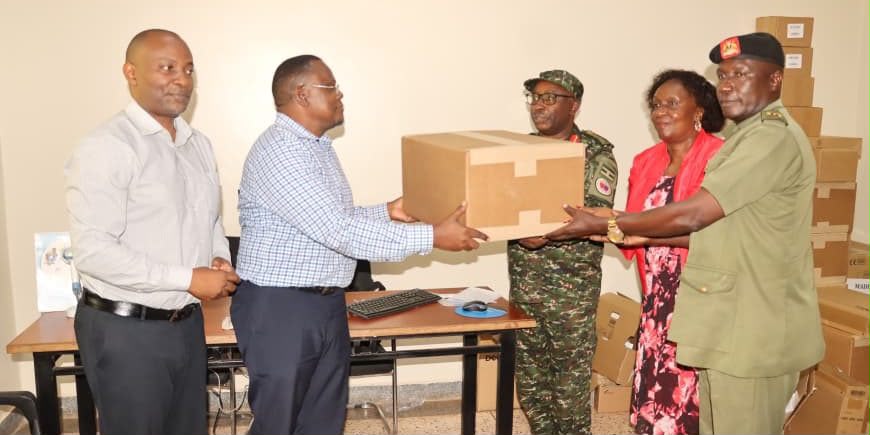
The Uganda Peoples’ Defence Forces has received a new consignment of GeneXpert diagnostic machines aimed at strengthening tuberculosis (TB) detection, treatment, and prevention within its health system.
The development was announced by the Head of Public Health and Director of the HIV/AIDS Programme in the UPDF, Col Dr Francis Xavier Bakehena, during the official handover ceremony held at the Senior Officers Diagnostic Centre in Mbuya.
Dr Bakehena, who represented Joint Staff Health Services, said the machines represent a timely intervention in Uganda’s ongoing fight against TB and HIV, diseases that continue to pose a major public health burden.
“Uganda is one of the high-burden countries for TB and HIV. We are only diagnosing approximately 60 per cent of the cases clinically, while the remaining 40 per cent remain undetected in the community. This remains a challenge both for the civilian population and the UPDF,” he said.
He stressed that the military health strategy prioritises early detection, timely treatment, and the expansion of Tuberculosis Preventive Therapy (TPT) for individuals at risk of infection.
“Our first objective is to find and treat every TB patient. Secondly, we want to ensure that all eligible individuals receive preventive therapy. However, locating those affected remains one of the biggest challenges,” he added.
Dr Bakehena also assured stakeholders that the equipment would be properly secured, maintained, and fully integrated into military health operations, including digital systems for improved data management and decision-making.
“Our laboratory managers understand the responsibility of safeguarding this equipment. The machines will be installed in secure locations with restricted access, while maintenance and quality assurance measures will be strictly followed,” he said.
“We are also installing electronic medical systems across our health facilities to ensure that information generated from these machines is shared efficiently and contributes to better decision-making.”
The machines were handed over during a ceremony attended by senior military health officials, representatives from the Ministry of Health, development partners, and medical personnel.
Dr Denis Bwayo, Programme Director at University Research Co. LLC (URC), said the intervention is being implemented under support from the United States Government through the President’s Emergency Plan for AIDS Relief (PEPFAR), in partnership with the Directorate of HIV/AIDS and Joint Staff Health Services.
He noted that the equipment was procured in line with Ministry of Health standards to ensure compatibility with Uganda’s national health systems and long-term sustainability.
Representing the Ministry of Health, Dr Emmanuel Twongere said the new machines will contribute significantly to Uganda’s goal of eliminating TB and leprosy as public health threats.
He noted that Uganda has made progress in reducing TB-HIV co-infection rates to about 33 per cent, though challenges in early diagnosis remain.
Dr Twongere emphasised that laboratory confirmation is essential before treatment, noting that TB symptoms often overlap with other illnesses such as pneumonia and malnutrition.
“The advantage with TB is that it is curable. However, every patient must first be confirmed to have TB. Many other conditions can mimic TB… The only way to confirm TB is through laboratory testing,” he said.
He added that Uganda currently has about 397 GeneXpert machines nationwide but still requires nearly 200 more to achieve universal diagnostic coverage.
Each additional machine, he said, brings the country closer to closing the diagnostic gap and strengthening its overall TB response.
