
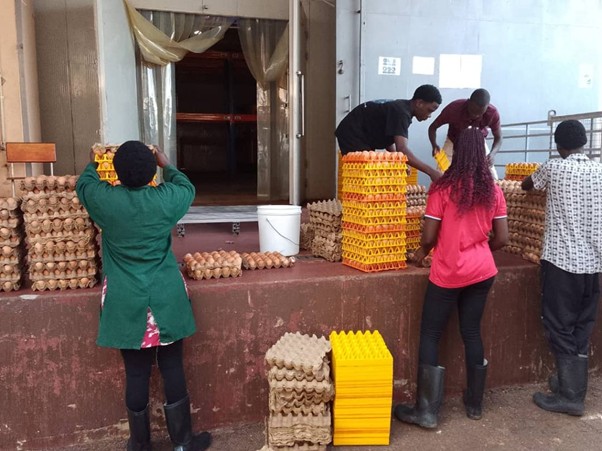
A business that once struggled to convince lenders to finance an unfamiliar idea has grown into one of Uganda's leading egg-processing companies, supplying value-added products to regional markets while creating reliable income opportunities for poultry farmers.
Pristine Foods Ltd, which began commercial production in July 2019, has expanded from selling just 100 kilograms of processed egg products during its first month of operation to processing nearly 15,000 trays of eggs and selling close to 17 tonnes of finished products every week.
The company's rapid growth has been driven by a combination of financial investment and technical assistance supported by the European Union through the Yield Uganda Investment Fund and later the Uganda Development Bank.
Managing Director Joel Guma said raising capital was the biggest challenge during the company's formative years because most financial institutions considered the business too risky.
"When we started, one of the biggest challenges, like any business, was access to finance. Many financial institutions considered us too risky because we were a startup," Guma said.
He explained that industrial egg processing was still a relatively new concept in Uganda, making it difficult for investors to appreciate the commercial potential of the venture.
"We were pursuing something many people believed could not work. Very few people believed Uganda could sustain a large-scale egg processing business."
After unsuccessful attempts to secure conventional financing, the company obtained investment through the Yield Uganda Investment Fund in 2018.
"We went to some banks which didn't support us because we were a startup, and that's how the Yield Fund came in. They invested in our business in 2018, and we started production in July 2019," Guma said.
According to Guma, Pristine Foods received between US$1.5 million and US$2 million in financing, alongside business development support worth approximately US$250,000.
The funding enabled the company to establish one of Uganda's few dedicated egg-processing plants by investing in essential equipment, including pasteurizers, cold storage facilities, industrial egg breakers, centrifuges, drying systems and delivery trucks.
Initially focused on liquid egg products, the company expanded into whole egg powder production in 2024 as demand for value-added egg products continued to grow.
Today, Pristine Foods manufactures liquid eggs, egg powder, mayonnaise and other egg-based products supplied to bakeries, biscuit manufacturers, hotels, restaurants and food processors across Uganda and the wider region.
Its products are also exported to Kenya, the Democratic Republic of Congo, Somalia, Burundi and Ethiopia, while institutions such as UNICEF are among its customers.
Beyond commercial markets, the company produces nutrient-rich egg powder that is blended into porridge and other complementary foods aimed at improving nutrition for children between six and 23 months.
The nutrition programme currently reaches vulnerable communities in districts including Kamwenge, Kyegegwa, Kikuube and Kiryandongo.
Guma said the company's expansion has strengthened Uganda's poultry value chain by creating a dependable market for egg producers.
Pristine Foods sources eggs from between 100 and 150 active farmers across districts including Mukono and Luwero, purchasing consignments of as few as 50 trays to accommodate small-scale producers.
"We take as low as 50 trays of eggs from the farmer. The more you have, the better," Guma said.
Farmers are paid according to the weight of their eggs, with larger eggs attracting higher prices. Fresh eggs are collected every week before being transported to the factory for processing.
Through EU-supported technical assistance, the company has profiled more than 2,000 poultry farmers and trained around 1,000 in poultry management, hygiene, egg handling, climate-smart agriculture, animal nutrition, gender inclusion and agribusiness practices.
Guma said the training has helped improve product quality while enabling many farmers to expand their businesses.
"We have seen farmers grow tremendously over time. Some farmers who started by supplying 50 trays of eggs are now supplying over 200 trays regularly."
The company also benefited from additional investment during the COVID-19 pandemic, when Uganda's poultry sector faced severe market disruptions due to excess egg production.
Between 2022 and 2024, factory expansion financed through EU-supported programmes increased processing capacity through larger spray dryers and industrial egg breakers, enabling the business to absorb more eggs from farmers.
"That expansion allowed us to support more farmers and process larger volumes," Guma said.
Pristine Foods has also diversified into mayonnaise manufacturing using locally sourced eggs and sunflower oil as part of efforts to substitute imports with locally manufactured products.
Its mayonnaise is currently distributed through about 240 retail outlets across Uganda, with additional flavours including garlic, chilli, pepper, tartar sauce and thousand island under development.
The company now directly employs nearly 60 people while supporting numerous downstream businesses, particularly bakeries that use liquid eggs to improve efficiency and reduce production time.
According to Guma, the business continues to invest in research and product development as it explores new opportunities for Uganda's growing agro-processing sector.
For the company, its journey from an idea rejected by lenders to a regional supplier demonstrates the role that patient investment and technical support can play in unlocking innovation, strengthening agricultural value chains and creating sustainable markets for local farmers.
"The support helped us build a business that is creating impact across the value chain. From farmers to manufacturers to consumers, the benefits continue to grow," Guma said.
Pristine Foods, Joel Guma, European Union, Yield Uganda Investment Fund, Uganda Development Bank, egg processing, poultry farming, agro-processing,
