
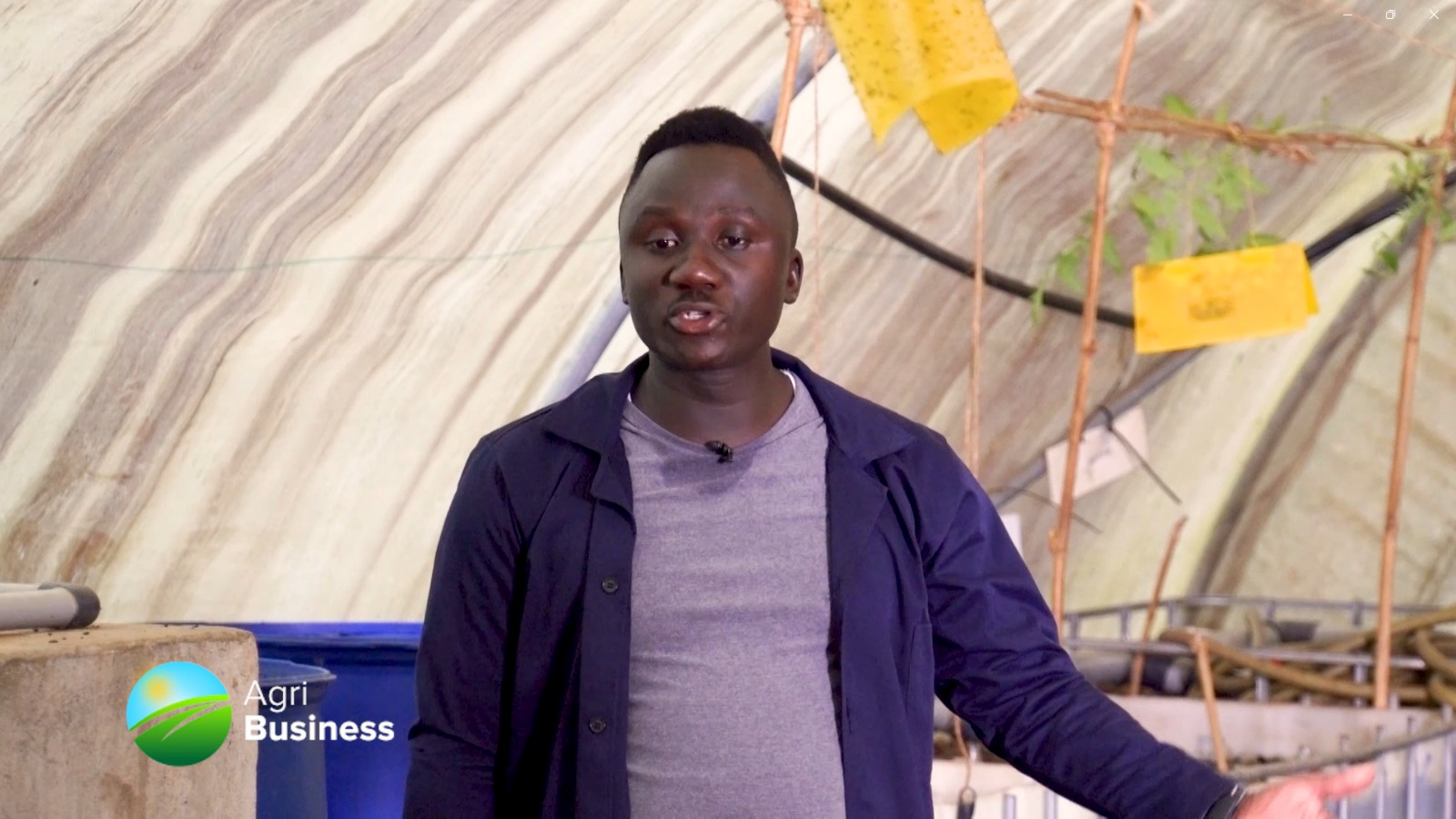
Deep in the heart of Namulonge, Uganda, a brilliant scientist named Derrick Okware is working tirelessly to transform the way local farmers generate income.
His ground-breaking work in the field of aquaponics is not only generating sustainable income for local farmers but also ensuring that the environment is protected for future generations.
Aquaponics is a revolutionary method of farming that combines hydroponics (the practise of growing plants in water) with aquaculture (the cultivation of fish). The fish waste provides nutrients for the plants, while the plants help filter the water for the fish. This symbiotic relationship creates a closed-loop system that requires minimal inputs and produces high yields.
Derrick, who holds a PhD in environmental science, is passionate about the potential of aquaponics to transform agriculture in Uganda and Africa at large.
He believes that this method can help address many of the challenges faced by farmers in the region, including soil degradation, water scarcity, and the high cost of inputs.
Through his work at the Namulonge Agricultural and Animal Production Research Institute, Derrick has been conducting extensive research on aquaponics and its potential applications in Uganda.
He has worked closely with local farmers to develop and refine the technology and has helped establish several successful aquaponics systems in the area, such as Mukono, among other areas.
One of the key benefits of aquaponics is its ability to generate sustainable income for farmers. By growing both fish and plants in the same system, farmers can diversify their income streams and reduce their dependence on traditional crops. This can be particularly beneficial in areas where traditional crops are vulnerable to disease or other environmental factors.
In addition to generating income, aquaponics also has a number of environmental benefits. Because the system is closed-loop, it requires significantly less water than traditional farming methods. It also produces minimal waste and requires no synthetic fertilisers or pesticides, making it a more sustainable and environmentally friendly option.
As the NBSAgribusiness team toured one of Derrick's aquaponics systems in Namuloge, we were struck by the simplicity and elegance of the technology. The fish swam lazily in their tanks, while the plants thrived in the nutrient-rich water. The system required minimal inputs, and the yields were impressive.
But what struck us the most was the sense of hope and possibility that Derrick's work represents. By harnessing the power of science and technology, he and his team in Namulonge are helping to create a more sustainable and prosperous future for farmers in Uganda and beyond.
And by doing so, he is ensuring that the natural resources that sustain us all are protected for generations to come.
Find out more about this on Afro Mobile and YouTube.
