

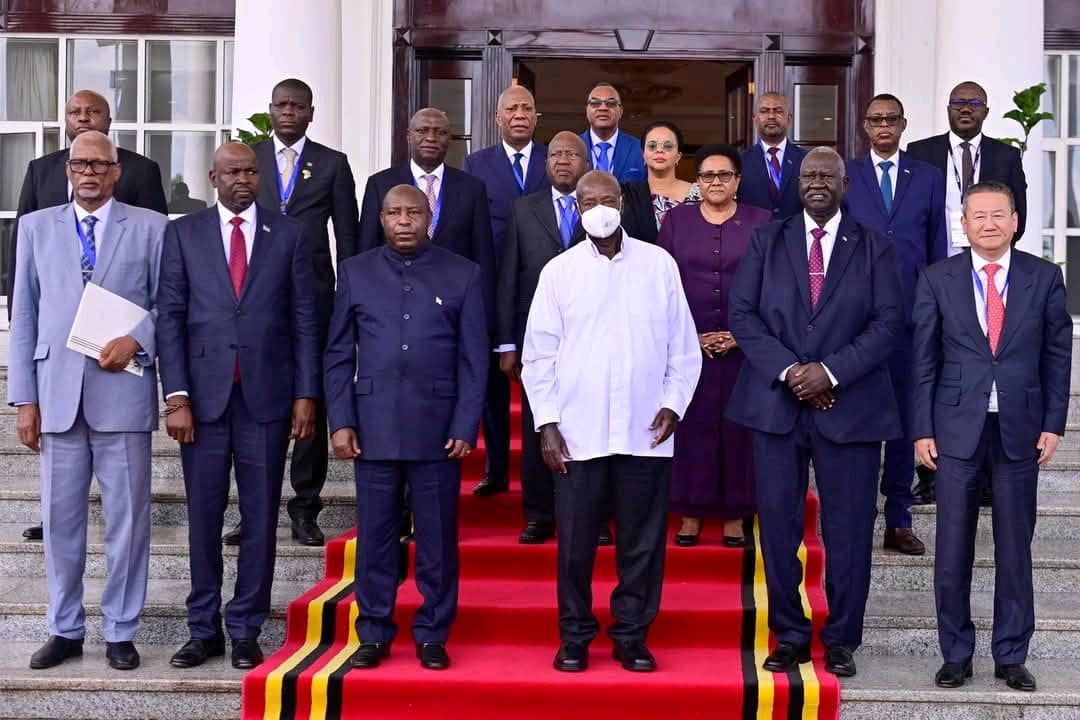
Heads of State and Government from across the Great Lakes region have called for urgent measures to address the deteriorating security and humanitarian situation in eastern DRC.
This followed the leaders' 12th High-Level Meeting of the Regional Oversight Mechanism (ROM) of the Peace, Security and Cooperation (PSC) Framework, held in Entebbe, Uganda.
The meeting, chaired by President Museveni, brought together leaders and representatives from 13 signatory countries including Angola, Burundi, Congo-Brazzaville, the DRC, Kenya, Rwanda, South Africa, South Sudan, Sudan, Tanzania, Uganda and Zambia, alongside the African Union (AU), International Conference on the Great Lakes Region (ICGLR), and the United Nations (UN).
The leaders unanimously called for strict adherence to the PSC Framework’s commitments, especially respect for sovereignty and territorial integrity, and a cessation of support to armed groups operating in the region.
“We call for neither tolerating nor providing assistance or support of any kind to armed groups,” they said in the communiqué.
Expressing deep concern over the worsening conflict in eastern DRC, the leaders condemned the advances and establishment of parallel administrations by the M23/Alliance Fleuve Congo (AFC) with external support.
They urged full implementation of UN Security Council Resolution 2773 (2025), particularly paragraphs 4 and 6, which address armed group disengagement and political dialogue.
They also condemned foreign armed groups operating in DRC, including the FDLR, ADF, RED-Tabara, and CODECO, urging them to disarm unconditionally.
The leaders directed the Operational Cell of the Contact and Coordination Group to continue facilitating voluntary disarmament and repatriation.
The communique noted progress in disarmament efforts, particularly the deployment of the CCG Operational Cell in DRC and a technical workshop in Burundi to help former combatants reintegrate.
The leaders encouraged countries with nationals in foreign armed groups to repatriate those who have renounced violence.
On Sudan, the leaders affirmed their support for a nationally led peace roadmap, condemned atrocities by the RSF militia, and called for an end to the siege on El Fasher.
“We reaffirm the principles of sovereignty, territorial integrity and unity,” they said, while also calling for an end to drone strikes on Port Sudan which threaten humanitarian operations.
The meeting commended South Sudan’s progress in implementing its peace agreement and welcomed Uganda’s bilateral initiatives including military operations against ADF in the DRC and regional infrastructure projects.
The leaders praised recent peace efforts, including the appointment of President Faure Gnassingbé of Togo as AU-designated mediator between the DRC and Rwanda.
They welcomed the signing of a joint declaration between the DRC and M23 on April 23 in Kinshasa and Goma, as well as a declaration of principles between DRC and Rwanda on April 25 in Washington, D.C.
They emphasized the need for coordination among international mediators and acknowledged the role of the EAC-SADC Panel of Facilitators.
“We call for alignment of international diplomatic efforts,” the communiqué read.
The leaders adopted an Action Plan to revitalize the PSC Framework, recognizing its continued relevance in addressing the root causes of conflict in eastern DRC.
They committed to regular reporting and the creation of a peer-review system, to be operational by the next high-level meeting.
They also pledged to increase participation of women, youth and civil society in peace implementation and welcomed the revitalization of the Advisory Board on Women, Peace and Security.
A group of women mediators will also be formed to support peace processes.
They called for justice and accountability, implementation of the Kinshasa Declaration on judicial cooperation, and action against the illegal exploitation of natural resources, which they noted remains a key driver of instability.
The leaders expressed gratitude to President Évariste Ndayishimiye of Burundi for his leadership as outgoing ROM Chair and to President Museveni and the Ugandan people for hosting the meeting. They encouraged Uganda to lead consultations on the designation of the next ROM Chair.
Acknowledging that “there can be no economic development without peace,” the leaders agreed to reconvene in 2026 to review progress on the revitalized PSC Framework.