

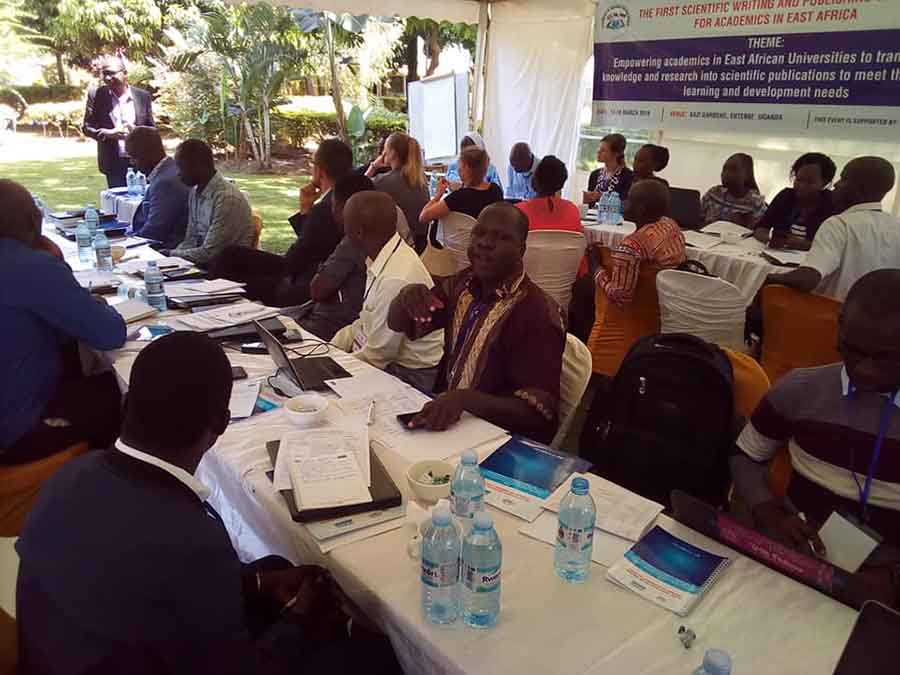
Academics from the East Africa Community (EAC) member states and Germany have been cautioned against the habit of plagiarising research work, during writing of their theses or dissertations.
This was echoed by various academic experts, during the five days ongoing Scholarly Writing and Publishing Workshop, being held at KAZ Gardens in Entebbe last week.
“We have some quack PhD holders, whose University Thesis are duplication of other academicians’ research work”, said Dr Justus Makokha, a lecturer at Kenya’s Kenyatta University.
He was giving a lecture to PhD students on; Scientific Writing, Sources, types, Products, Habits and Tools for the Scientific Writer.
He said duplication of other researchers’ work erodes academic standards and results in poor performance of tasks or jobs, offered to these quack academicians by their employers.
He said a remedy has now been found, to eradicate plagiarism in tertiary Institutions.
“All Thesis and dissertations in credible universities are now being put online, where it will be proved that one plagiarised the work of another researcher, even if you completed your PhD in Asia, Africa, Europe or the US”, he added.
He said good scholarly writers should be informed of methodological and theoretical landscapes of their subject matter.
Nicholas Bwebare, Fountain Publishers' Scientific Publications Editor, said knowledge to support innovation and research is vital in research writing.
“Fountain Publishers intends to partner with the PhD researchers to have their writings published for public consumption”, he said.
He enumerated challenges facing researchers to include: research for financial gain which jeopardises research findings and promotes plagiarism and limited time frame of only four months, to publish scientific research work among others.
The workshop was organized by the German Academic Exchange Service (DAAD).
DAAD Regional Office for Africa Program Manager, Miriam Pahl, said early career scholars should be supported to realize their professional dreams.
“In Uganda, DAAD has so far conducted four workshops on a yearly basis”, she said.