
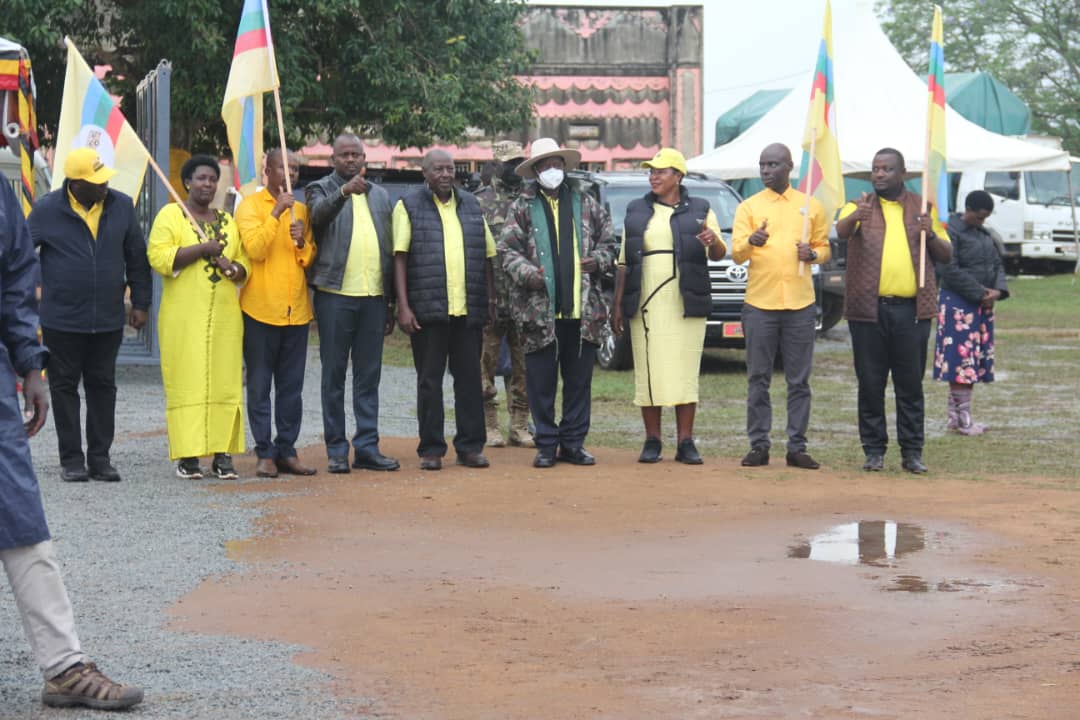
President Museveni, the National Resistance Movement (NRM) presidential flag bearer, on Monday pledged to establish irrigation systems in Bukomansimbi District to support modern agriculture, which he said remains central to lifting households out of poverty and sustaining rural incomes.
The President made the pledge while campaigning in Kitanda Sub-county, where he addressed hundreds of supporters at the playground of Mirembe Muslim Primary School despite a heavy downpour, as part of his countrywide mobilisation ahead of the January 15, 2026 general elections.
Museveni told residents that continued investment in irrigation would enable farmers to produce consistently throughout the year, reduce reliance on rain-fed agriculture and stabilise household incomes.
He linked irrigation to broader government efforts to promote commercial farming, value addition and rural industrialisation.
He urged voters to renew his mandate in the 2026 polls, arguing that this would allow him to complete and expand programmes aimed at transforming agriculture, improving infrastructure and growing household wealth, after more than four decades at the helm of Uganda’s leadership.
Residents welcomed the President with enthusiasm and credited government interventions for visible improvements in livelihoods, particularly in agriculture.
They pointed to improved access to markets and increased farm output as some of the gains realised in recent years, attributing them to better feeder roads, extension services and government support programmes.
However, the interaction also highlighted persistent service delivery gaps in the district. Local leaders and residents appealed to Museveni to prioritise the construction of the Kyabakuza–Kibinge–Mateete road, which they said remains critical for easing the movement of agricultural produce and boosting trade links within the region.
They also asked the government to upgrade Butenga Health Centre IV into a fully-fledged general hospital, citing the long distances residents currently travel to access specialised medical services and emergency care.
In response, Museveni reiterated the government’s commitment to expanding infrastructure and public services in rural districts.
He said extending electricity to unserved areas would remain a priority, noting that access to power is essential for agro-processing, small-scale industries and value addition at community level.
The President emphasised that rural electrification would complement irrigation and agricultural reforms by enabling farmers to process their produce locally, reduce post-harvest losses and earn higher returns.
On education, Museveni said government efforts were already underway to strengthen learning infrastructure in Bukomansimbi.
He pointed to plans to ensure that each parish has a government-aided primary school, an initiative aimed at improving access to education and reducing the distance children travel to school.
He also encouraged residents to take an active role in fighting poverty, stressing that government programmes can only succeed if citizens themselves embrace wealth creation.
Museveni urged farmers to adopt the Four-Acre Model, which promotes efficient use of small landholdings for commercial agriculture through a mix of crops, livestock and value addition.
The Bukomansimbi rally formed part of Museveni’s wider campaign tour, during which he has been highlighting agriculture, infrastructure, energy and education as pillars of his development agenda heading into the 2026 elections.
