
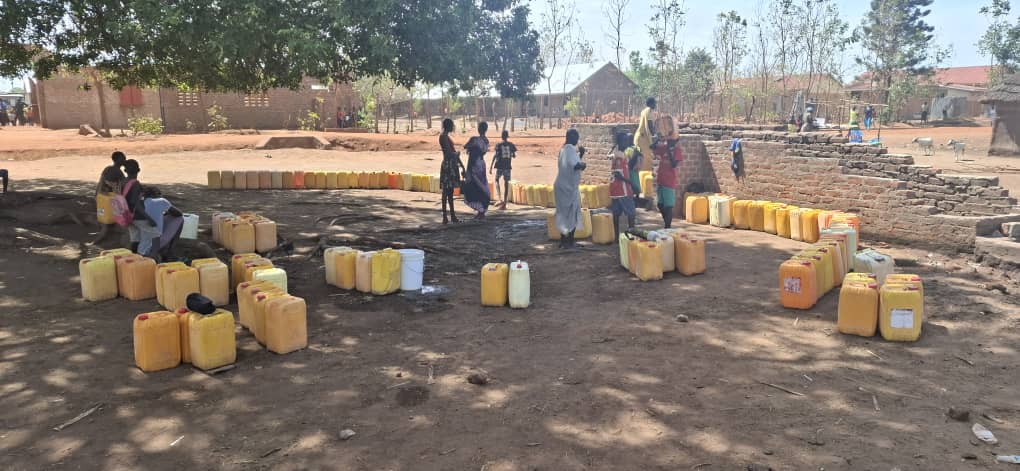
A section of refugees in Nyumanzi Refugee Settlement, home to more than 40,000 people in Dzaipi Sub-county, Adjumani District, are facing serious challenges in accessing clean and safe water, with hundreds of households depending on a single borehole.
The situation has forced many, especially women and children, to queue for hours at overcrowded water collection points. Several boreholes in the area have become unreliable due to the recent dry spell, deepening the water crisis.
Elizabeth Deng, a resident of Nyumanzi and a single mother of three children, says they must wake up as early as 4:00 a.m. to queue at the few available water points.
“Sometimes we wait for hours and go back home with just one jerrycan,” she said. “The water is not always clean, but we don’t have a choice.”
Titus Jogo, the Adjumani Refugee Desk Officer under the Office of the Prime Minister, acknowledged the challenge. He said efforts are underway to find a lasting solution and reduce reliance on unsafe or distant water sources.
According to Jogo, the rapid increase in the refugee population has placed immense pressure on existing water infrastructure.
“The demand has far outstripped supply. The systems we have in place were not designed for such high numbers,” he noted, adding that available boreholes and water trucking interventions in Nyumanzi are no longer sufficient.
Adjumani District leaders said Water, Sanitation, and Hygiene (WASH) partners operating in the area are working with limited funding, and local authorities warn that without urgent investment, the situation could deteriorate further, posing health risks such as outbreaks of waterborne diseases.
The district leadership, together with the OPM and humanitarian agencies, is calling for increased support from the government and international donors to expand water sources, improve infrastructure, and ensure equitable access to safe water for both refugees and host communities.
