

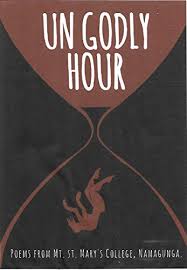
The anthology, The ‘Ungodly Hour’, is a product of St. Mary’s College, Namagunga’s Writers’ Club.
In the spirit of such wholesomeness, I will not call these young ladies poetesses. Because the word “poet” is gender neutral. And it means “a person possessing special powers of imagination or expression.”
In Chapter 1, “The Human in You”, such special powers are expressed in Senior Three’s Ronete Daniella Wakabi’s poem: “It’s Poetry!”
“Scribbling and chanting,
Out of my mind feelings come to life
Smiling and laughing
As passion comes to life
And voilà! A manifestation
Perhaps I could make it dedication
To this great nation or generation.”
This poem is a gift outright. You sense the power of her enthusiasm, the willfulness of her optimism. Her sentiments carry the poem to powerful heights. And she hereby proves that youth is not wasted on the young.
Chapter 2, Blinded By Light, is a little less optimistic as indignation and exasperation replace satisfaction with the poem “Who else is tired?” by Kanyike Favour of Senior Three:
“Who else is tired?
Of listening to deceitful tongues
Of watching people dig their own graves
Of digging your grave alongside them
Of sinning against God…”
Her powerful use of anaphora or the repetition of a word or phrase at the beginning of successive clauses is stirring. Martin Luther King employed the same device in his "I Have a Dream" speech. And it is no less effective here.
In an age where all our traditions, customs and cultural mores are being swept aside by (backward) strides in technology, “Anti-Cultural,” a poem by Khainza Priscilla Keza of Senior Three, is damning and refreshing in its battle against the dying of a light:
“Now
We can’t seem to see behind us
The ancestors are now denied before modernity
The same modernity that destroyed our past…”
After this withering poem, there is some redemption in modernity, however.
Jovinta Stella Nakaazi of Senior Six, cheekily tells us so in PSALMS 23 (The dot com era):
“Instagram is my shepherd,
I shall not want;
It lets me lie down on my family couch
And leads me to meet the unrealistic me;
It gives me work
It guides my work;
It guides me in the path of gossiping
Even if I miss an outing;
I will not be afraid, for it is an app on my phone,
Its stories and feed keep me informed;
It prepares a platform for me
Where all my followers watch me slay;
I become a queen with no crown to my head
For I know ‘likes’ and ‘comments’ will be with me
All the days of my youth.”
I could quote it all day! The form of the poem is the content, and its content the form.
Chapter 3 is entitled “Mathematical Equations for Women”, but take heart…you will not have to use a calculator to enjoy this chapter. It is calculated to make you understand precisely what the poets wish to say.
Kirabo Ivy Kimberly of Senior Four writes her poem “Let’s Pretend:”
“Let’s pretend
That we don’t have to fake our smiles
And hugs are not transformed to still awkward
handshakes
Let’s pretend that we’re really still okay…”
The employment of irony and borderline sarcasm asks us to pretend that we are not pretending in order to expose pretense as something that may cure the pretender of pretense.
Confused?
I told you we were going to get mathematical, didn’t I?
Next, we shall handle some subtraction in Abaho Bridget of Senior Six’s poem: “OH I HATE THIS MAN!”
“That is what he is telling people?
Ebyonibyo bishuba byariyo nogambira abantu?
That undiluted imbecile!”
Another player bites the dust! The fury in the poet’s active voice gives you an idea of the spoken voice that could be used to recite this aria. Although full of anger, its flow could shape a ballad sung as lyrics to a melody.
Chapter 4, LET US ALL SING THE UGANDA NATIONAL ANTHEM (IN SARCASM!), is predictably political.
“Oh Uganda may God surely uphold thee,
For we are afraid to lay our future in thy hands
Because disunited; we are slaves to Asia…”
This poem is the eponymous verse of the Chapter and is written by Aheisibwe Lisa –Marie and Kirabo lvy both of Senior Three.
In a world that’s “Made in China”, this commentary carries a defining quality of the times as the embodiment of Uganda’s divided self. We are divided by our subjection and subjectivity when it comes to the unity of Uganda.
The power of the division is that it captures not only the way we see ourselves, but the way we see the world and ourselves in the world.
Chapter 5 is entitled “Ungodly Hour” and it is introduced with an illustration of soldiers amidst flags with the caption: To build this nation, I held the gun.
This chapter captures the sense and sensibilities of the poets. It again marks the paradox of the divided self—“that one might deny love’s existence while also suffering from love’s existence.”
In rather broader terms, this paradox informs the poet’s unitary self and brings together brilliant poetry:
“I sent the devil to hell,
Through my heart
And through my heart
I did not forget your face father
When I sent the devil back to hell.”
Writes Obii Amelia of Senior Six in her poem “Confessions.” And she effectively accepts, on behalf of Namagunga, that every poet in this anthology is guilty of exquisitely wholesome poetry.
