
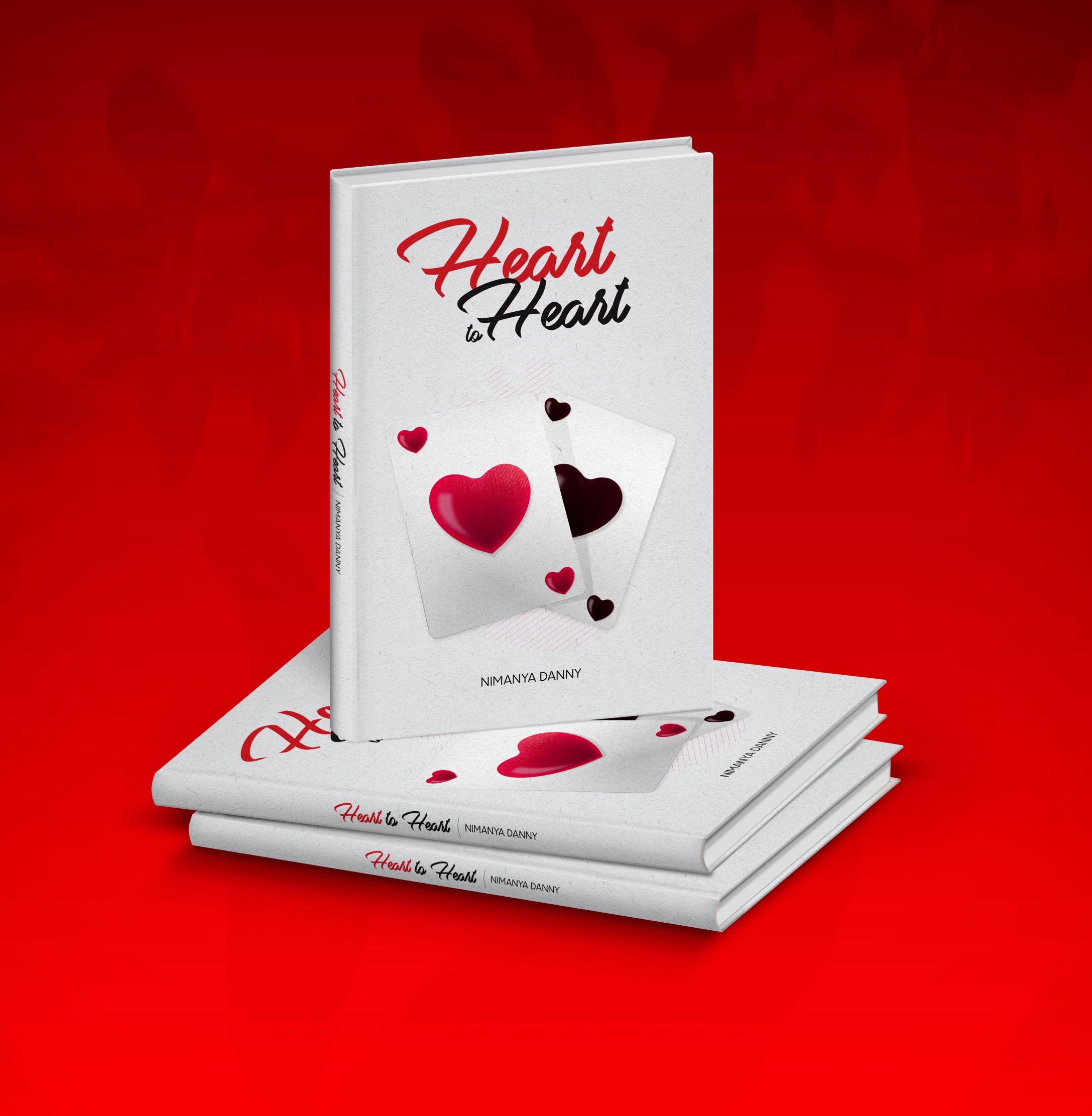
Book title: Heart to Heart
Author: Danny Nimanya
Availability: All Ugandan bookshops
Length: 65 pages
We all love to love.
I see you shaking your head, but we both know you do too.
Some call it desire; shrinks call it “limerence”. I simply call it essential. So most welcome is a poetry book whose dedication reads like this:
“To all the hopeless romantics tired of talking to the moon. To all the broken hearts looking for a remedy. To all the people with big dreams that only they can see.”
If you now love to love after loving that dedication (despite its fragment or incomplete second sentence), then Open Mic Uganda-affiliated poet Danny Nimanya will take you through a 63-poem love fest dedicated to heightening your loving love.
His poem “Love Struck” strikes me as a poem perfectly suited to spread such love.
It is written in only six lines. This, in essence, makes it a sestet. Not only because of the number of lines but also due to the fact that these lines form a single stanza, a unit of verse in a poem.
More to the point, “stanza” is an Italian word and it means “room”. This is so appropriate because one might need to get a room after reading these lines:
“You’ve made me want you, which I can’t deny.
Maybe I can’t have you, but at least I’ll try.
Give yourself to me; I promise you’ll never forget that day.
Forget all the others; I swear I’ll love you in a different way.”
This conjunction of a simple plea with the momentous promise of more, actuated by the words “different way”, is central to the text.
The poem’s blending of a lofty passion with modest expression steers the poem’s phrasing, promising and delivering something we could all identify as true love.
However, I suspect that you are still skeptical.
Maybe that is why Danny, the poet, enlists more Oomph to turn your feelings around with his next offering entitled, My Apology.
“I know I’m way less than holy; I WAS a player, but that was the old me.
I know my past actions broke your heart but I’m ready for a new genesis, babe.”
Robert Frost, the great poet, once admitted to using colloquial and informal speech in his poetry.
He then went on to boast that he uses diction even William Wordsworth, another great poet, wouldn’t stoop to.
So the poem’s persona can thus claim some great poetic company when s/he uses colloquialisms such as “player” and “babe” to drive passions home.
However such diction defrosts (pun intended) the persona’s feelings with a casual and understated effect, almost robbing the poem’s earnestness of the power it is supposed to unleash.
Skillfully, though, the poet runs a temperature of un-casual cool with another poem:
Love Song
“Let me write a song about you,
So that I still fall asleep with your voice as my lullaby even when you’re gone
Because to tame a beast like me, only your symphony can qualify
Let me write a song about you,
Weave emotions in hook, bridge, and chorus,
And blend my passion in the notes
Let me write a song about you,
So that my soul can search for you in a different plane,
And we can always have a piece of each other whether in pleasure or pain…”
The lyrical constrictions of rhythm and rhyme gather great sweeps of affection introduced in the first stanza, unto the last.
An undertow of uncontrived passion ultimately acts to reduce each verse and line into a single and powerful gesture to write a loved one a love song.
It is satisfying, and consistently so.
All the love, and need to love, threading through this wonderful anthology deliver each love poem’s main rhetorical purpose: a heart to heart.
One must applaud the poet for being able to bring his feelings to life on the page so they can breathe life into every reader with the earnest hope, I suspect, that someday we all love to love.
Not for love’s sake, but for our own.
