
“In analyzing civil-military relations, the first necessity is to define the nature of the officer corps. What sort of body is the officer corps? What sort of man is the military man?” Samuel Huntington asks in his 1957 book, The Soldier and The State.
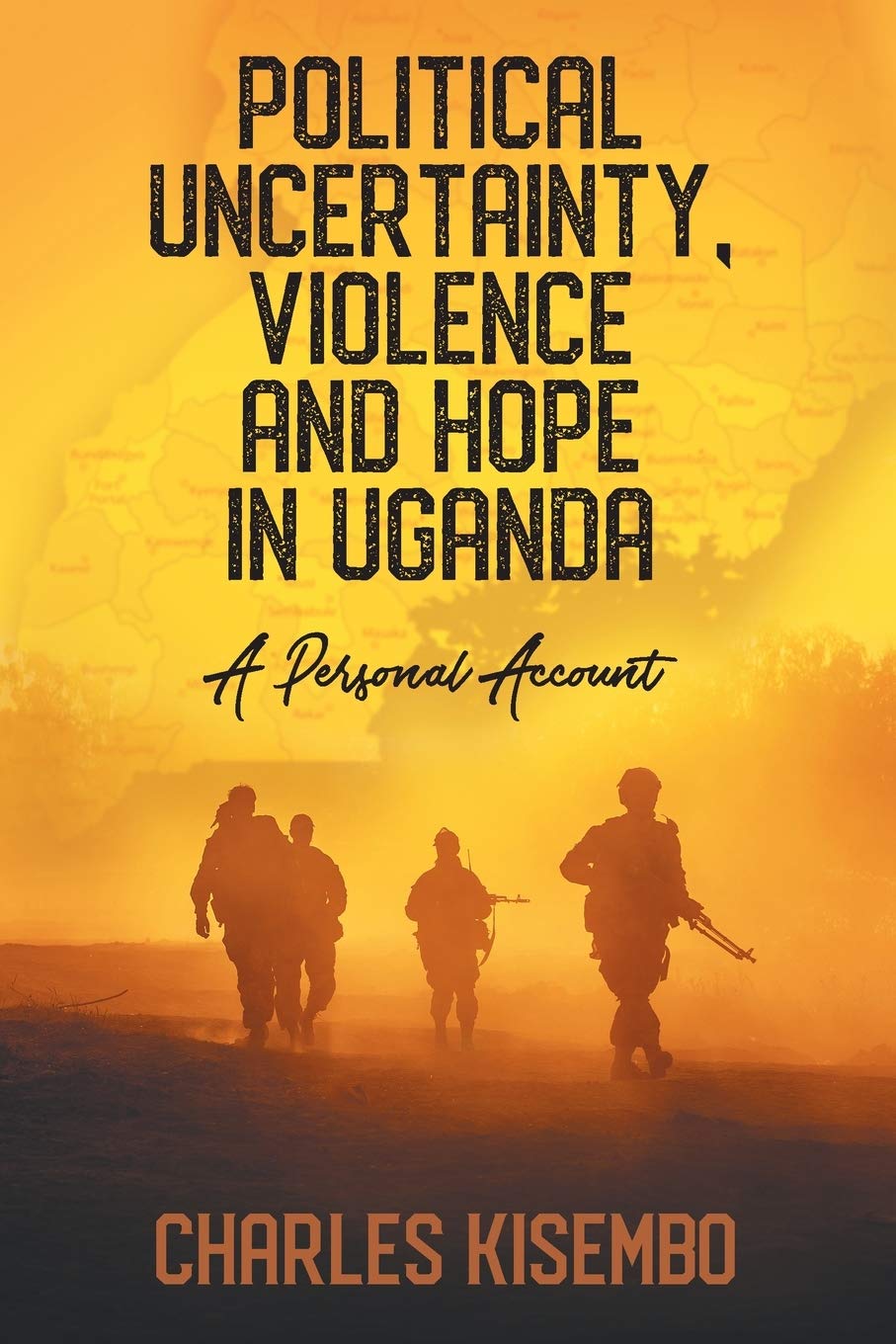
Col. Charles Kisembo attempts to answer this question in his book, “Political Uncertainty, Violence and Hope in Uganda: A Personal Account”.
In its twelve chapters and 342 pages, we are introduced to the author’s evolution from civilian to soldier. Then, ultimately, how the different phases of his life overlap to embody the civil-military dichotomy whose duality the author seeks to bring into single focus.
It is intriguing how he seeks to winnow military history from a history of the military in such a lively and personal manner.
As to the latter, he shares an anecdote regarding when he returned from an intelligence course in Cuba in 1987.
A few weeks after the course, he and the other “cadres” who underwent the intelligence course were invited to dine with President Museveni at State House.
After a hearty meal punctuated by the President’s upbraiding of the State House chefs for cooking amounts of meat unequal to the big appetites of these young troopers, selected soldiers were invited to brief the president on the different dimensions of the course.
The author briefed the president on Marxist-Leninist ideology, thereby recommending that its two-stage approach to ridding the world of capitalism should be taught to Ugandans in order to sculpt our country’s superstructure towards patriotic determinism.
After a briefing worthy of Karl Marx himself, the author hoped he would get apolitical thumbs up from the putatively Marxist president.
Instead, as Kisembo basked in the afterglow of his “workers of the world unite” briefing, Museveni said to all of them: “Do you see this one? He is dangerous. Do you know what he is saying? He is saying that we should teach the population Marxism.”
As the author retreated with his tail between his legs, he attempted (in this book) to clarify the President’s derision of his stance as being expressive of his own (Kisembo’s) shortcomings.
Who was he to teach such ideology to the population when he himself hadn’t fully grasped its scientific complexities?
This discussion (if we may call it that) between the President and the author actually illuminates an age-old disjunction between Marx and would-be Marxists.
In Marx’s time, many workers were continuously stung by the cruel lash of exploitation, so they didn’t need Marx to superimpose an “ism” on their suffering for them to understand what capitalism meant.
This begs the question, should anyone teach Marxist-Leninist ideology or must its philosophical nature be treated as a function of how we live?
It appears that, as illustrated by the president’s dismissal of the author’s ideological preoccupations, the NRM/A merely espoused Marxism but never took seriously the ‘vertical’ notions of ‘classical’ Marxism — e.g. the primacy of the class struggle.
Such a struggle presupposes “international proletarian solidarity” to defeat capitalism in hopes of creating the horizontal plane of a classless society. But to the NRM, it appeared to be just another opportunity to posture.
In Chapter Two “The UPC Political Challenges and Ideological Confusion, 1962-1972”, the book again walks into the mine-strewn field of ideological contestation and exposition.
Through the lens of a browsing philosopher, the author looks at President Milton Obote’s Nakivubo Pronouncements.
These Pronouncements were an article of faith issued by the Uganda People’s Congress (UPC) in 1970.
They outlined the UPC government’s plan to acquire 60% holdings in several private enterprises as part of the move towards socialism described by the Common Man's Charter of 1969 (the "Move to the Left").
Obote’s approach can be viewed through the prism of ideological experiments African leaders undertook to unshackle their nations of the yoke of imperialism in the “aftermathematics” of independence.
In Tanzania there was Ujamaa (brotherhood), Senegal (Négritude), Zambia (Humanism), Zaire (Authenticity) and Ghana (consciencism) to name but five.
The author uses Obote’s socialism as a jumping off point into analyzing the chaos which it engendered instead of attempting to dissect its intersections of cultural and intellectual history.
We see clearly that he has taken the line that Obote was a malefactor in Uganda’s politics, hence creating the cleavages formed between civilian and military.
These cleavages are exemplified by political party conflicts which were brought to a head by the Uganda National Liberation Army (UNLA) and Front for National Salvation’s (FRONASA) rivalry.
Chapter five is dedicated to this rivalry, and herein is where the author reverts to revisionism.
“To overcome the rising political hurdles, Obote decided to abolish the 1962 Federal Constitution, and replace it with a Republican one. He endorsed a Constitution that granted Federal Status to five traditional kingdoms---Buganda, Bunyoro, Toro, Ankole and Busoga, hence breaking the Buganda Federal monopoly,” he writes.
This ahistorical view fails to take into account that these kingdoms were inimical to republicanism, not an endorsement of it.
Furthermore, it was the British who left behind a quasi-federal constitution embracive of the five kingdoms as a fudge or compromise to ease regional tensions, real or imagined, in Uganda at the time.
In later chapters, the author chronicles the rise of the National Resistance Army (NRA).
Being a former NRA combatant (class of ’85), he ably explains how it grew into a conventional force with a national character and was duly renamed Uganda Peoples Defence Forces (UPDF).
To crystallize civilian and military interests in the national interest, the author says the UPDF’s mission is to defend Uganda’s territorial integrity through patriotic duty and resolving conflicts placing great store by clear political objectives which “redress wrongs and re-establish peace and security”.
It’s a mission which jibes with Prussian General and Military theorist Carl Von Clausewitz's most famous words “war is merely the continuation of policy by other means”.
The author builds his thesis upon the role of the military in fostering hope in Uganda.
In the end, one cannot gainsay the UPDF’s signal contribution to Uganda’s growth and development.
However, as it continues to be politicized in support of the current ruling elite, one cannot help but wonder whether the author would have the intellectual daring to concede that the violence wrought through poor civil-military relations in the past is bound to happen again, as a result of said politicization.
In fine, this book is an engrossing read which will capture your attention and only release it when you’ve turned the final page.
