
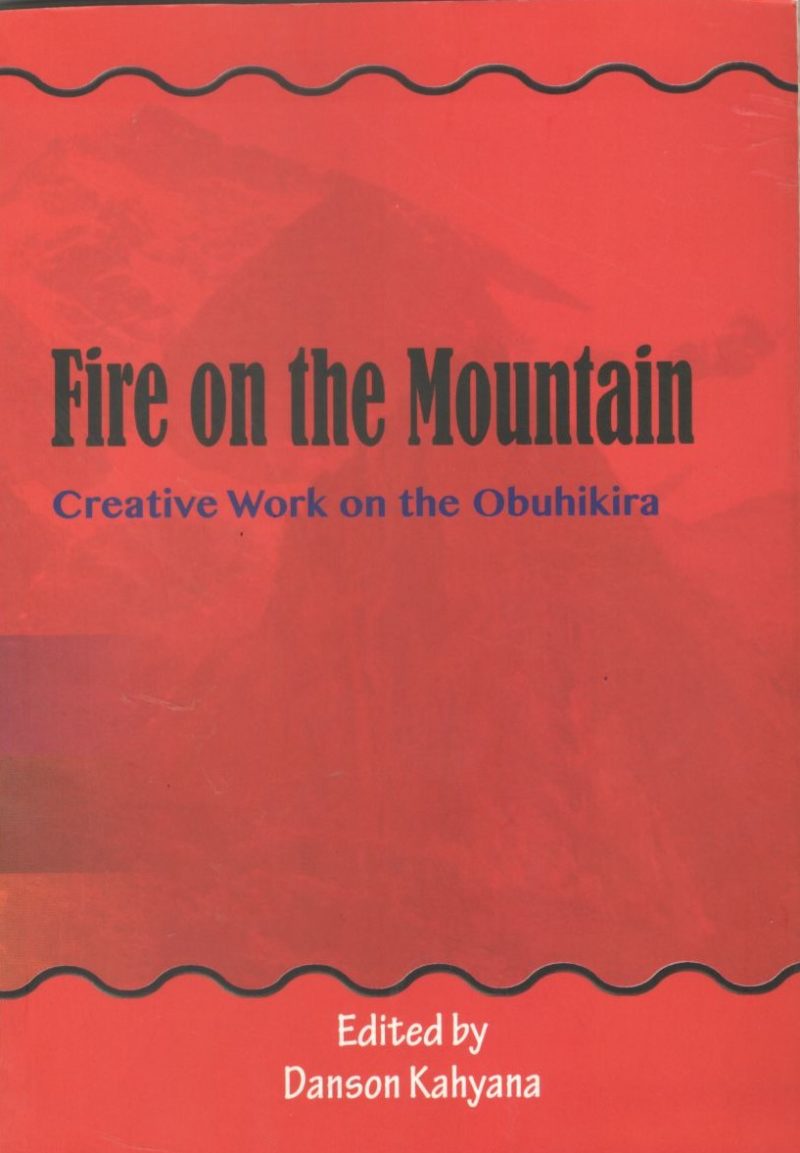
Dr. Danson Kahyana is many things: a teacher, writer of children’s books, motivational speaker, poet, events manager, anthologist, publisher and editor of the poetry anthology Fire on the Mountain: Creative Work on the Obuhikira.
First published in 2018, this anthology revisits the calamitous events surrounding the Uganda army’s storming the Obuhikira, the palace of the King of the Rwenzururu Kingdom, Omusinga Charles Wesley Mumbere Iremangoma.
And thereby killing more than 100 persons, including at least 15 children, on November 26 and 27, 2016, in Kasese, Uganda.
Throughout what Sir Winston Churchill called “the lamentable catalogue of human history”, every social and political occurrence has been marked by a corresponding reflection in the character of literature recorded by writers, historians and, best of all, poets.
In this vein, this anthology brings together 23 outstanding artistic minds who, through verse and drama, vividly re-examine the death and despoil on those two days in November which will forever live in infamy.
“Mountain Ablaze”, a poem by Professor Timothy Wangusa, rages against the dying of any poetic light with apocalyptic fervor:
‘When the Mountain of Rain explodes into fire,
And astounded foot-hills cry out in protest;
When the Mountains of the Sun turn crimson,
And the Mountains of the Moon turn scarlet...”
Those are the first two stanzas of the first poem in this anthology. And they amplify the page like a howling siren betokening grave danger. Oh yes, each word and inflection move in imitation of the fateful scenes they describe.
With alliterative “bouts of bafflement”, professor Wangusa characterizes a nation as taken aback by a murder most foul.
It is gripping in its narrative power and repulsive in the way it abandons us at the “Terminal Coming”.
A coinage (by the professor) whose currency ensures that we shall all eventually pay the ultimate price of living to die.
In Dr. Susan Nalugwa Kiguli’s poem “The Unending Game”, dangerous times are captured by words suited to elegies best read aloud to warn the neighbours, but also to remind us all:
“No one deserves to receive news of
The death of a father
By watching uniformed men
Club his head
Until he crumbles
In an incoherent heap
While television cameras run…”
Our humanity is linked by the poem’s reason and rhythm to the sense that when any of is cut, we all bleed.
So no communities should be subjected to “the power of violence” or unpeopled by the “silence of terror”.
We deserve better than being condemned to a Uganda orphaned by the sword of its own rage turned inward.
Through the poem “Possessed Men” by Bash Fahad Mutumba, we are invited to positively identify those consumed by the need to unto the chords of our Ugandaness:
“These men…
flogged our children
with whips embedded with nails
then rubbed hot pepper
into our tenders eyes.”
After reading this stanza, you feel your mouth instinctively forming the word “Ouch!”
The cold fury of indignation rushes through your veins, accompanied by the evocative force of these words.
The poet’s style of introducing several images to illustrate the pain of those who perished and how their loved ones felt is powerful.
The pain of loss is universal and so ably ties in with the universal truths of the poet’s preoccupations.
“Red Teeth” by Harriet Anena is pithy, punchy and provocative:
“Tie a rope
around my neck and
herd me
to the peak of Ruwenzori.
Take a blunt knife
a twin-tongued spear and
tattoo my body
black
white
like a Zebra’s stripes
Soak my skin
in buckets of kerosene and
strike a match.
Watch me get chewed by thered teeth of
fiery flames until
I’m subdued
like my king.”
I had to write out the whole poem, not because I wanted to. But because the masonry of its lyrical apparatus grows on you word by word, stanza by stanza until the quiet contemplation behind these words and stanzas ignites into your fiery adoration for it.
She effortlessly projects her presence of mind by inviting her (our) tormentors to do their worst.
As her spirit burns bright, you realize you can’t extinguish it with fear or violence.
It is immune to your torment; for its fire will consume yours. And when your evil is ashes, it will allow it to be carried away by the winds of change.
“Do You Believe in Uganda?” Monica Arac de Nyeko asks:
“I believe in Uganda
I believe in our history
I believe in our present
I believe in our future…”
She, with simplicity, outlines a broader mission: collective belief in our country. Which is another way of exhorting us toward patriotism, so we can rise from the ruins of our own shortcomings by dint moral courage.
To be sure, that is what “belief” is: taking a grand leap and hoping you can fly.
Yeah, it’s true, actor Will Smith said that too. But Monica said it slightly better.
All told, Dr. Kahyana’s collection of versifiers have laid down words which read like the “We are the World” of Ugandan poetry.
Each poem matches the equal parts which make them whole as they join together as a requiem for those who were killed in Kasese.
Sometimes this anthology is judgmental, sometimes it’s moralistic and oftentimes it is angry and emotional. But through its carefully pointed messages, it’s spangled with the dreams of a better Uganda.
We truly feel the defiance which comes from its rejection of dejection.
Fire on the Mountain may even change its title to “We Shall Overcome” and lose none of its luster or suffer from any misnomer.
On top of such exquisite poetic feats of fluency, there’s a play written by Mercy Mirembe Ntangaare to further whet your whistleblowing alerts to fellow Ugandans to get with the program and save “a nation in labor”.
As the Afterword (written by Shaun Viljoen, Professor of English, Stellenbosch University, South Africa) reveals, Dr. Kahyana includes a wide array of poets from Stella Nyanzi to Kened Bwambale “to give us an idea of various generational responses”.
And, in this, he proves that he is yet another thing: a channel through which those responses may be heard.
