
Spoken word poetry reinforces a poet’s meaning with facial expressions, hand gestures and vocal inflexions.
These can be further reinforced by a rapport between poet and audience which has the quality of immediacy in terms of feedback. So the poet and audience are on the same page, so to speak.
However when a poet commits words to the written page, that poet must observe certain literary principles in order to be completely understood.
This can be a problem for a spoken word artist who relies on the looseness of phrase and a conversational style steeped in colloquialisms, which cannot be clarified to the reader by voice or gesture.
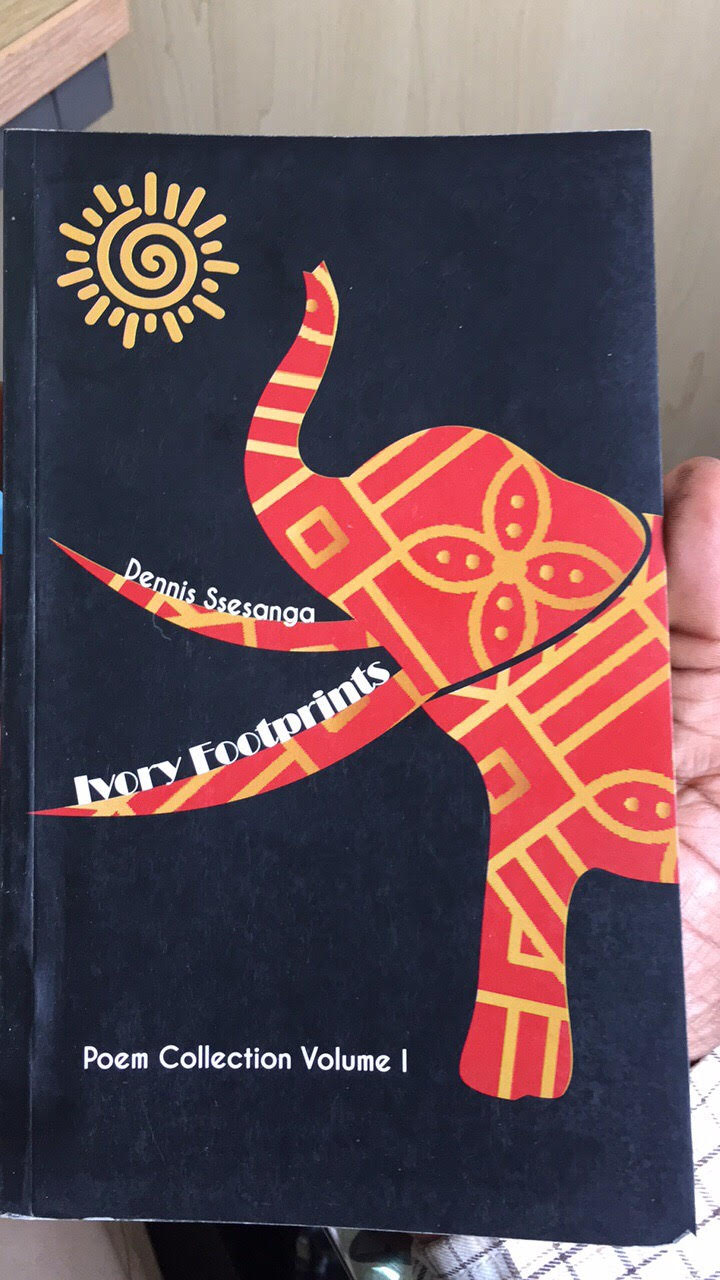
That clarity must be found in the power of the written word. To this end, Dennis Ssesanga has made the transition from the spoken word to the written word in his book “Ivory Footprints”.
In the poem, Spoken Word Comeback, we see this transition unfolding with a shouted yet calm use of expressions to convey meaning:
“Beautiful masterpiece… hot chocolate….
Blue berry… pink nails…. syrup in the cupcake…
You’re the…
The calm glare on my glass
The blue chip in my blood
The antidote for the toxins
The milky chocolate in my glass
The sweet perfume in the arena
The moon light in my dark night path”.
The conversational looseness of poem which could easily be spoken is replaced by his own typographical peculiarities and metaphysical vocabulary to reconcile metaphor with the way he feels.
Although, one must note, the barrage of metaphors are somewhat levied upon the reader’s attentiveness.
They come fast and furious, changing constantly to conjure meaning out of the same thing.
This can be exhausting to the reader, even though it works well to a listener at a spoken word event.
In this poem, the reader is tasked with visualizing metaphor upon metaphor which requires a lot of mental effort in visualizing the different images used to convey a single image.
Interestingly, the “prosody” or patterns of rhythm and sound comes down a prosaic flow in another poem entitled, Of taking the little thereof without justice:
“You will pay three times the average in taxes
Having a third of your salary go to their authority
And still take some for your social security
Like they love you so much to care enough!
Yet they never bother to redeem your bankrupt accounts
But will steadfastly come to probe the funds on your account.”
His emphatic fury with the lack of fairness on the part of the authorities has worked its way into this literary opus to highlight injustice eloquently.
He ably demonstrates the hypocrisy and greed which the artist is subjected to in the name of social progress.
His tone is defiant, his sense of grievance unmistakable.
Although this poem is sterile of the florid word play this poet often favors, the plain-spokenness easily strikes a chord with the reader.
It is clear and straight-shooting, so the reader cannot get lost in any undue verbiage.
Another poem entitled “My pillow” starts exquisitely. The first stanza is literary gold, mirroring the poet’s regard for his pillow:
“My pillow
A gold mine of sweet dreams
Each time I lay I sniff in some gold dust
That sends my mind
To wonderland
A place I thought never existed.”
Then, inexplicably, the poem becomes heavy-footed and clumsy:
“In my dreams I toast glasses with the likes of Barrack Obama
Patting their heads and say anything in the comfort of KGB
Pat them on the head without the KGB chasing me”.
In the first stanza, each line was smooth, short and sensual. All the lines contained no unclear correspondence between the words used as they married sense and sound in literary matrimony.
It was simple, with the imagery evoking a rhythmic spell keeping the reader attuned to each word and inflection.
Then the second stanza hits you like an alarm bell, just as you’re enjoying the comfort of the pillow.
Alarmingly, elegance is substituted by inelegance as ordinary prose takes charge with military urgency.
The poet assumes, wrongly, that we all know what the KGB stands for and who Barrack Obama is.
Sure, we mostly do.
However to assume we do is lazy in the sense that the poet doesn’t make any effort to make us see Obama and the KGB through his eyes.
Thankfully, he reverts to the smooth flow of words which appeals to our mental ear in the poem: About patriots, politics and family: The next revolutionaries:
“The next revolutionaries
They shall not be musicians
They shall be poets
Their words shall not be bullets
But they shall sound like loaded guns…”
Whether written or spoken, the literary elegance is there for all to see.
The plain polish of his written style sparkles with rhetorical Oomph which hits you between the eyes and leaves you out for the count as you’re left reeling from such punchy poetry.
In his ode to the waitress entitled “Delighted Waiter”, Ssesanga writes:
“She serves wine never tasted by her
Wine only known by name to her
One wonders whether she would ever taste such
Sweet wine, dry wine all the same.”
We feel his sense of injustice, it reminds one of Chris Rock’s speech in the movie Head Of State entitled “That ain’t aright”:
“How many of you work in a city you can't afford to live in?” Chris rock asks.
The poem’s careful balance of phrases is a rhetorical home run.
Ssesanga in this and most of the poems in this beautiful anthology is adept at deploying descriptive aliases instead of simple nouns.
The operative word here being “deploying”, for Dennis Ssesanga uses words like armies use soldiers: to battle until the war is won.
If that war is for great poetry, then Ssesanga can consider himself a winner.
