

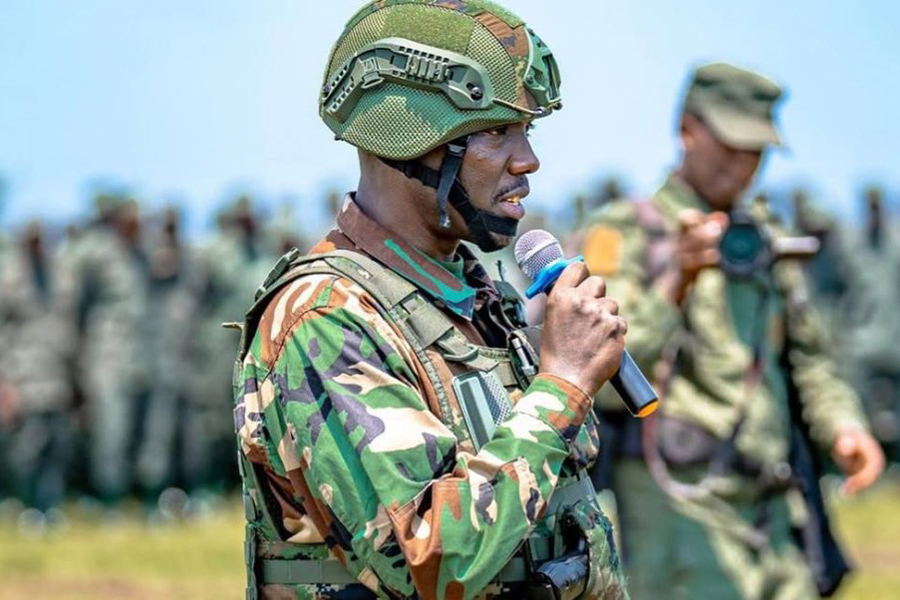
The military commander of the March 23 Movement, Major General Sultani Makenga, has resurfaced publicly, presiding over the pass-out ceremony of 1,518 newly trained fighters at the group’s key training facility in Rumangabo, North Kivu Province.
Makenga’s appearance at the Tuesday ceremony follows more than a week out of the public eye after a drone strike in Masisi territory that killed the group’s military spokesperson, Lt Col Willy Ngoma, on February 23.
In the aftermath of the attack, pro-Kinshasa social media accounts had claimed that Makenga had also been killed or seriously injured in the strike — claims that had not been independently verified.
A video shared by the AFC/M23 head of communications, Lawrence Kanyuka, shows Makenga officiating the ceremony, marking his first confirmed public appearance since the bombing.
The event saw the graduation of members of what the group described as the Mobile Special Forces of the Congolese Revolutionary Army (ARC), the armed wing of the rebel movement.
In a statement, Kanyuka said: “1,518 members of the Mobile Special Forces of the Congolese Revolutionary Army (ARC) successfully completed their training this Monday, March 2, 2026, in Rumangabo, in North Kivu Province. Now fully operational, these new commandos stand ready to serve, defend, and protect civilian populations, victims of the war imposed by the Kinshasa regime.”
The confirmation of Ngoma’s death earlier this week marked a significant moment for the rebel movement. As the group’s most visible public figure and principal spokesperson, Ngoma had frequently represented M23’s positions in media engagements and online communications.
His death was confirmed by the movement after initial reports from regional media.
Addressing the newly trained fighters, Makenga framed their role as one of liberation rather than conquest.
“From today, you are in the army that is the liberation army, which is here to liberate our country,” he said during the ceremony.
He accused the government in Kinshasa of having “captured” the country and harming its own citizens, alleging that it had relied on allied forces and foreign mercenaries in its campaign against the rebels. “Our people have been refugees for years and years, some are even refugees in their own country here,” Makenga said. “Now that you have joined the liberation army, be ready to fight for them.”
Makenga urged the recruits to maintain discipline and high standards, distinguishing themselves from other armed actors accused of abuses against civilians.
“You must be different from how you were before, be different from the others who kill the citizens, because your colleagues and the people will be happy to see the difference you create in their lives,” he said.
“Have high standards and discipline, be patient and the people we serve will see the difference.”
Makenga, who was in his usual unassuming and collegial element and paced from side to side with his left hand jabbed deep into his pocket, told the enthusiastic new fighters that the "Kinshasa regime has captured our country" and that is was killing its own citizens.
The Kinshasa government has largely framed the M23 cause as that of neighbouring country Rwanda, and that the rebel group was largely comprised of Rwandan Tutsi people, using ethnicity to sow division in eastern DR Congo.
The vast central African state has more than 200 ethnic and shares many with neighbouring countries of Burundi, Rwanda, Uganda and South Sudan.
But Makenga told his fighters to only think like patriots, that the country is for everyone who belongs to it.
He also challenged the fighters with rhetorical questions about expelling hostile forces, ending tribalism, and restoring national dignity, telling them they would be respected if they acted as true liberators.
“Being fully operational means more than mastering combat,” Makenga said. “It means embracing the moral responsibility that comes with bearing arms. Defending a territory is defending a dignity.”
The resurgence of M23 activity in eastern Democratic Republic of Congo has intensified tensions in North Kivu in recent months, with repeated clashes reported between the rebels, Congolese armed forces, and allied militias.
The group, which first rose to prominence in 2012 before being defeated and later re-emerging, continues to position itself as a political-military movement seeking reforms and security guarantees.
Makenga’s public reappearance is likely to bolster morale within the rebel ranks while countering narratives that the leadership had been weakened by the recent strike.
However, the broader conflict in eastern Congo remains fluid, with regional and international actors closely monitoring developments amid ongoing instability in the mineral-rich region.