
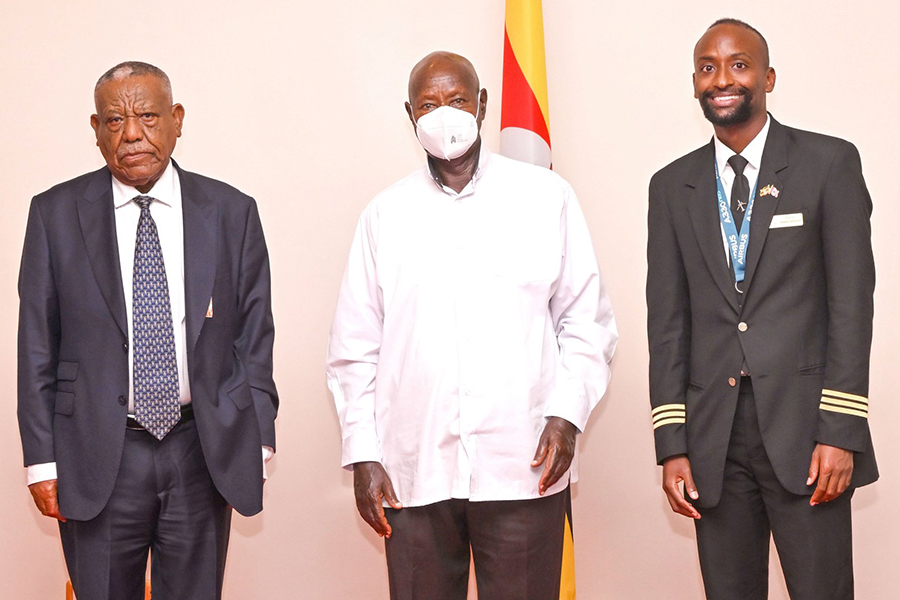
In a move that has jolted the aviation industry and stirred sharp reactions on the floor of Parliament, President Museveni has bypassed conventional recruitment procedures to appoint 82-year-old retired Ethiopian aviation executive Girma Wake as Acting Chief Executive Officer of Uganda Airlines.
The directive, contained in a letter dated February 13, 2026 and addressed to the Minister of Works and Transport, followed the immediate dismissal of the embattled former CEO Jenifer Bamuturaki.
Wake is expected to serve as Consultant and Acting CEO until July 2026 as government searches for a substantive replacement.
While Wake’s reputation in African aviation circles is formidable—having previously led Ethiopian Airlines through a period of dramatic expansion—his age and the manner of his appointment have triggered intense debate over governance standards at Uganda’s national carrier.
Critics argue that the process once again sidesteps competitive recruitment and established corporate governance norms. The appointment mirrors the 2022 elevation of Bamuturaki to the top job, a decision that also bypassed open competition and later came under scrutiny amid reports of financial losses and management turmoil at the airline.
Ibrahim Ssemujju Nganda, the MP for Kira Municipality, questioned both the accountability structure and the long-term intent behind the decision.
“Who is this manager accountable to? What are the targets for this CEO?” Ssemujju asked. “You need to find the most competent people through strategic criteria, not informal recommendations. Ethiopian Airlines works for its country with a clear model. What is Uganda’s model? If we continue like this, we risk operating an airline without a clear national objective.”
His remarks underscore broader concerns within Parliament about transparency and oversight in the management of state-owned enterprises.
Uganda Airlines, revived in 2019 after nearly two decades of dormancy, has struggled to achieve profitability amid high operational costs, global aviation volatility and internal management disputes.
MP Ndyomugyenyi Roland, a member of Parliament’s Committee on Commissions, Statutory Authorities and State Enterprises (COSASE), which previously audited the airline, described the appointment as both “long overdue” and “informal.”
“The job was too big for Bamuturaki, and she was never fully comfortable in the role,” Ndyomugyenyi said.
“But we must also be honest: the problems at Uganda Airlines are systemic. One individual, however experienced, cannot solve structural weaknesses overnight.”
He argued that while Wake’s experience is not in doubt, the airline requires a comprehensive institutional overhaul rather than a temporary stewardship.
“We need dynamic, efficient leadership backed by a thorough audit of human resource capacity, financial controls and technical operations. Without a full institutional review, we risk repeating the same cycle,” he added.
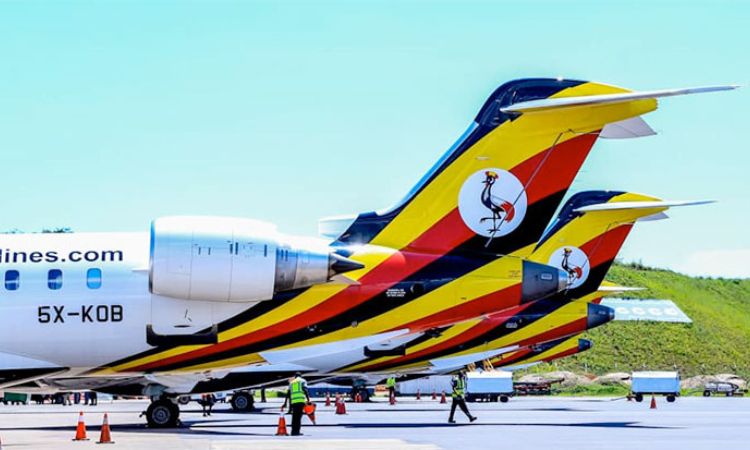
Wake’s supporters, however, point to his decades-long experience in turning around complex aviation operations across Africa. During his tenure at Ethiopian Airlines, the carrier transformed into one of the continent’s most profitable and globally connected airlines, widely regarded as a benchmark for state-owned aviation success.
For Uganda Airlines, whose fleet expansion and route development strategy have been overshadowed by mounting operational losses and boardroom tensions, the expectation is that Wake’s short-term mandate will stabilize management structures and restore investor and public confidence.
President Museveni’s directive indicates that a substantive CEO should be identified by July 2026. Yet skeptics caution that the interim period must not become merely a “cleanup window” that postpones deeper reforms.
Parliamentarians are increasingly demanding measurable targets, transparent performance benchmarks and strict adherence to corporate governance principles. They argue that the airline’s previous financial setbacks—estimated in the hundreds of billions of shillings—have already strained public confidence.
“The president has constitutional authority,” Ndyomugyenyi said, “but Parliament must ensure value for money. Proper due diligence is non-negotiable if we are to protect taxpayers and restore Uganda’s credibility.”
At the heart of the controversy lies a broader question about the governance of state enterprises: Should executive appointments of this magnitude be driven by presidential directive, or through independent, competitive processes that insulate companies from political perception?
As the national carrier—whose emblematic crane symbolizes Uganda’s aspirations—enters yet another leadership transition, the stakes are high. The coming months will determine whether Wake’s tenure represents a decisive reset or simply another chapter in a cycle of instability.
For now, Uganda Airlines finds itself at a crossroads, balancing the weight of its financial challenges against the reputation of an octogenarian aviation icon tasked with steadying its wings.
