

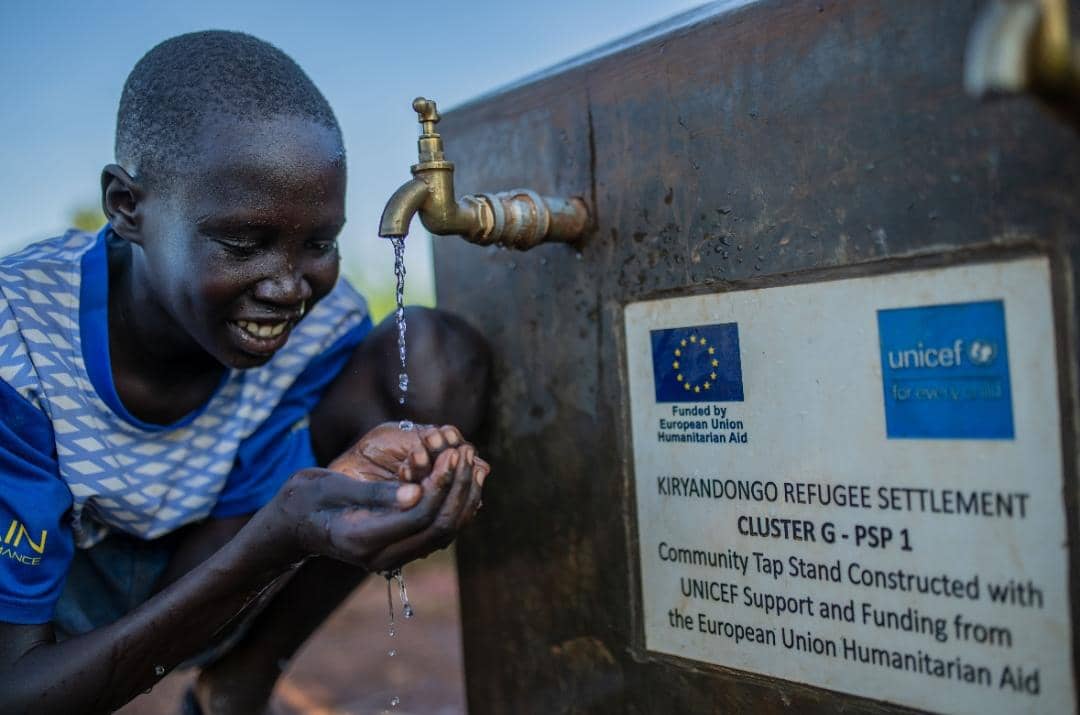
More than 165,000 refugees in Kiryandongo Refugee Settlement are celebrating a major relief following the installation of two solar-hybrid piped water systems that have ended years of long treks and unsafe water collection.
The project, funded by the European Union Civil Protection and Humanitarian Aid Operations (DG ECHO) and implemented by UNICEF in partnership with the Lutheran World Federation (LWF), provides safe and reliable water to both refugees and host communities in Uganda’s mid-western region.
Completed within just three months between July and October 2025 the new systems are already operational in Clusters C and G of the settlement, serving families who fled conflict from South Sudan, Sudan, the Democratic Republic of Congo, and Kenya.
“I used to spend almost the whole day walking three kilometres to fetch water,” recounts Habib Ahmad, 30, a refugee from Sudan who arrived in January 2025. “Now I only walk a few metres, and within 10 to 15 minutes I’m done. UNICEF and the European Union have solved our water problem. People were really suffering.”
According to Liam Kelly, the Head of EU Humanitarian Aid in Uganda, the initiative underscores the EU’s commitment to promoting green humanitarian solutions.
“This project demonstrates the European Union’s commitment to greening its humanitarian aid through sustainable and life-saving assistance to refugees and their host communities,” Kelly said.
“By investing in solar energy and resilient water systems, we are building a better future for the most vulnerable.”
The new hybrid systems draw water from deep production wells using solar-powered submersible pumps, supported by diesel generators at night or during cloudy weather. The water is transmitted through 2.6 kilometres of pipes to 108-cubic-metre hilltop reservoirs, and then distributed through 4.6 kilometres of pipelines to 22 public standposts all providing free access to clean water.
Dr. Robin Nandy, the UNICEF Representative to Uganda, hailed the collaboration with the EU, describing it as a “lifeline” for thousands of families.“Access to clean water is a fundamental right for every child and their family,” said Dr. Nandy. “With these systems now complete, refugees and host communities no longer have to spend hours searching for water. This partnership with the European Union has been instrumental in ensuring around-the-clock access to safe and clean water.”
Before the installation, refugees in Kiryandongo were surviving on just 9 litres of water per person per day, far below the Sphere humanitarian standard of 20 litres.
The new systems are expected to raise water availability to the global benchmark, improving living conditions and public health across the settlement.
The project also replaces costly water trucking, which had been the main water source since a surge of refugees in 2023 outpaced existing infrastructure.
Beyond convenience, the systems are bringing transformative health and social benefits. With water now closer to homes, women and childrenbwho traditionally bear the burden of collection can focus on education, childcare, and economic activities.
"When water is within reach, families stay healthier, children attend school regularly, and women can engage in productive work,” Dr. Nandy added.
The initiative will also serve over 4,000 learners at Canrom Primary School within the settlement, improving hygiene, reducing waterborne diseases, and supporting the overall well-being of children.
The success of the Kiryandongo water project marks another milestone in Uganda’s ongoing efforts to promote sustainable and dignified living conditions for its growing refugee population the largest in Africa.