
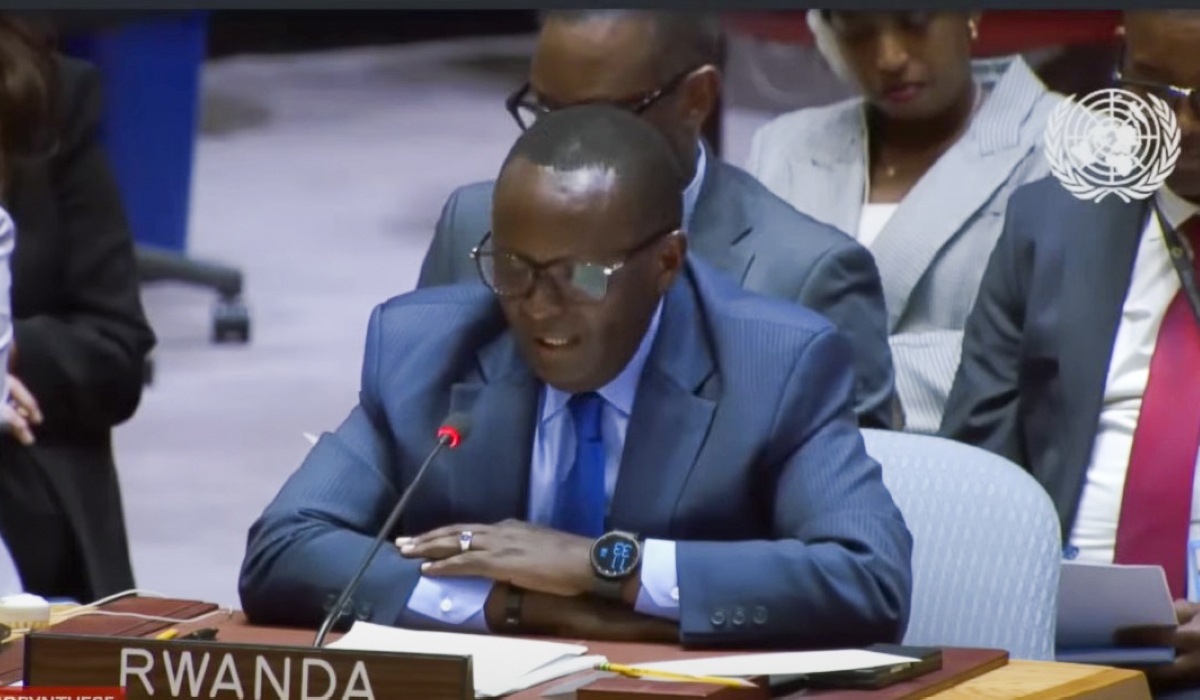
Rwanda has sharply criticised the Democratic Republic of Congo over what it describes as a failing democracy and inadequate handling of security threats from the FDLR militia.
The remarks were delivered by Rwandan Ambassador to the UN, Martin Ngoga, during a Security Council session on October 1, Patriotism Day in Rwanda.
“If democracy produces what we see in DR Congo, that's not the type of democracy Rwanda wants,” Ambassador Ngoga said, questioning DR Congo’s governance and its response to regional security threats.
Ngoga told the Security Council that recent UN reporting on eastern DR Congo omits critical facts, such as hate speech and the implication of Monusco’s support to the Congolese army despite its documented alliance with the genocidal forces of FDLR.
“Monusco cooperates with the DR Congo government, knowing FDLR is within DR Congo army,” Ngoga told the council, adding that the UN mission “avoid[s] units and battalions in which FDLR is deployed.”
He said those omissions in the Secretary-General’s report undercut the Security Council’s understanding of drivers of violence in the eastern DR Congo, singling out hate speech, identity-based persecution and the use of mercenaries as underreported problems.
“Hate speech is something very dangerous... Who has not seen hate speech in social media, in classrooms, in churches, where hate is taught to 10-year-olds?” he said.
He urged the Council to treat the issue as more than a passing reference.
Highlighting cross-border attacks, he said, “If you want to know how many times the FDLR has attacked Rwanda, just look at the travel advisories some of your countries have issued.
"Every time the FDLR attacks Rwanda, you advise your citizens not to travel to that part of the country.”
He further questioned the threshold for action under Article 51 of the UN Charter, asking, “If 21 attacks in 31 years are not enough… which threshold justifies that?”
FDLR are remnants of the militia that is largely responsible for carrying out the 1994 Genocide against the Tutsi in which more than a million people were slaughtered.
The group fled into DR Congo jungles after the RPA took control of the country. The Rwandan government says the militia has since been embedded into the Congolese military and continue to pose security threat to Kigali.
Ambassador Ngoga also criticized hate speech in DR Congo, pointing to its prevalence on social media, in schools, and even in churches, saying, “This is not something the report should refer to in passing.”
He contrasted Rwanda’s approach to regional security with Tanzania’s, praising the latter for effectively neutralizing perpetrators who fled there after the 1994 genocide, while the DRC allegedly reorganized and armed them instead.
“The issue is not whether the FDLR are Rwandans or not. The issue is that they must be neutralized,” Ngoga emphasised, insisting that DR Congo address the threat decisively. He also warned that the visible impact of DR Congo’s governance is reflected in its mismanagement of resources, contrasting it with Rwanda’s development despite limited minerals.
His remarks come days after DR Congo military tribunal handed a death sentence to former President Joseph Kabila for treason and war crimes—a decision widely criticised as a sign of declining democracy in the country.
Ambassador Ngoga concluded his fiery intervention by rejecting what he described as DR Congo’s attempts to deflect from the FDLR issue, framing it as a matter of regional security and justice.
