

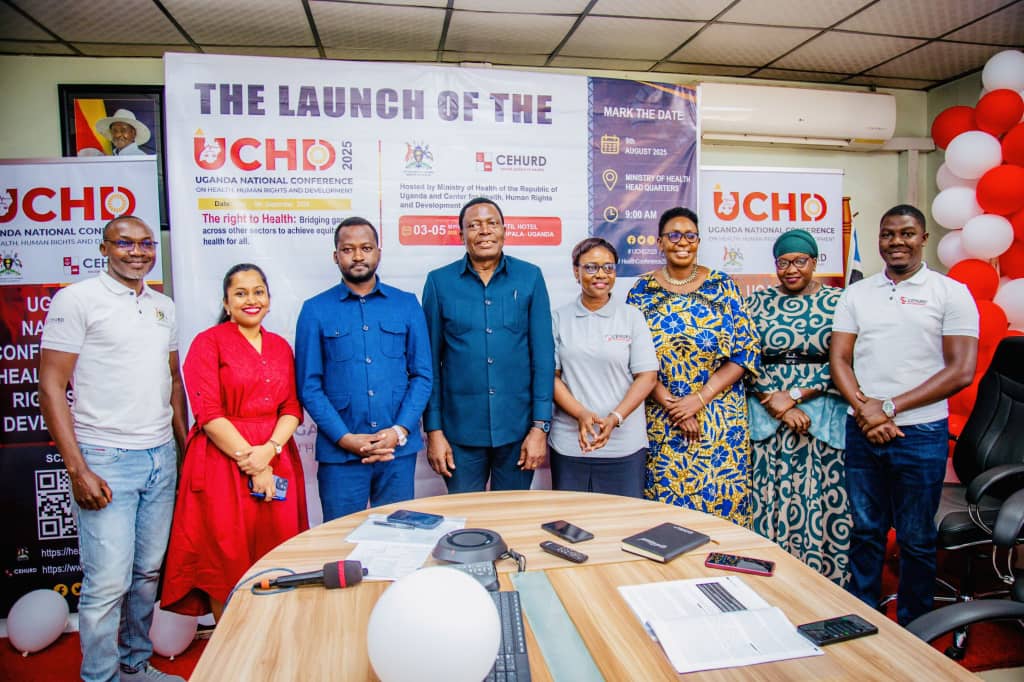
The Ministry of Health, in partnership with the Centre for Health, Human Rights and Development (CEHURD), has launched the 2nd Uganda National Conference on Health, Human Rights and Development (UCHD 2025), set for September 3–5 at Mestil Hotel, Kampala.
The event will bring together more than 350 delegates from government, civil society, academia, the private sector, and international partners to explore innovative strategies for advancing social justice in health.
Themed “The Right to Health: Bridging Gaps across Other Sectors to Achieve Equitable Health for All,” the conference will highlight how factors beyond hospitals such as clean water, education, housing, transport, food quality, and environmental conditions shape health outcomes.
Speaking at the launch, Dr. Charles Olaro, Director General of Health Services, urged Ugandans to rethink the way health is approached.
“Health is not just about hospitals and clinics,” Dr. Olaro noted. “It is shaped by where we live, what we eat, the air we breathe, the transport we use, and whether we live free from discrimination. If we want equitable health for all, we must work together across sectors to address these root causes.”
Dr. Olaro added that the conference will act as a platform for evidence-sharing, best practices, and cross-sector solutions to drive Uganda closer to Universal Health Coverage (UHC) and the Sustainable Development Goals (SDGs).
CEHURD Executive Director Fatia Kiyange stressed that medical care accounts for only 20% of health outcomes, while the remaining 80% depends on social determinants such as income, housing, education, and access to resources and power.
“Sexual and reproductive health rights are central to this,” Kiyange noted. “It’s not just about clinical care people must have the freedom to make informed choices about their bodies and lives, free from stigma and discrimination.”
Kiyange pointed to the 2021 World Health Assembly resolution urging member states to adopt multi-sectoral policies addressing social determinants of health.
She cited road safety as an example, explaining that injuries from traffic accidents are a major cause of death and disability yet this challenge falls outside the traditional health sector.
On the issue of food safety, Agnes Kirabo, Executive Director of the Food Rights Alliance, warned that 10% of Ugandans fall ill because of contaminated or poorly handled food.
“We are what we eat,” Kirabo said. “The mismanagement of our food from farms to markets is sending too many people to hospitals. It’s not enough to produce in quantity, we must also ensure quality.”
Kirabo urged farmers, traders, and consumers alike to take responsibility for ensuring safe, nutritious food and called for tighter coordination between agriculture, public health, and environmental sectors.
This year’s conference will focus on non-communicable diseases (NCDs), food and environmental safety, sexual and reproductive health and rights (SRHR), and the social determinants of health.
Organizers aim to produce a joint action plan prioritizing prevention and cross-sector collaboration to reduce health inequities and strengthen community resilience.