

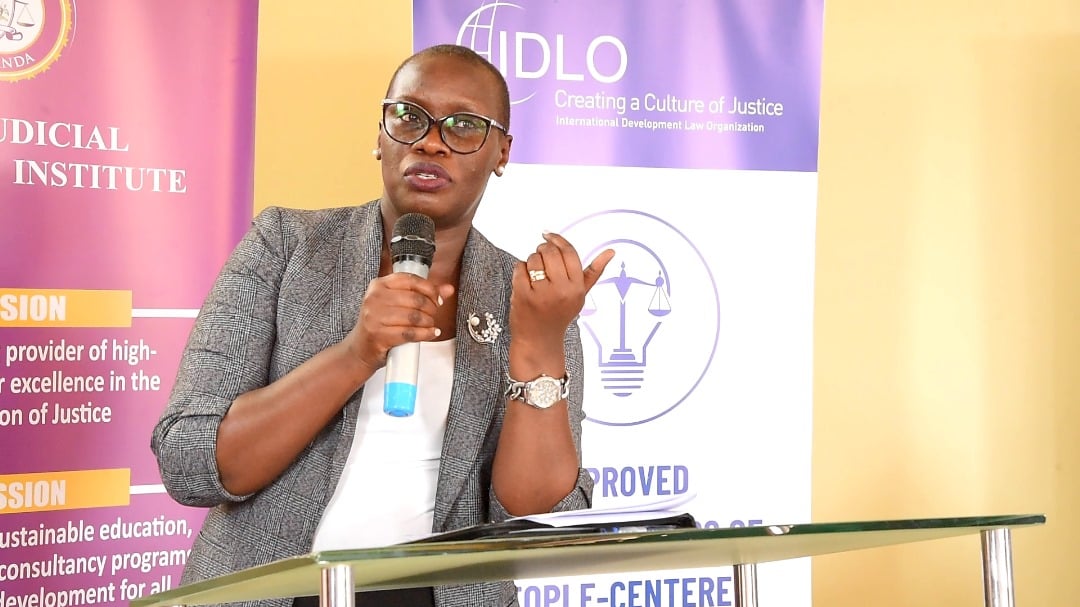
Acting Principal Judge Jane Okuo Kajuga has urged judicial officers to embrace integrity, stronger leadership, and modern case management tools to speed up justice delivery, address systemic inefficiencies, and win public trust.
Speaking in Mbale during the closure of a five-day training on Alternative Dispute Resolution (ADR) and efficient case management for judges and magistrates from Eastern Uganda, Kajuga stressed that leadership within the bench is vital if the judiciary is to reduce delays and clear the mounting backlog of cases.
The acting principal judge warned against habitual adjournments, saying some judicial officers had become known for repeated postponements.
“There are judicial officers whose names are synonymous with adjournment—people come to court already expecting it,” she said.
She proposed stricter case management rules to curb unnecessary delays, citing the Anti-Corruption and Commercial Divisions as examples where such measures work.
“Rules like, if a judicial officer will be absent, prior written notice should be given,” Justice Kajuga said.
“Likewise, if any party cannot proceed on the scheduled hearing date, they must provide written reasons with supporting evidence.”
Justice Kajuga revealed that the judiciary has adopted a mentorship and guidance program pairing judicial officers with senior and retired judges.
“Even if we created peer mentorship teams among different levels of court, you would know you are not walking the journey alone,” she said.
“Justice David Wangutusi has graciously accepted to be the mentor for Eastern Uganda, working with circuit judges.”
The mentorship program complements technology-led initiatives such as the Court Case Administration System (CCAS) and the Electronic Court Case Management Information System (ECCMIS), which allow online filing and tracking of cases, digital court fee payments, and real-time monitoring of backlog and completion rates.
Kajuga also encouraged judicial officers to prioritise ADR, stressing its potential to ease pressure on the courts.
“If each of you conducted just three mediations per month, multiplied by the number of judicial officers we have, the impact would be significant,” she noted.
“The beauty with ADR is that it reduces the recurrence of appeals.”
The Mbale training brought together senior judicial figures, including Deputy Chief Justice Richard Buteera, former Principal Judge Yorokamu Bamwine, and retired High Court Judge David Wangutusi.
Participants took part in simulation exercises pairing junior and senior officers to sharpen practical skills in ADR and case handling.
Uganda’s judiciary is grappling with a backlog of about 167,353 pending cases, with the High Court and Chief Magistrates’ Courts accounting for the largest share—70,006 and 64,937 cases, respectively.
While 72% of these have been pending for less than two years, 2,327 cases remain unresolved for over a decade.
Delayed judgment writing and inconsistent judgment quality continue to slow case resolution, as highlighted in the Chief Justice’s 2023/2024 Annual Performance Report.
With over 200 judicial officers trained in similar programmes across various regions, Kajuga expressed optimism that continuous mentorship and technological adoption will better equip the judiciary to deliver justice more efficiently.