

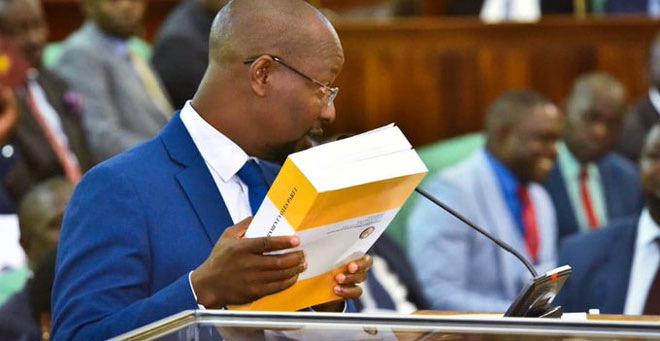
As President Yoweri Museveni and Finance Minister Matia Kasaija prepare to unveil Uganda’s Shs 72.367 trillion national budget for the 2025/26 financial year today, Shadow Finance Minister Ibrahim Ssemujju Nganda has issued a hard-hitting critique, labelling the budget a vehicle for enriching elites while leaving the ordinary citizen in deeper poverty and debt.
In his alternative budget statement, Ssemujju accused the government of excessive borrowing and misallocating national resources to recurrent expenses, debt servicing, and politically connected individuals.
“This year alone, government will borrow Shs 32 trillion nearly half the total budget to finance largely non-developmental expenditures,” Ssemujju stated.
The shadow minister highlighted that 38% of the proposed budget Shs 27.3 trillion is earmarked for debt servicing.
This includes Shs 9.4 trillion in interest payments, mostly to local commercial banks, and nearly Shs 5 trillion in external debt principal.
“We are in a situation where we borrow Shs 34 trillion and repay Shs 27 trillion. That’s one step forward, two steps back,” he warned.
Uganda’s total public debt currently stands at Shs 106.2 trillion, about 52.4% of the GDP. Ssemujju expressed concern over rising interest rates, a depreciating currency, and dwindling foreign reserves, which he says could plunge the country into a debt crisis.
He also questioned the government’s revenue targets, pointing to the Uganda Revenue Authority’s (URA) ambitious projections.
The URA is expected to raise Shs 34 trillion, a sharp jump from last year’s target of Shs 29.3 trillion, which it failed to meet. Over the past four years, URA has consistently missed its revenue targets.
“In 2023/24, the actual collection was Shs 25.7 trillion against a target of Shs 29.2 trillion,” Ssemujju observed, questioning the realism behind the projected Shs 34 trillion.
Ssemujju further criticised the disproportionate budget allocations favouring a small elite at the expense of the wider population.
He noted that Shs 12.8 trillion (16%) of the budget will go to public servants, who comprise less than 1% of the population.
Additionally, Shs 500 billion has been allocated to the President’s residence, with another Shs 306 billion for his office.
Meanwhile, only Shs 1 trillion just 1.3% of the budget is allocated to the Parish Development Model (PDM), meant to uplift 14.8 million Ugandans from subsistence farming.
“The budget must reflect the needs of ordinary people, not political cronies,” he said.
He raised red flags over allocations to controversial projects and individuals, including Shs 465 billion to Ms.
Enrica Maria Aristidina Pinett for the Lubowa Hospital project, bringing total payments to her to Shs 1.239 trillion; Shs 60 billion to Roko Construction Company, despite concerns from the Auditor General over irregular share acquisition; and Shs 247 billion to the Democratic Republic of Congo as reparations following a court ruling over Uganda’s past military involvement.
Drawing on census data, the Shadow Finance Minister painted a grim picture of Ugandans’ living conditions, revealing that 14 million walk barefoot, 15.7 million are unemployed, 28 million still use firewood as a cooking source, 5.6 million households share single rooms, and 20 million are food insecure.
“This budget does little to address the fundamental needs of Ugandans. We need a national conversation on priorities,” he urged.
Ssemujju proposed a fundamental restructuring of the national budget to focus on job creation and youth employment, investment in agriculture and irrigation, support for health and education infrastructure, and transparent monitoring of poverty alleviation programmes like PDM.
“Before allocating more money to PDM, Parliament must demand accountability and a value-for-money audit,” he insisted.