

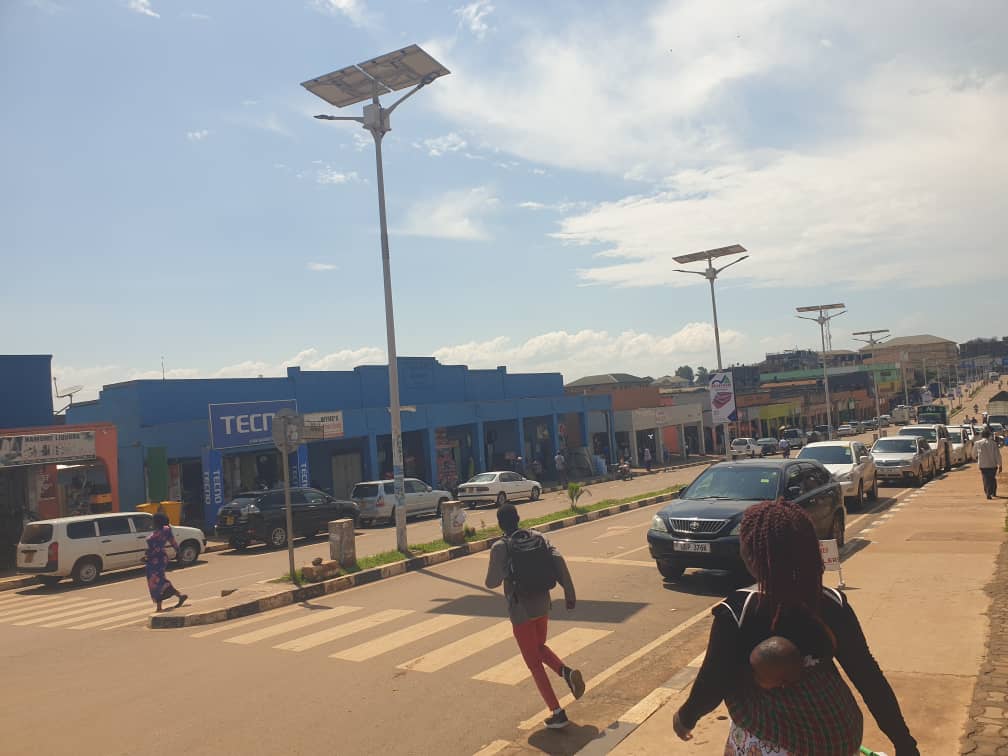
The state minister for urban development Obiga Kania Mario has revealed government’s intentions to standardize the quality of solar-powered street lights imported for government projects.
This follows widespread concern over the short lifespan of solar-powered lights installed along USMID road projects across the country.
Hundreds of solar-powered security lights were installed along the World bank loan-funded Uganda Support to Municipal Infrastructural Programme (USMID) road projects in Mbale with the first phase of the project commissioned by President Museveni in 2019.
Each unit was reportedly procured at shs7 million and shs9 million for single arm and double arm respectively including the pole, light, battery, and solar panels.
However, the lights started blacking out in phases barely two years after commissioning instead of the projected five years.
Today dozens of the installations stand as decorations leaving the streets in complete darkness, raising queries over the monies sunk into them.
Mwanje Muhammad a resident says there is rampant insecurity in the city due to darkness.
“The lights along Republic Street blacked out in six months, those along Nabuyonga rise malfunctioned within one and a half year.
Other solar power street lights are along Pallisa , Mugisu hill and Kumi roads.
Isaac Mutenyo, the USMID project coordinator says the problem cuts across all the project implementing local governments.
“We did a study, because we had complaints in Gulu and Mbale, “Mutenyo said, adding that a study conducted in the implementing local governments revealed a number of causes for the shot lifespan ranging from vandalism, accidental breakages, and defects.
“There is a kind of battery which was not good that it starts very well but the rate at which it gets spoilt is very quick.”
Mutenyo further attributed the problem to failure by the respective local governments to maintain the installations partly due to inadequate knowledge on the maintenance protocols and sheer abandonment by the local governments.
“That is when the solar street lighting was just starting, the technology then was not very well known, everything was imported. Our own engineers here were not good at managing them.”
The state minister for urban development Obiga Kania shared a similar sentiment saying “I entirely agree. This is a learning process, these lights are imported, so in testing , they may test good but over a certain period of time you find some of them break down.”
The Minister unveiled plans to standardize the quality of lights imported for government projects.
However, some stakeholders have challenged the authorities move to shift from electricity to solar street lights saying the latter is exorbitantly expensive and wanting in value for money.
For instance, Mwanje claims that at the cost of a shs7 million single-arm solar light is equivalent to the electricity bill of a similar light for 83 years at a rate of shs84,000 per year compared to the five-year estimated lifespan of the solar light.
However, Isaac Mutenyo, the USMID project coordinator explained the project opted for solar lights because most of the implementing municipalities had huge outstanding electricity bills.
“Almost all the security lights in the local governments municipalities then were not functioning because the local governments were not able to pay the electricity bills.” Mutenyo said.
“At that time, the best option was using solar street lighting which was a one- off investment.”
Mutenyo however revealed that research is underway to to ascertain the most appropriate street lighting system including the possibility to revert to electricity.
This he says is possible with subsidized electricity rates for street lighting.
The current electricity rate for street lighting is shs370 per unit.
A 50 watts light would consume one unit in two nights totaling to shs5000 used per month.