

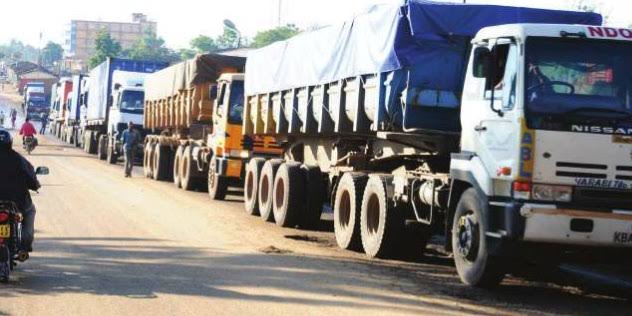
The Regional Electronic Cargo and Driver Tracking System (RECDTS) is to be launched at border points of Malaba, Rusumo, and Kobero on 7 August 2020; Mutukula on 14 August 2020; and Namanga on 21 August 2020.
East Africa Community (EAC) partner states adopted the EAC Regional Electronic Cargo and Drivers Tracking System to be hosted at the EAC Headquarters in Arusha, Tanzania in May 2020.
The system is expected to share truck driver’s information leveraging on that which is managed and operated by Revenue Authorities in the region, and the existing health information systems in Partner States.
The system allows the users to share information across borders in a transparent manner, and the truck drivers will need to upload the phone app on their phones.
Continuous screening will be done at selected check points along the transport corridors, which have already been designated, and information made available for all Partner States.
Verification of documents will be done by customs, immigration, law enforcement agencies/ persons who will confirm if a particular traveller is fit to proceed on their journey.
The Digital surveillance tracker will interface and connect directly to designated laboratories in the Partner States to allow the Partner States, for purposes of COVID -19 laboratory results needed to generate the COVID-19 Test Certificates / attestation Certificates for COVID-19 test results.
A Joint Consultative Meeting of the EAC Ministers/Cabinet Secretaries of Health, Transport and EAC Affairs that was held via Video Conferencing on 29th May, 2020 the system decided that it will be supported by four (4) Command Operating Centres (COCs) located in four locations at designated national Revenue authorities in Kenya, Uganda, DRC and Rwanda, with one additional COC to be set up at the Nimule border post for the Republic of South Sudan.
The report of the the Joint Consultative Meeting which was chaired by Rwanda’s Minister for Health, Hon. Dr. Daniel Ngamije, was signed by Partner States' Heads of Delegation/Health Ministers, namely: Hon. Dr. Ngamije (Rwanda); Hon. Mutahi Kagwe (Kenya); Hon. Dr. Jane Ruth Aceng (Uganda), and; Hon. Elizabeth Achuei (South Sudan).
The Ministers/Cabinet Secretaries were further informed that the truck driver and crew members’ mobile phones will be used as the tracking devices once they commence their journey along the corridors, and command centres will be able to communicate directly with the drivers as long as the phones are not switched off.
Additional information and/or updates will be along all check points along the corridor and shared along the system.
The Ministers/ Cabinet Secretaries further adopted the EAC COVID-19 Test Certificate for truck drivers and crew members.
The Ministers/ Cabinet Secretaries were informed that a system has been developed to facilitate a common approach to certifying results of those tested for COVID-19, by using the system to generate a COVID-19 test certificate for drivers and crew members.
Consequently, the generated COVID-19 certificate for drivers and crew members who have undergone tests would be shared with all respective stakeholders both at accredited designated testing points and border crossing points in the region. This certificate that is recognised in the EAC is expected to be valid for 14 days, and would allow the owner to travel in the region without being subjected to re-testing unless he or she is found to have signs and symptoms for COVID -19, on screening at check points using the screening tool.
The Certificates will be issued only for those drivers and crew members that test negative for COVID-19. Those that test positive will be expected to follow existing national protocols to access care and other services.
Source information: The East African Community Affairs
