

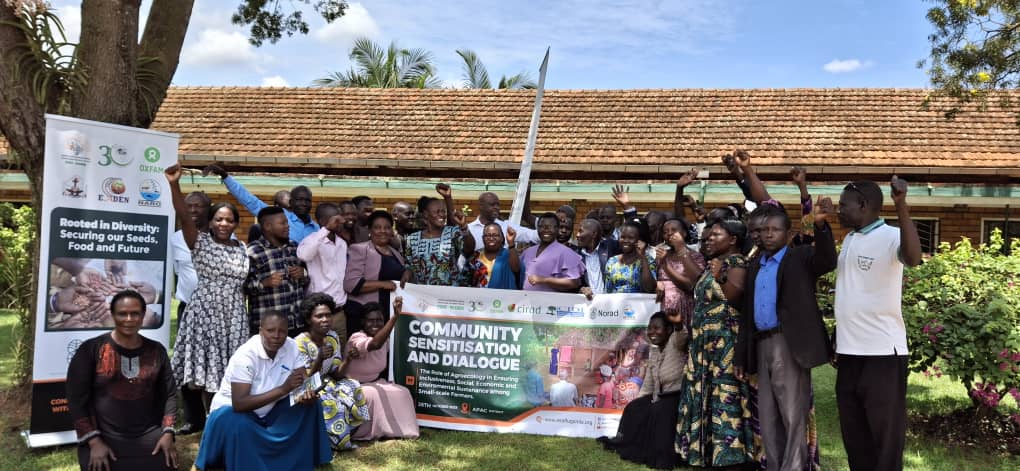
The much-anticipated National Agroecology Festival 2025 officially kicked off today at Namugongo Kyoto (Les Foyers de Charite), Kampala, ushering in a week-long celebration and dialogue on sustainable agriculture, climate resilience, and food sovereignty.
Organized by the Eastern and Southern Africa Small Scale Farmers Forum (ESAFF Uganda) in partnership with the National Agricultural Research Organization (Naro), and supported by Oxfam in Uganda, Greenpeace Africa, and the Norwegian Agency for Development Cooperation (Norad), the festival will run until October 31.
Activities are spread across Apac, Serere, Amuria, and Amuru districts under the theme: “Agroecology for Inclusiveness, Social, Economic and Environmental Sustenance.”
Uganda’s agricultural sector, dominated by small-scale farmers, employs over 75 percent of the population and significantly contributes to export earnings and national GDP, according to the Uganda Bureau of Statistics (UBOS).
Yet, farmers face increasing challenges from climate change, unpredictable weather, limited access to quality seeds, and land conflicts, threatening both livelihoods and national food security.
The festival aims to promote best agroecological practices among farmers, communities, and local leaders, emphasizing their role in environmental conservation and climate change mitigation. Since 2019, ESAFF Uganda has championed smallholder-driven agricultural transformation that restores ecological balance and empowers communities to produce healthy food sustainably.
“Agroecology is not just a farming practice, it is a philosophy of life,” said Nancy Mugimba, ESAFF Uganda National Coordinator.
“It centres the voices of small-scale farmers, who hold the traditional knowledge and skills to nurture both people and the planet. We are uniting communities, scientists, and policymakers to co-create a future where food systems are fair, sustainable, and resilient.”
Festival activities will include community dialogues, farm visits, exhibitions, and earth markets. Farmers will showcase indigenous seeds, local foods, herbal medicines, and cultural practices that highlight Uganda’s rich biodiversity.
In Serere district, a Community Seed Bank will be launched to conserve traditional crop varieties and provide farmers access to quality planting materials, serving as both a learning hub and a living archive of Uganda’s agricultural heritage.
Hakim Baliraine, National Chairperson of ESAFF Uganda, highlighted the urgency of supporting farmers grappling with climate change.
“For us, agroecology is about restoring balance. When we protect our soils, save our seeds, and grow food that respects nature, we safeguard our future. Resilience begins with us,” he said.
The festival also serves as a platform for discussions on market access and policy transformation. Many smallholder farmers struggle to find fair and reliable markets despite growing consumer interest in organic produce. Masudio Margaret, Vice Chairperson of ESAFF Uganda, stressed the need for political will and investment in farmer-led innovations.
“Small-scale farmers feed Uganda, yet they remain the least supported. Agroecology offers a sustainable path, but it must be backed by policies that ensure fair markets, affordable credit, and recognition of farmers’ seed rights.”
The festival is expected to foster partnerships that strengthen local markets for agroecological produce, enhance household incomes, and improve food diversity across communities.
