

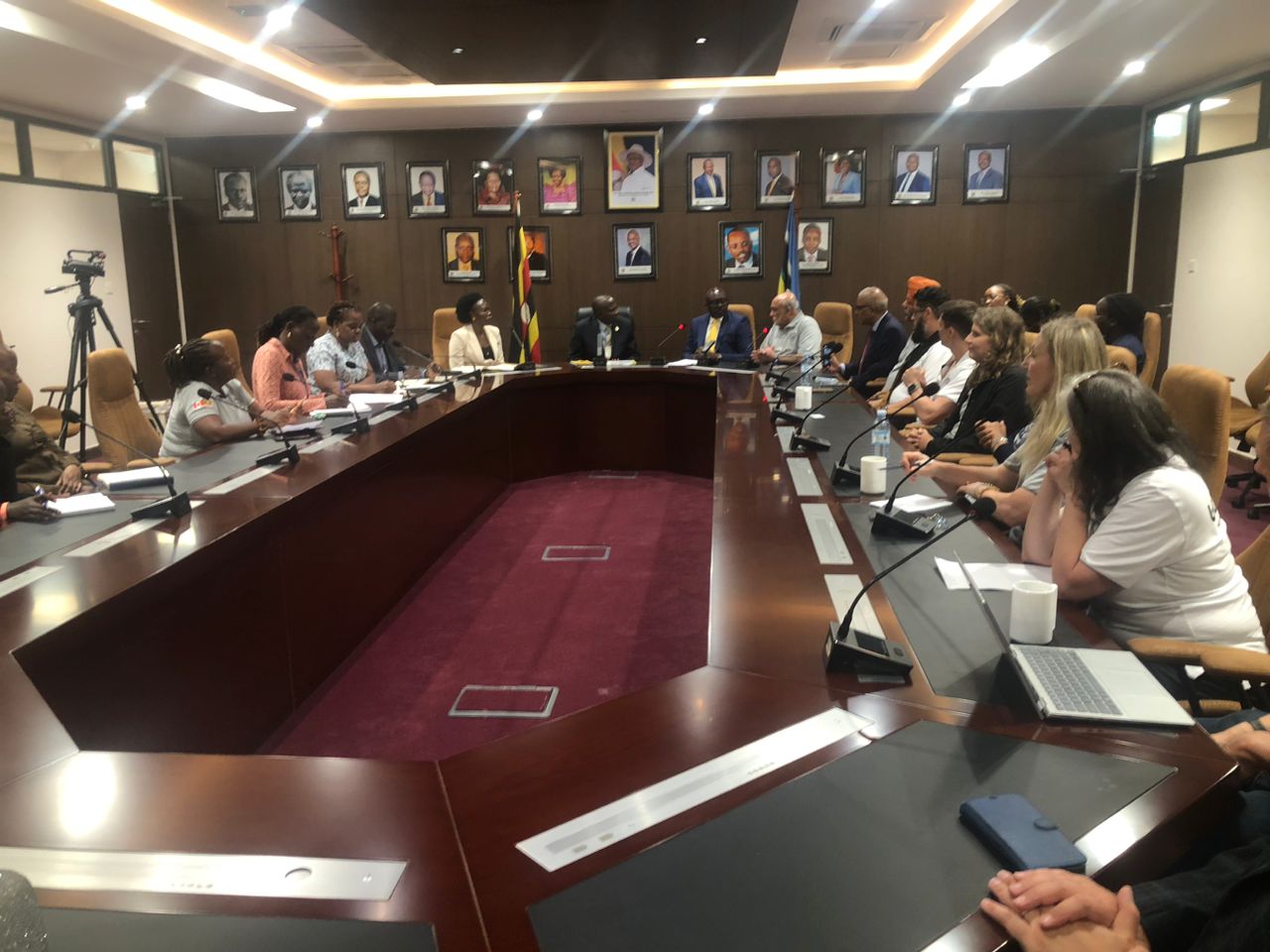
Matia Kasaija has met a Canadian tourism delegation in Kampala, as Uganda intensifies efforts to position tourism as a high-return investment frontier expected to play a central role in the country’s long-term economic transformation.
Kasaija, who is the Minister of Finance, Planning and Economic Development, said tourism is projected to become one of the key drivers of Uganda’s economic expansion, supporting ambitions to grow the economy to about $500 billion in the long term.
Speaking during the engagement, he said Uganda is now shifting focus from basic promotion to large-scale, private-sector-led investment in tourism infrastructure and experiences.
“Uganda has established itself as a competitive tourism destination supported by a stable political and macroeconomic environment. We are now focused on unlocking investment in high-impact infrastructure and experiences that will accelerate sector growth,” Kasaija said.
The minister outlined a pipeline of projects including cable car systems in mountainous regions, upgraded tourism roads, and integrated recreation zones on islands and lakefronts.
Feasibility studies on cable car systems in the Rwenzori Mountains National Park indicate potential to significantly increase annual visitor numbers, with projections rising from about 10,000 to over 50,000 tourists.
The Rwenzori ranges, often referred to as the “Mountains of the Moon,” are among Uganda’s flagship eco-tourism attractions due to their snow-capped peaks along the equator.
Government is also targeting investment along the River Nile, with plans for cruise boats, houseboats, floating restaurants and navigation systems designed to boost experiential and luxury tourism.
Additional opportunities have been identified across Uganda’s lakes and islands, where integrated tourism zones are being proposed to include transport systems, accommodation, and recreation facilities.
State Minister for Investment and Privatisation Evelyn Anite said government is offering targeted fiscal incentives, including tax exemptions on key hospitality inputs, to reduce investment costs and attract developers.
“We continue to provide tax exemptions on key inputs for the hospitality industry, especially for upcountry investments. This is aimed at lowering entry costs and accelerating the development of accommodation capacity,” Anite said.
She noted that limited high-end accommodation remains one of the sector’s biggest bottlenecks, but also a key opportunity for investors in hotels and tourism services.
Uganda’s tourism sector is already showing signs of recovery. Officials from Uganda’s mission in Canada said arrivals linked to that market have grown from 3,900 in 2013 to 9,688 in 2025.
Allan Kajik, Acting Head of Mission to Canada, said the visiting delegation comprising tourism strategists, media investors and tour operators is assessing bankable opportunities across the country.
Uganda’s economy is currently valued at about $61.3 billion, with projected growth of 6.3 percent in the 2024/25 financial year and inflation maintained below 5 percent.
Officials say the combination of underdeveloped high-value tourism assets, rising demand, and policy incentives positions Uganda as one of East Africa’s emerging tourism investment destinations.
As government deepens engagement with foreign investors, tourism is increasingly being reframed not just as a cultural showcase, but as a structured economic sector capable of generating jobs, foreign exchange, and long-term national value.
