

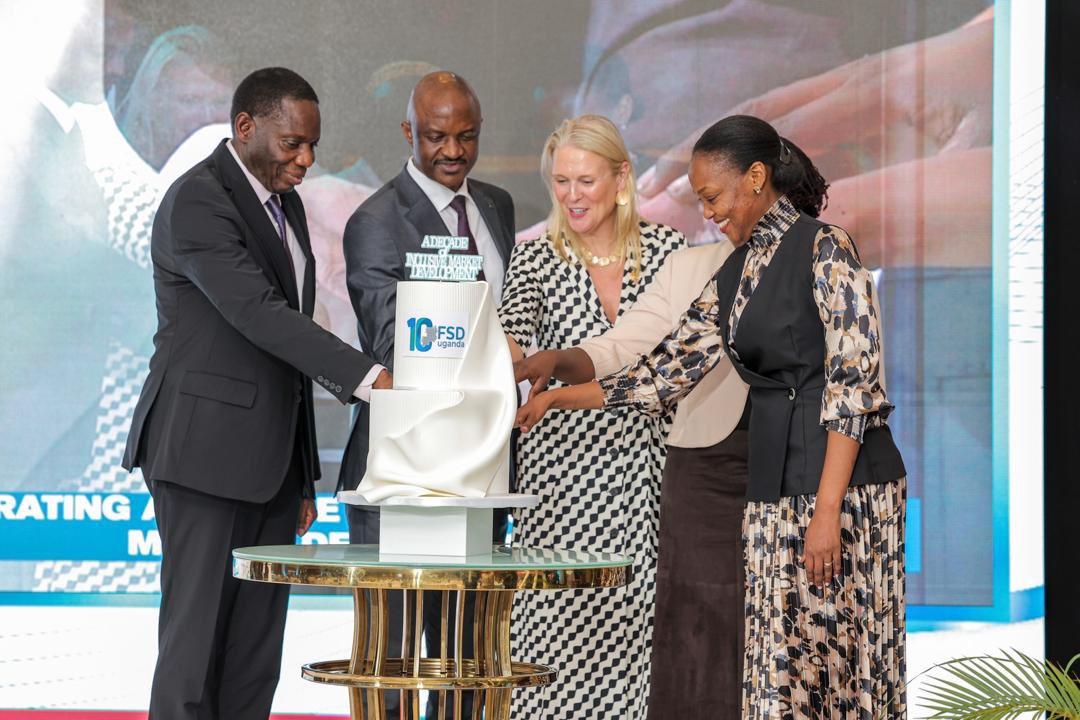
Uganda’s financial landscape has transformed over the past ten years, with more adults able to access formal financial services than ever before, as Financial Sector Deepening Uganda (FSD Uganda) marked its 10-year anniversary.
The celebration convened government officials, regulators, development partners, and private-sector leaders to reflect on past achievements and chart a vision for the next decade.
Acting Executive Director Sarah Byabazaire said the organization has laid a strong foundation but acknowledged that barriers remain, particularly around affordability and trust.
“We started with one fundamental question: how do we build a truly inclusive financial system that serves all people, regardless of background? A decade later, we’ve made remarkable progress, but there is more to do,” Byabazaire said.
FSD Uganda has focused on enabling seamless and safe information exchange across platforms, empowering Ugandans to use financial tools confidently while unlocking economic opportunities.
The organization plans to mobilize $5 billion by 2040 to advance inclusive financial systems across the region.
Board Chair Emma Mugisha emphasized the importance of governance, strategic leadership, and strong donor confidence in FSD Uganda’s success.
“Tonight, we celebrate ten years of partnership, prudent stewardship, and shared purpose,” Mugisha said, citing contributions from funders including the FCDO, Gates Foundation, Mastercard Foundation, European Union, and TradeMark Africa.
British High Commissioner Lisa Chesney highlighted the dramatic growth in financial access, from 52% of adults in 2012 to 88% today, with 77% using formal services such as banks, SACCOs, and mobile money.
Mobile money now accounts for over 60% of all transactions, while the number of licensed financial institutions has doubled.
“These are not just statistics,” Chesney said. “Behind them are millions of Ugandans who can now save securely, send and receive money easily, and access credit to grow their businesses.”
FSD Uganda has reached 1.6 million people—nearly half women—and supported over 144,000 small enterprises through fintech innovations, refugee finance solutions, SACCO payment systems, and Africa’s first shared agent banking platform.
Chesney cited the example of Grace, a dairy farmer who leveraged digital milk sales to establish a credit history and secure a commercial loan.
Bank of Uganda Governor Michael Atingi-Ego stressed the central bank’s commitment to building a resilient, innovative financial sector anchored in digital transformation and long-term financing.
He highlighted opportunities in oil and gas, capital markets, and digital financial services, as well as the expansion of Uganda’s fixed-income market to include green, social, and infrastructure bonds.
“Our mandate is clear: ensure that long-term capital flows abundantly to the sectors that will drive Uganda’s transformation,” Atingi-Ego said.
Permanent Secretary and Secretary to the Treasury Ramathan Ggoobi praised FSD Uganda’s role in the national Financial Sector Development Strategy, emphasizing government support to de-risk SMEs, deepen capital markets, and promote policy coherence.
“We promise one thing: government will remain committed to enabling the environment that supports innovation, partnerships, and long-term investment,” Ggoobi said.
As FSD Uganda embarks on its next decade, leaders agreed that financial inclusion must go beyond access to meaningful usage, with collaboration between government, regulators, development partners, and the private sector forming the backbone of Uganda’s resilient financial future.
