
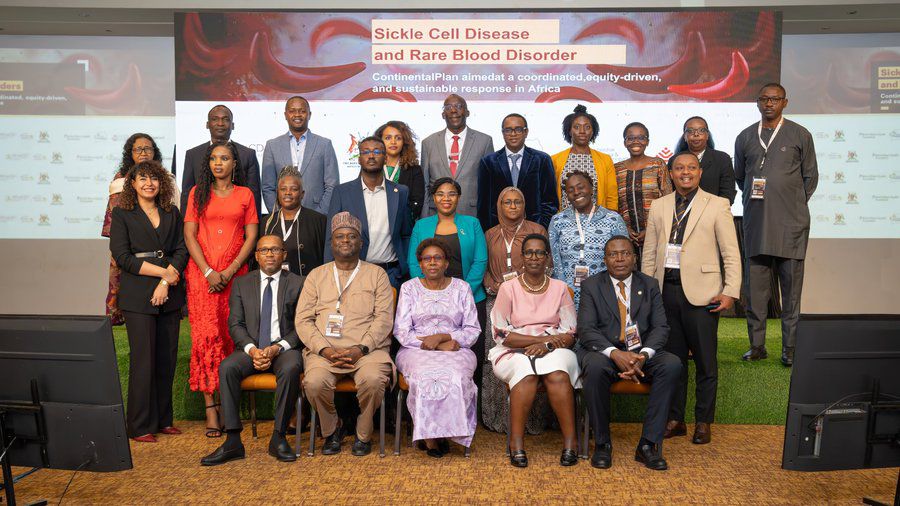
African health leaders have launched a continent-wide strategy to combat sickle cell disease and other rare blood disorders.
They warned that fragmented national responses are no longer sufficient to tackle a condition that kills hundreds of thousands of children annually across Africa.
The Technical Validation and Launch Workshop of the Continental Plan opened at Speke Resort Munyonyo, bringing together health ministers from across Africa, the Africa Centres for Disease Control and Prevention (Africa CDC), development partners, and international health agencies to endorse a coordinated response to sickle cell disease.
Opening the meeting, Uganda’s Minister of Health Dr. Jane Ruth Aceng said Africa bears more than 80 percent of the global burden of sickle cell disease, with over 300,000 children born with the condition each year.
“These are not statistics, these are our children,” Dr. Aceng said. “And today, we say: enough.”
She warned that without urgent intervention, up to 90 percent of affected children in Africa die before their fifth birthday, describing sickle cell disease as a long-standing but preventable public health crisis.
Dr. Aceng said Uganda alone records about 20,000 newborns affected annually, placing it among the top five most burdened countries on the continent alongside Nigeria, the Democratic Republic of Congo, Tanzania and Cameroon.
She outlined Uganda’s progress over the past decade, including newborn screening programmes implemented in partnership with regional initiatives, which have tested more than 500,000 infants in ten years.
The minister also highlighted the introduction of locally manufactured diagnostic kits and the integration of sickle cell screening into maternal and child health services.
“We are progressively integrating sickle cell screening into our immunisation platforms, recognising that the moment of a child’s first vaccine is the right time to detect the disease early,” she said.
Dr. Aceng noted that Uganda has expanded treatment access through the Strengthening Care Access and Linkage for Sickle Cell Disease (SCALE) programme, through which more than 2,000 patients have received hydroxyurea therapy in Uganda and the wider East African region.
Despite these gains, she warned that progress remains fragile due to weak drug supply chains, shortages of specialists, and fragmented health data systems across countries.
“Progress achieved in isolation is progress that cannot be sustained,” she said. “We cannot solve these challenges alone — and neither can any other nation.”
She said the new continental framework developed under Africa CDC is structured around eight pillars, including governance, early detection, treatment access, supply chain resilience, financing, psychosocial support, and health information systems.
The plan sets ambitious targets for 2035, including screening at least 70 percent of newborns across Africa, ensuring 80 percent of eligible patients access treatment, and significantly improving survival rates for children living with the disease.
Dr. Aceng said Uganda has committed to scaling up newborn screening to 80 percent coverage by 2028, finalising a national sickle cell strategy aligned with the continental plan, and expanding local production of medicines and diagnostic tools.
She urged development partners to align funding behind the new framework, warning that shifting global health financing trends make continental coordination more urgent.
“To our partners, we must pool resources and trust African institutions to lead a unified response,” she said.
Addressing fellow ministers, Dr. Aceng called for political commitment beyond policy formulation. “Let us leave Kampala not merely having validated a plan, but having committed to its implementation,” she said. “Our constituents living with sickle cell disease deserve nothing less.”
Uganda’s Permanent Secretary in the Ministry of Health Dr. Diana Atwine also endorsed the continental strategy, describing it as a “technically credible and politically grounded roadmap” for Africa’s response to sickle cell disease.
Dr. Atwine said Uganda was “proud to host” the continental meeting, noting that the framework arrives at a critical time when African countries are seeking coordinated solutions to inherited blood disorders.
She praised Africa CDC for developing what she called a well-structured plan anchored on eight strategic pillars, particularly highlighting governance and early detection as foundational elements.
“The governance pillar is critical because political commitment underpins everything else,” she said.
Dr. Atwine supported the plan’s target of screening 70 percent of newborns by 2035, saying Uganda’s experience shows it is achievable when integrated into routine child health services such as immunisation.
She stressed that screening alone is insufficient without strong follow-up systems, trained personnel, and caregiver education.
Dr. Atwine pointed to Uganda’s Consortium on Newborn Screening in Africa (CONSA) programme and SCALE initiative as examples of successful integration of sickle cell services into primary health care.
She also highlighted that Uganda has enrolled more than 2,000 patients on hydroxyurea treatment, while cautioning that supply chain weaknesses remain a major risk.
She backed a proposed continental pooled procurement mechanism to improve access to essential medicines.
On health systems, Dr. Atwine said task-shifting to nurses and community health workers is essential to expand coverage, drawing lessons from Uganda’s HIV programme.
She also confirmed that Uganda is integrating sickle cell indicators into the DHIS2 health information system, calling for it to become a minimum standard across African Union member states.
However, she raised concern over the absence of detailed costing in the continental plan, urging that financial estimates be finalised before endorsement to allow governments to make realistic budget commitments.
“The technical foundation of this plan is sound,” she said. “The task now is intentional implementation by member states.”
Uganda pledged to finalise its national sickle cell strategy within 12 months and align it fully with the continental framework.
The three-day workshop is expected to finalise the continental strategy and agree on implementation mechanisms across African Union member states, as governments move to improve survival rates and strengthen care for people living with sickle cell disease and other rare blood disorders.
